Review
. 2021 Jun 9;22(12):6222.
doi: 10.3390/ijms22126222.

Tocopherols and Tocotrienols-Bioactive Dietary Compounds; What Is Certain, What Is Doubt?

Affiliations
Review

Tocopherols and Tocotrienols-Bioactive Dietary Compounds; What Is Certain, What Is Doubt?

Kacper Szewczyk et al. Int J Mol Sci. .

Abstract

Tocopherols and tocotrienols are natural compounds of plant origin, available in the nature. They are supplied in various amounts in a diet, mainly from vegetable oils, some oilseeds, and nuts. The main forms in the diet are α- and γ-tocopherol, due to the highest content in food products. Nevertheless, α-tocopherol is the main form of vitamin E with the highest tissue concentration. The α- forms of both tocopherols and tocotrienols are considered as the most metabolically active. Currently, research results indicate also a greater antioxidant potential of tocotrienols than tocopherols. Moreover, the biological role of vitamin E metabolites have received increasing interest. The aim of this review is to update the knowledge of tocopherol and tocotrienol bioactivity, with a particular focus on their bioavailability, distribution, and metabolism determinants in humans. Almost one hundred years after the start of research on α-tocopherol, its biological properties are still under investigation. For several decades, researchers' interest in the biological importance of other forms of vitamin E has also been growing. Some of the functions, for instance the antioxidant functions of α- and γ-tocopherols, have been confirmed in humans, while others, such as the relationship with metabolic disorders, are still under investigation. Some studies, which analyzed the biological role and mechanisms of tocopherols and tocotrienols over the past few years described new and even unexpected cellular and molecular properties that will be the subject of future research.

Keywords: bioaccessibility; bioactivity; bioavailability; tocopherols; tocotrienols; vitamin E metabolites; α-tocopherol.


Conflict of interest statement

The authors declare no conflict of interest.

Figures
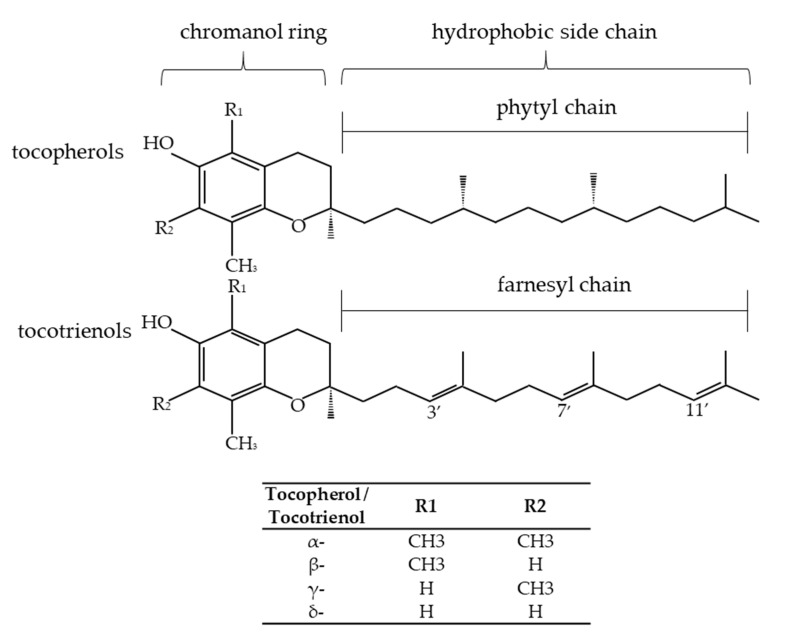
Figure 1
Figure 1
The structure of tocopherols, tocotrienols, and differences in the structure of their isoforms [17,18].
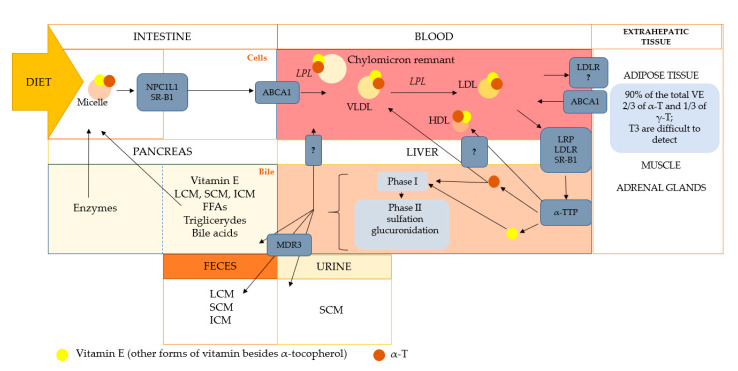
Figure 2
Figure 2
The simplified scheme of the transport and metabolism of vitamin E. The metabolism of vitamin E follows generally like other lipids species. In the intestine, vitamin E, along with other lipids, is packed into micelles, which are captured by receptors. In the intestinal epithelial cells, vitamin E is incorporated into chylomicrons or HDL via ABCA1. Vitamin E in the blood follows the lipoprotein transport route and is delivered to the liver or extrahepatic tissues. Vitamin E transport takes place with the participation of chylomicrons, which are subjected to hydrolysis by lipoprotein lipase. Further transport of vitamin E is through by chylomicron remnants, HDL, LDL, and VLDL. In the liver, vitamin E is sorted and directed to catabolism or to various lipoproteins (the mechanisms are not fully understood), returning to the bloodstream. The transport route is the same for all forms of vitamin E. Discrimination of the other forms in favor of α-tocopherol occurs in the liver by α-TTP, which protects against excessive degradation and excretion of α-tocopherol. The remaining forms of vitamin E are included in catabolism (phase I and II). NPC1L1, Niemann-Pick C1 Like 1 protein; SR-B1, scavenger receptor class B type 1; ABCA1, ATP-binding cassette transporter; VLDL, very-low-density lipoproteins; HDL, high-density lipoproteins; LDL, low-density lipoproteins; LDLR, LDL receptor; VE, vitamin E; α-T, alpha-tocopherol; γ-T, gamma-tocopherol; T3, tocotrienols; LRP, LDL receptor-related protein; LCM, long-chain metabolites (13′-COOH); ICM, intermediate-chain metabolites (11′-COOH, 9′-COOH); SCM, short-chain metabolites (7′-COOH, 5′-COOH, 3′-COOH); FFAs, free fatty acids; MDR3, multidrug resistance protein 3. The figure was modified from [1,32,33,34,35,36].
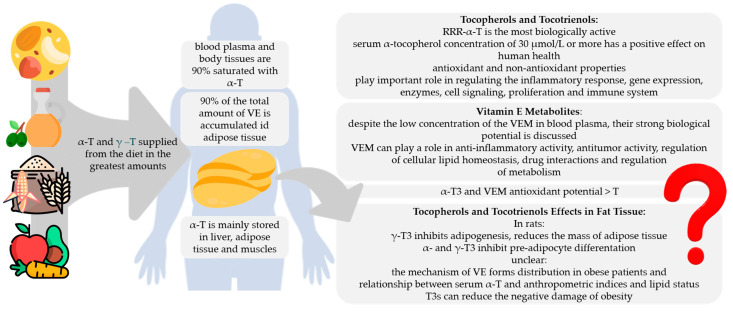
Figure 3
Figure 3
Summary of potential health benefits of tocopherols and tocotrienols. T, tocopherol; T3, tocotrienol; VE, vitamin E; VEM, vitamin E metabolites. The author’s own study based on [4,8,10,11,12,35,36,37,74,99,104,105,106,107,112,113,114]; icons source: www.flaticon.com (accessed on 31 March 2021).

References

    1. Galli F., Azzi A., Birringer M., Cook-Mills J.M., Eggersdorfer M., Frank J., Cruciani G., Lorkowski S., Özer N.K. Vitamin E: Emerging aspects and new directions. Free Radic. Biol. Med. 2017;102:16–36. doi: 10.1016/j.freeradbiomed.2016.09.017. - DOI - PubMed
    1. Birringer M., Siems K., Maxones A., Frank J., Lorkowski S. Natural 6-hydroxy-chromanols and -chromenols: Structural diversity, biosynthetic pathways and health implications. RSC Adv. 2018;8:4803–4841. doi: 10.1039/C7RA11819H. - DOI - PMC - PubMed
    1. Food and Agriculture Organization. World Health Organization . Vitamin and Mineral Requirements in Human Nutrition. 2nd ed. WHO; Geneva, Switzerland: 1998. pp. 1–20.
    1. Shahidi F., De Camargo A.C. Tocopherols and tocotrienols in common and emerging dietary sources: Occurrence, applications, and health benefits. Int. J. Mol. Sci. 2016;17:1745. doi: 10.3390/ijms17101745. - DOI - PMC - PubMed
    1. Waniek S., di Giuseppe R., Plachta-Danielzik S., Ratjen I., Jacobs G., Koch M., Borggrefe J., Both M., Müller H.-P., Kassubek J., et al. Association of vitamin E levels with metabolic syndrome, and MRI-derived body fat volumes and liver fat content. Nutrients. 2017;9:1143. doi: 10.3390/nu9101143. - DOI - PMC - PubMed