


Reality Check 2: The Cost-Effectiveness of Policy Disallowing Body Checking in Non-Elite 13- to 14-Year-Old Ice Hockey Players
- PMID: 34207977
- PMCID: PMC8296129
- DOI: 10.3390/ijerph18126322
Reality Check 2: The Cost-Effectiveness of Policy Disallowing Body Checking in Non-Elite 13- to 14-Year-Old Ice Hockey Players
Erratum in
-
Correction: Currie et al. Reality Check 2: The Cost-Effectiveness of Policy Disallowing Body Checking in Non-Elite 13- to 14-Year-Old Ice Hockey Players. Int. J. Environ. Res. Public Health 2021, 18, 6322.Int J Environ Res Public Health. 2024 Feb 27;21(3):269. doi: 10.3390/ijerph21030269. Int J Environ Res Public Health. 2024. PMID: 38541378 Free PMC article.
Abstract
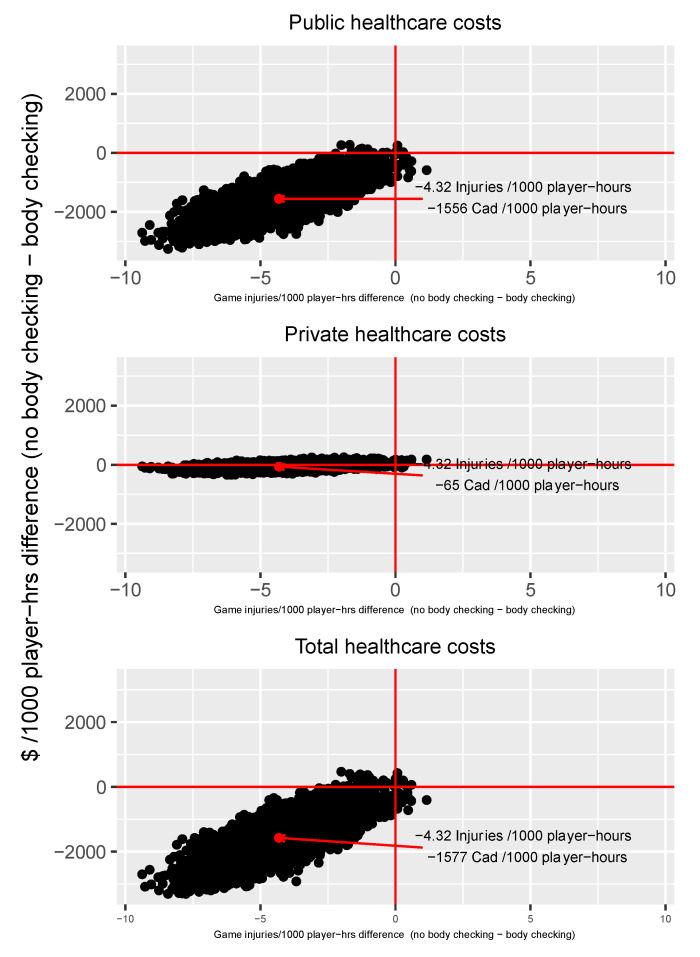
Sport-related injuries are the leading cause of injury in youth and are costly to the healthcare system. When body checking is disallowed in non-elite levels of Bantam (ages 13-14 years) ice hockey, the injury rate is reduced, but the impact on costs is unknown. This study compared rates of game injuries and costs among non-elite Bantam ice hockey leagues that disallow body checking to those that did not. Methods: An economic evaluation was conducted alongside a prospective cohort study comparing 608 players from leagues where body checking was allowed in games (Calgary/Edmonton 2014-2015, Edmonton 2015-2016) with 396 players from leagues where it was not allowed in games (Vancouver, Kelowna 2014-2015, Calgary in 2015-2016). The effectiveness measure was rate of game injuries per 1000 player-hours. Costs were estimated based on associated healthcare use within the publicly funded healthcare system as well as privately paid healthcare costs. Probabilistic sensitivity analysis was conducted using bootstrapping. Results: Disallowing body checking reduced the rate of injuries by 4.32 per 1000 player-hours (95% CI -6.92, -1.56) and reduced public and total healthcare system costs by $1556 (95% CI -$2478, -$559) and $1577 (95% CI -$2629, -$500) per 1000 player-hours, respectively. These finding were robust in over 99% of iterations in sensitivity analyses in the public healthcare and the total healthcare system perspectives. There was no statistically significant difference in privately paid healthcare costs (-$65 per 1000 player-hours (95% CI -$220, $99)). Interpretation: Disallowing body checking in non-elite 13-14-year-old ice hockey nationally would prevent injuries and reduce public healthcare costs.
Keywords: body checking policy; economic evaluation; hockey; injury prevention; youth.
Conflict of interest statement
None of the authors have any competing interests to declare.
Figures
References
-
- Annual Report 2018–2019. Hockey Canada. [(accessed on 13 November 2019)];2019 Available online: https://cdn.agilitycms.com/hockey-canada/Corporate/About/Downloads/2018-....
-
- Slutzky C.B., Simpkins S.D. The link between children’s sport participation and self-esteem: Exploring the mediating role of sport self-concept. Psychol. Sport Exerc. 2009;10:381–389. doi: 10.1016/j.psychsport.2008.09.006. - DOI
Publication types
MeSH terms
Grants and funding
LinkOut - more resources
Full Text Sources
Medical
