Review
. 2021 Jun 11;10(6):701.
doi: 10.3390/antibiotics10060701.

Donnan Potential across the Outer Membrane of Gram-Negative Bacteria and Its Effect on the Permeability of Antibiotics

Affiliations
Review

Donnan Potential across the Outer Membrane of Gram-Negative Bacteria and Its Effect on the Permeability of Antibiotics

Olaniyi Alegun et al. Antibiotics (Basel). .

Abstract

The cell envelope structure of Gram-negative bacteria is unique, composed of two lipid bilayer membranes and an aqueous periplasmic space sandwiched in between. The outer membrane constitutes an extra barrier to limit the exchange of molecules between the cells and the exterior environment. Donnan potential is a membrane potential across the outer membrane, resulted from the selective permeability of the membrane, which plays a pivotal role in the permeability of many antibiotics. In this review, we discussed factors that affect the intensity of the Donnan potential, including the osmotic strength and pH of the external media, the osmoregulated periplasmic glucans trapped in the periplasmic space, and the displacement of cell surface charges. The focus of our discussion is the impact of Donnan potential on the cellular permeability of selected antibiotics including fluoroquinolones, tetracyclines, β-lactams, and trimethoprim.

Keywords: Donnan potential; Gram-negative bacteria; antibiotics; cellular accumulation; membrane permeability.


Conflict of interest statement

The authors declare no conflict of interest. The funders had no role in the design of the study; in the collection, analyses, or interpretation of data; in the writing of the manuscript, or in the decision to publish the results.

Figures
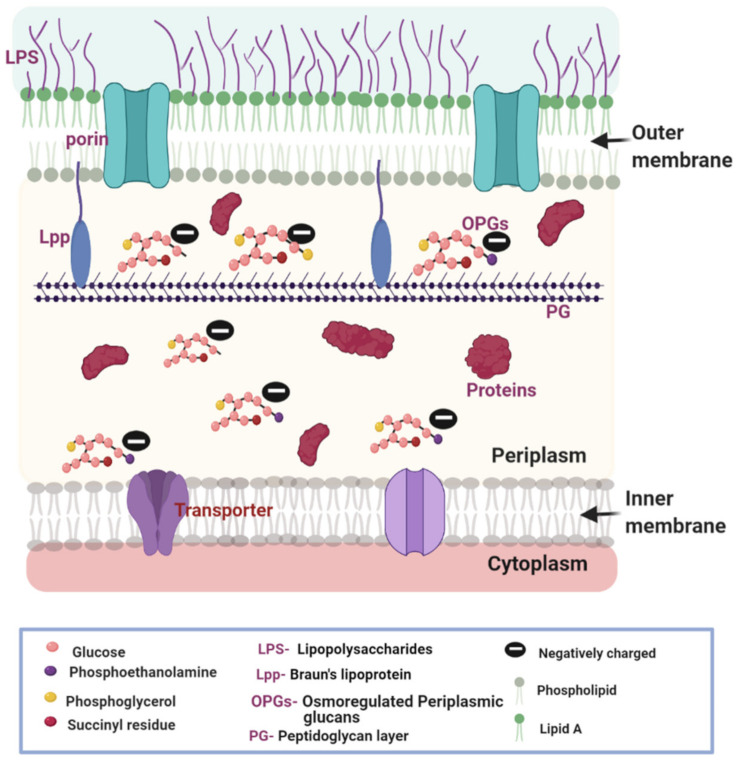
Figure 1
Figure 1
Cell envelope of the Gram-negative bacteria is composed of two layers of lipid bilayer membranes and an aqueous periplasmic space sandwiched in between. The outer membrane (OM) is an asymmetric bilayer with lipopolysaccharide (LPS) on the outer leaflet and phospholipids on the inner leaflet. Porins on the OM aid passive diffusion of nutrients and antibiotics. The inner membrane (IM) is composed of phospholipids and contains transporters. A thin layer of peptidoglycan (PG) cell wall exists in the periplasm, which is anchored to the outer membrane by Bruan’s lipoprotein (Lpp). The periplasm is also rich in macromolecules including proteins and glycans. OPGs are special glucans with a glucose backbone and modifications such as phosphoethanolamine, phosphoglycerol, and succinyl residues. OPGs contribute to the net negative potential across the OM. The selective permeability of the outer membrane leads to the development of a membrane potential. The figure was created using BioRender.com.
Figure 2
Figure 2
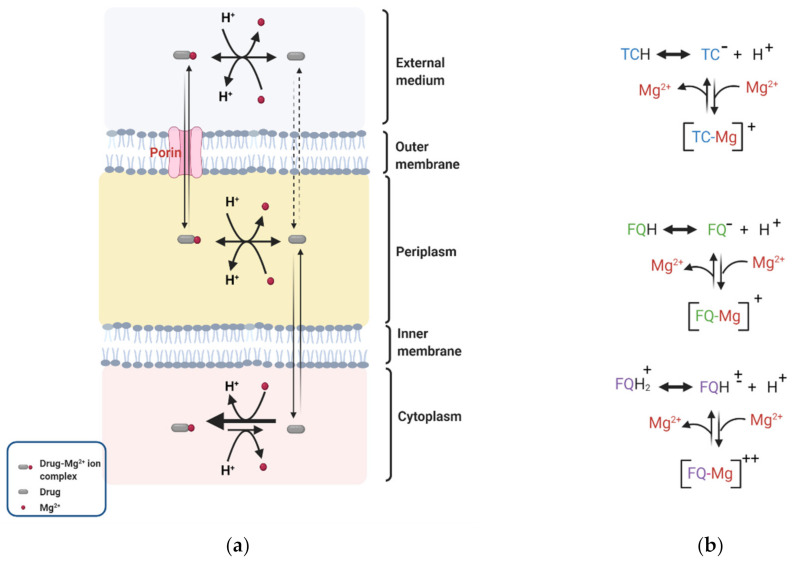
Donnan potential (DP) across the OM of Gram-negative bacteria drives the periplasmic accumulation of antibiotics such as tetracyclines (TC) and fluoroquinolones (FQ). (a) TC or FQ permeates the OM complexed with Mg2+, becomes protonated in the periplasmic and loses its Mg2+ to a neutral form and crosses into the cytoplasm, where it is deprotonated and complexed with Mg2+ again. (b) A notable difference between FQ and TC is that some zwitterionic fluoroquinolones [FQH]± permeate the OM as fluoroquinolone-divalent ion complexes [FQ-Mg]++. Figures were created with BioRender.com.

References

    1. Beveridge T. International Review of Cytology. Elsevier; Amsterdam, The Netherlands: 1981. Ultrastructure, chemistry, and function of the bacterial wall; pp. 229–317. - PubMed
    1. Shockman G., Kawamura T., Barrett J., Dolinger D. The autolytic system of Streptococcus faecium; Proceedings of the International FEMS Symposium; Berlin, Germany. 13–18 March 1983; pp. 165–172.
    1. Nikaido H. Molecular Basis of Bacterial Outer Membrane Permeability Revisited. Microbiol. Mol. Biol. Rev. 2003;67:593–656. doi: 10.1128/MMBR.67.4.593-656.2003. - DOI - PMC - PubMed
    1. Koebnik R., Locher K.P., Van Gelder P. Structure and function of bacterial outer membrane proteins: Barrels in a nutshell. Mol. Microbiol. 2000;37:239–253. doi: 10.1046/j.1365-2958.2000.01983.x. - DOI - PubMed
    1. Schulz G.E.J.B. The structure of bacterial outer membrane proteins. Biochim. Biophys. Acta (BBA)-Biomembr. 2002;1565:308–317. doi: 10.1016/S0005-2736(02)00577-1. - DOI - PubMed

LinkOut - more resources