Review
. 2021 Jun 11;10(6):1470.
doi: 10.3390/cells10061470.

iPSC Preparation and Epigenetic Memory: Does the Tissue Origin Matter?

Affiliations
Review

iPSC Preparation and Epigenetic Memory: Does the Tissue Origin Matter?

Giuseppe Scesa et al. Cells. .

Abstract

The production of induced pluripotent stem cells (iPSCs) represent a breakthrough in regenerative medicine, providing new opportunities for understanding basic molecular mechanisms of human development and molecular aspects of degenerative diseases. In contrast to human embryonic stem cells (ESCs), iPSCs do not raise any ethical concerns regarding the onset of human personhood. Still, they present some technical issues related to immune rejection after transplantation and potential tumorigenicity, indicating that more steps forward must be completed to use iPSCs as a viable tool for in vivo tissue regeneration. On the other hand, cell source origin may be pivotal to iPSC generation since residual epigenetic memory could influence the iPSC phenotype and transplantation outcome. In this paper, we first review the impact of reprogramming methods and the choice of the tissue of origin on the epigenetic memory of the iPSCs or their differentiated cells. Next, we describe the importance of induction methods to determine the reprogramming efficiency and avoid integration in the host genome that could alter gene expression. Finally, we compare the significance of the tissue of origin and the inter-individual genetic variation modification that has been lightly evaluated so far, but which significantly impacts reprogramming.

Keywords: Yamanaka factors; epigenetic memory; iPSCs; methylation; reprogramming methods.


Conflict of interest statement

The authors declare no conflict of interest.

Figures
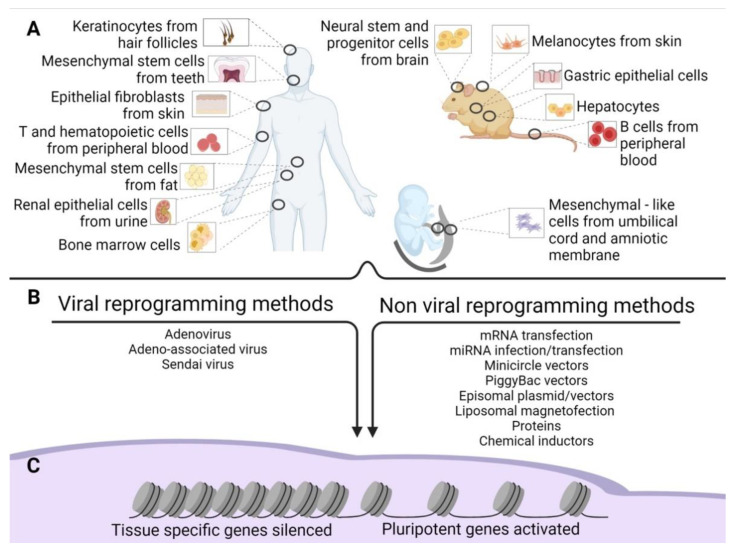
Figure 1
Figure 1
Old and new epigenetic memory in iPSCs. (A) Schematic representation of the possible tissue of origin of the source cells used for reprogramming in human and mouse adult tissues and extraembryonic human tissues. (B) Methods of reprogramming (viral and non-viral) of the source cells. (C) Gene silencing and activation after reprogramming.
Figure 2
Figure 2
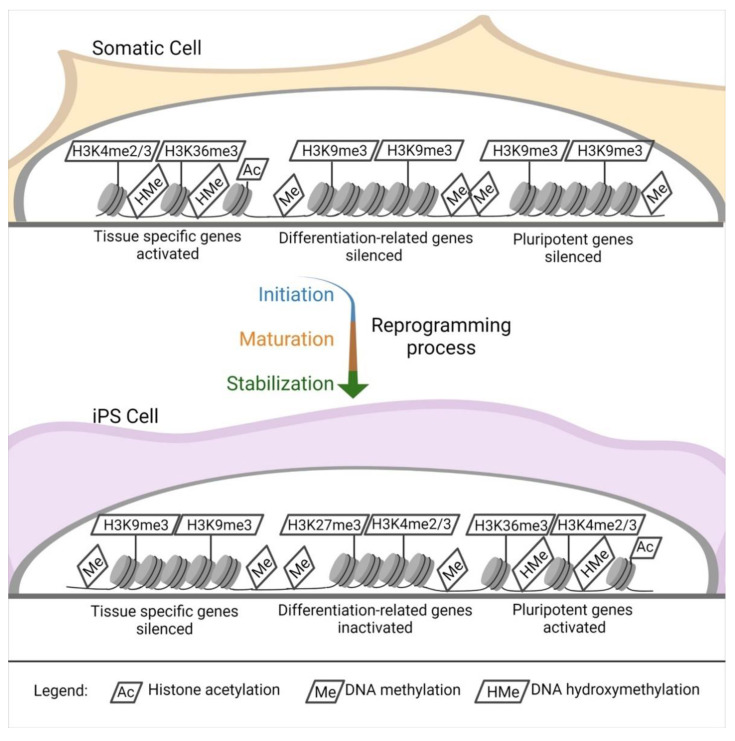
Epigenetic landscape changes. DNA and histones modification in the reprogramming process. Starting from a somatic cell throughout the reprogramming process (initiation, maturation, and stabilization), there is an intense modification of the histones and DNA in specific sites.
Figure 3
Figure 3
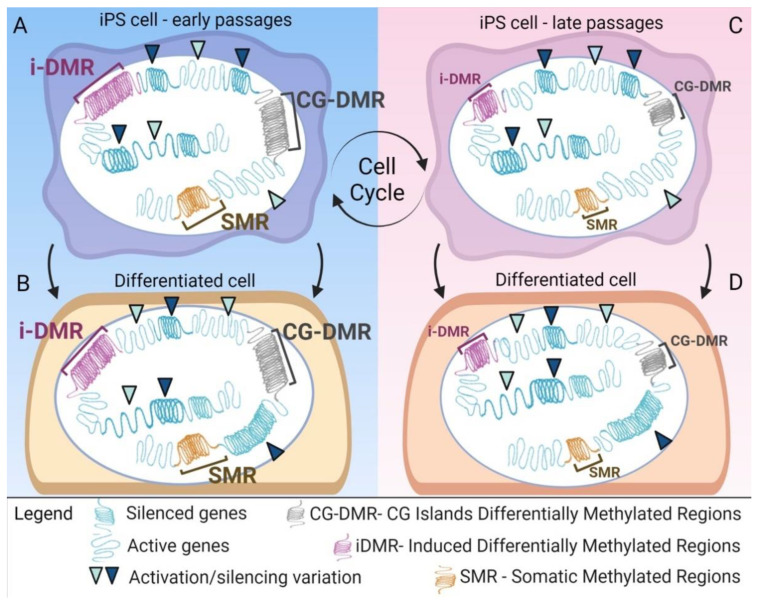
Old and new epigenetic memory in iPSCs. The figure summarizes how the modifications introduced by the reprogramming process fail to fully modify the epigenetic landscape of the original donor cell. Alongside the activation of genes that confer pluripotency characteristics, there are still states of activation, silencing, and methylation characteristic of the donor cell. (A) The persistence of methylated regions of the donor somatic cell, SMR (in brown), is found, in addition to the gene activation changes in the genes also related to pluripotency, cell cycling, cellular metabolism, differentiation, and tissue specificity, outlined by arrow points. Furthermore, at the end of the reprogramming process, there are also new aberrant methylation regions, induced (i)DMR (in violet), and methylations particularly concentrated in the CG islands—CG-DMR (in gray). (B) These new epigenetic arrangements remain even after the differentiation of the iPSCs into a new cell type. (C) With the expansion of iPSCs, there is a decrease in these differently methylated regions, which becomes clear at high passages. (D) This variation in the epigenetic landscape is also found in the differentiated cells.

Comment in

References

    1. Takahashi K., Tanabe K., Ohnuki M., Narita M., Ichisaka T., Tomoda K., Yamanaka S. Induction of pluripotent stem cells from adult human fibroblasts by defined factors. Cell. 2007;131:861–872. doi: 10.1016/j.cell.2007.11.019. - DOI - PubMed
    1. Thomson J.A., Itskovitz-Eldor J., Shapiro S.S., Waknitz M.A., Swiergiel J.J., Marshall V.S., Jones J.M. Embryonic stem cell lines derived from human blastocysts. Science. 1998;282:1145–1147. doi: 10.1126/science.282.5391.1145. - DOI - PubMed
    1. Takahashi K., Yamanaka S. Induction of pluripotent stem cells from mouse embryonic and adult fibroblast cultures by defined factors. Cell. 2006;126:663–676. doi: 10.1016/j.cell.2006.07.024. - DOI - PubMed
    1. Wernig M., Meissner A., Foreman R., Brambrink T., Ku M., Hochedlinger K., Bernstein B.E., Jaenisch R. In vitro reprogramming of fibroblasts into a pluripotent ES-cell-like state. Nature. 2007;448:318–324. doi: 10.1038/nature05944. - DOI - PubMed
    1. Bayart E., Cohen-Haguenauer O. Technological overview of iPS induction from human adult somatic cells. Curr. Gene Ther. 2013;13:73–92. doi: 10.2174/1566523211313020002. - DOI - PMC - PubMed