. 2021 Jun 16;10(6):540.
doi: 10.3390/biology10060540.

Low Intensity Extracorporeal Shock Wave Therapy as a Potential Treatment for Overactive Bladder Syndrome

Affiliations

Low Intensity Extracorporeal Shock Wave Therapy as a Potential Treatment for Overactive Bladder Syndrome

Jian-He Lu et al. Biology (Basel). .

Abstract

Background: The present study attempted to investigate the therapeutic effect and duration of low intensity extracorporeal shock wave therapy (LiESWT) on overactive bladder (OAB) symptoms, including social activity and the quality of life (QoL).

Methods: In this prospective, randomized, single-blinded clinical trial, 65 participants with OAB symptom were randomly divided into receive LiESWT (0.25 mJ/mm2, 3000 pulses, 3 pulses/second) once a week for 8 weeks, or an identical sham LiESWT treatment without the energy transmission. We analyzed the difference in overactive bladder symptom score (OABSS) and 3-day urinary diary as the primary end. The secondary endpoint consisted of the change in uroflowmetry, post-voided residual (PVR) urine, and validated standardized questionnaires at the baseline (W0), 4-week (W4) and 8-week (W8) of LiESWT, and 1-month (F1), 3-month (F3) and 6-month (F6) follow-up after LiESWT.

Results: 8-week LiESWT could significantly decrease urinary frequency, nocturia, urgency, and PVR volume, but meaningfully increase functional bladder capacity, average voided volume and maximal flow rate (Qmax) as compared with the W0 in the LiESWT group. In addition, the scores calculated from questionnaires were meaningfully reduced at W4, W8, F1, F3, and F6 in the LiESWT group.

Conclusions: Our results revealed that the therapeutic efficacy of LiESWT could improve voided volume and ameliorate OAB symptoms, such as urgency, frequency, nocturia, and urinary incontinence, and lasted up to 6 month of follow-up. Moreover, LiESWT treatment brought statistically significant and clinically meaningful improvements in social activity and QoL of patients. These findings suggested that LiESWT could serve as an alternative non-invasive therapy for OAB patients.

Keywords: low intensity extracorporeal shock wave therapy; overactive bladder; urinary frequency and urgency.


Conflict of interest statement

The authors declare no conflict of interest.

Figures
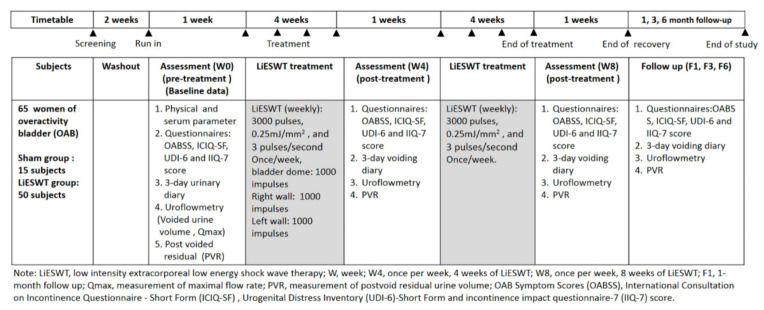
Figure 1
Figure 1
Timetable designed for clinical trial of overactive bladder (OAB) during LiESWT treatment procedure. LiESWT: low intensity extracorporeal shock wave therapy, Qmax: measurement of maximal flow rate, PVR: measurement of post-voided residual (PVR) urine volume, OABSS: overactive bladder symptom scores, ICIQ-SF: international consultation on incontinence questionnaire-short form, UDI-6: urogenital distress inventory-short form, IIQ-7: incontinence impact questionnaire-7.
Figure 2
Figure 2
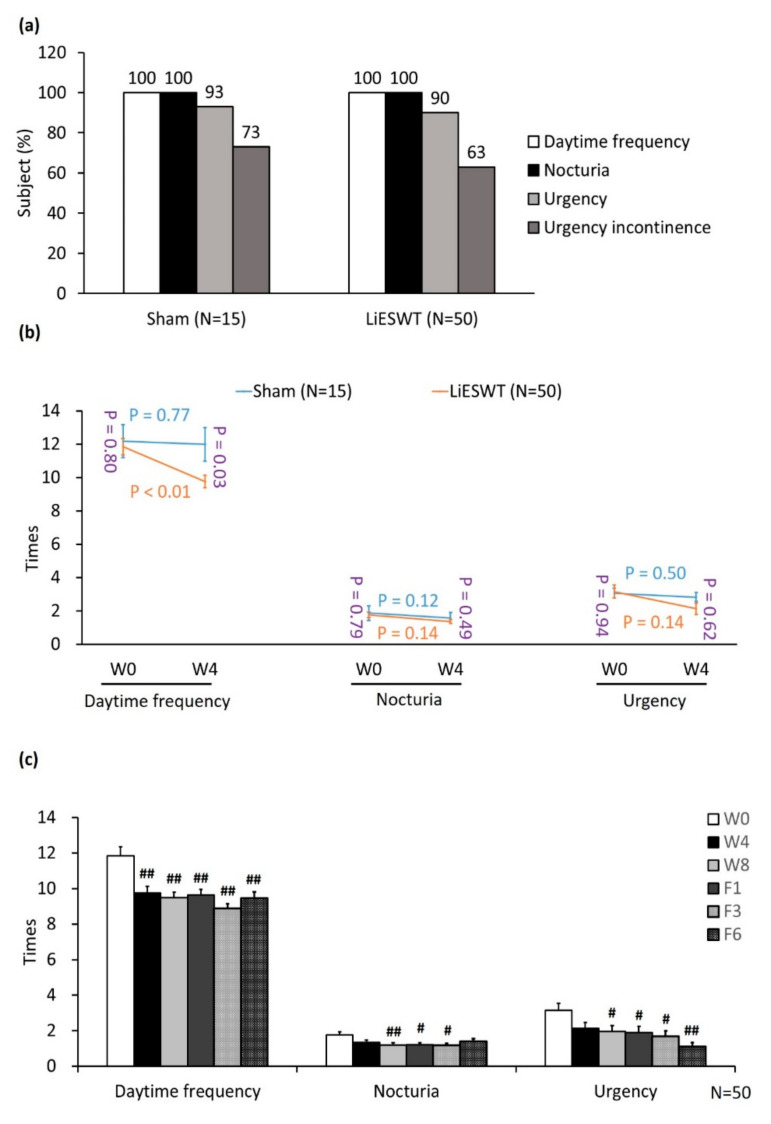
Analysis of studied population with OAB symptoms. (a) The percentage of studied population with OAB symptoms. OAB symptoms consisted of daytime frequency, nocturia, and urgency with or without urgency incontinence. (b) The changes in daytime frequency, nocturia and urgency at W4, as compared with W0. The blue or orange font denotes the p-value before and after 4 weeks treatment in the sham group or in the LiESWT-treated group, respectively. The purple font indicated the p-value between the sham group and the LiESWT-treated group at W0 and W4. (c) LiESWT improved the OAB symptoms. The mean values of daytime frequency, nocturia and urgency were meaningfully decreased after LiESWT treatment at W8. W0: the baseline, W4: 4-week of LiESWT treatment, W8: 8-week of LiESWT treatment, F1: 1-month follow-up, F3: 3-month follow-up, F6: 6-month follow-up. # p < 0.05; ## p < 0.01 as compared with W0.
Figure 3
Figure 3
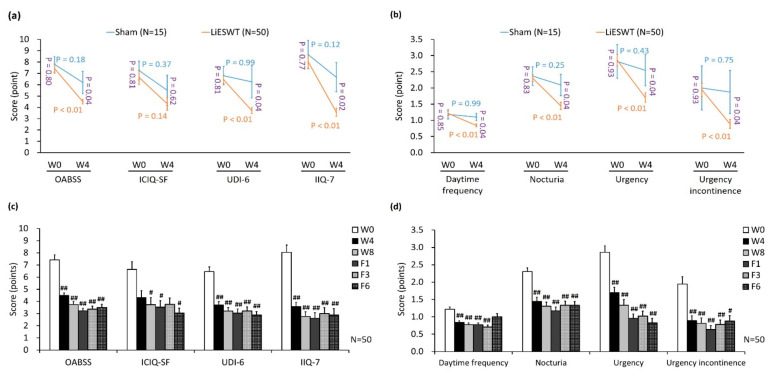
Improvement of OAB symptoms and life bothersome questionnaire scores after LiESWT treatment. (a,c) The therapeutic effect of LiESWT was analyzed by the OAB symptoms and life bothersome questionnaires, including OABSS, ICIQ-SF, UDI-6, and IIQ-7. LiESWT treatment significantly reduced the scores of OABSS, ICIQ-SF, UDI-6, and IIQ-7 as compared with the sham group. (b,d) Improvement of questionnaires scores for OAB symptom after LiESWT treatment, including daytime frequency, nocturia, urgency, and urgency incontinence. LiESWT improved OAB symptoms and the QoL. OABSS, overactive bladder symptom scores. ICIQ-SF: international consultation on incontinence questionnaire-short form, UDI-6: urogenital distress inventory–6, IIQ-7: incontinence impact questionnaire-7, W0: the baseline, W4: 4-week LiESWT treatment, W8: 8-week LiESWT treatment, F1: 1-month follow-up, F3: 3-month follow-up. The blue or orange font denotes the p-value before and after 4 weeks treatment in the sham group or in the LiESWT group, respectively. The purple font indicates the p-value between the sham group and the LiESWT group at the W0 and W4. # p < 0.05; ## p < 0.01 compared to W0.
Figure 4
Figure 4
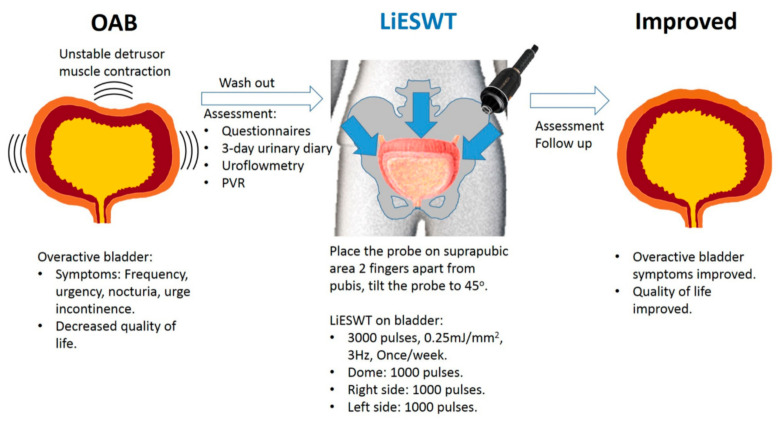
A brief diagram proposed for the potential effects of LiESWT on improving the OAB symptoms. OAB: overactive bladder, LiESWT: low intensity extracorporeal shock wave therapy, PVR: measurement of post-voided residual urine volume.

Comment in

References

    1. Chen Y., Ng S., Chen S., Huang Y., Hu S., Chen G. Overactive bladder in Taiwanese women: Re-analysis of epidemiological database of community from 1999 to 2001. Neurourol. Urodyn. 2012;31:56–59. doi: 10.1002/nau.21190. - DOI - PubMed
    1. Al-Zahrani A.A., Gajewski J. Urodynamic findings in women with refractory overactive bladder symptoms. Int. J. Urol. 2015;23:75–79. doi: 10.1111/iju.12954. - DOI - PubMed
    1. Jenks J.C. Overactive bladder in women. Nurs. Stand. 2016;31:52–63. doi: 10.7748/ns.2016.e10167. - DOI - PubMed
    1. Yoshimura N., Kaiho Y., Miyazato M., Yunoki T., Tai C., Chancellor M.B., Tyagi P. Therapeutic receptor targets for lower urinary tract dysfunction. Naunyn-Schmiedeberg’s Arch. Pharmacol. 2008;377:437–448. doi: 10.1007/s00210-007-0209-z. - DOI - PubMed
    1. Azadzoi K.M., Shinde V.M., Tarcan T., Kozlowski R., Siroky M.B. Increased Leukotriene and Prostaglandin Release, and Overactivity in the Chronically Ischemic Bladder. J. Urol. 2003;169:1885–1891. doi: 10.1097/01.ju.0000048668.97821.f4. - DOI - PubMed