. 2021 Jun 16;10(6):727.
doi: 10.3390/antibiotics10060727.

Evaluation of Benzguinols as Next-Generation Antibiotics for the Treatment of Multidrug-Resistant Bacterial Infections

Affiliations

Evaluation of Benzguinols as Next-Generation Antibiotics for the Treatment of Multidrug-Resistant Bacterial Infections

Hang Thi Nguyen et al. Antibiotics (Basel). .

Abstract

Our recent focus on the "lost antibiotic" unguinol and related nidulin-family fungal natural products identified two semisynthetic derivatives, benzguinols A and B, with unexpected in vitro activity against Staphylococcus aureus isolates either susceptible or resistant to methicillin. Here, we show further activity of the benzguinols against methicillin-resistant isolates of the animal pathogen Staphylococcus pseudintermedius, with minimum inhibitory concentration (MIC) ranging 0.5-1 μg/mL. When combined with sub-inhibitory concentrations of colistin, the benzguinols demonstrated synergy against Gram-negative reference strains of Acinetobacter baumannii, Escherichia coli, Klebsiella pneumoniae, and Pseudomonas aeruginosa (MICs of 1-2 μg/mL in the presence of colistin), whereas the benzguinols alone had no activity. Administration of three intraperitoneal (IP) doses of 20 mg/kg benzguinol A or B to mice did not result in any obvious adverse clinical or pathological evidence of acute toxicity. Importantly, mice that received three 20 mg/kg IP doses of benzguinol A or B at 4 h intervals exhibited significantly reduced bacterial loads and longer survival times than vehicle-only treated mice in a bioluminescent S. aureus murine sepsis challenge model. We conclude that the benzguinols are potential candidates for further development for specific treatment of serious bacterial infections as both stand-alone antibiotics and in combination with existing antibiotic classes.

Keywords: Gram-negative; Staphylococcus aureus; Staphylococcus pseudintermedius; antimicrobial resistance; benzguinols; bioluminescent mouse model; colistin; cytotoxicity; minimum inhibitory concentration; nidulins.


Conflict of interest statement

S.W.P. is a director of Advanced Veterinary Therapeutics, E.L. is a director of Microbial Screening Technologies, and A.C. and D.V. are employees of Microbial Screening Technologies.

Figures

Figure 1
Figure 1
Structures of fungal metabolites nidulin and unguinol and semisynthetic unguinol derivatives benzguinol A and benzguinol B.
Figure 2
Figure 2
Kinetic assay showing time and concentration-dependent inhibition of MRSA USA300 (AC) and MRSP VDL-828 (DF) for benzguinol A (A,D) and benzguinol B (B,E) using daptomycin (C) and amikacin (F) as control drugs. The sub-minimum inhibitory concentrations for benzguinols A and B = 0.25 μg/mL; daptomycin = 0.25 μg/mL; and amikacin = 8 μg/mL.
Figure 3
Figure 3
Time- and concentration-dependent antibacterial activities of benzguinols A and B alone and in combination with colistin. Growth inhibitory kinetics of the benzguinols alone or in combination with colistin against E. coli Xen14 (A,B) and P. aeruginosa Xen41 (C,D) were performed on a Cytation 5 Multimode reader (BioTek, Millennium Science Pty Ltd, Mulgrave, VIC, Australia) by optical density (A600nm) measurements.
Figure 4
Figure 4
Cytotoxicity assessment of benzguinols A and B alone and in combination with colistin. Real-time cell viability measurements for Hep G2 (A,B) and HEK293 (C,D) cells after treatment with different concentrations of benzguinols A and B alone and with 0.5 μg/mL of colistin. The viability of each cell line was measured hourly for 20 h at 37 °C in the presence of 5% CO2 on a Cytation 5 Cell Imaging Multi-Mode Reader (BioTek, Millennium Science Pty Ltd, Mulgrave, VIC, Australia) using the RealTime-GloTM MT Cell Viability Assay reagent (Promega, Madison, WI, USA). Data presented are relative light units (RLU) for each treatment per time point. Abbreviations: Amp, ampicillin; Col, colistin; Benz, benzguinol.
Figure 5
Figure 5
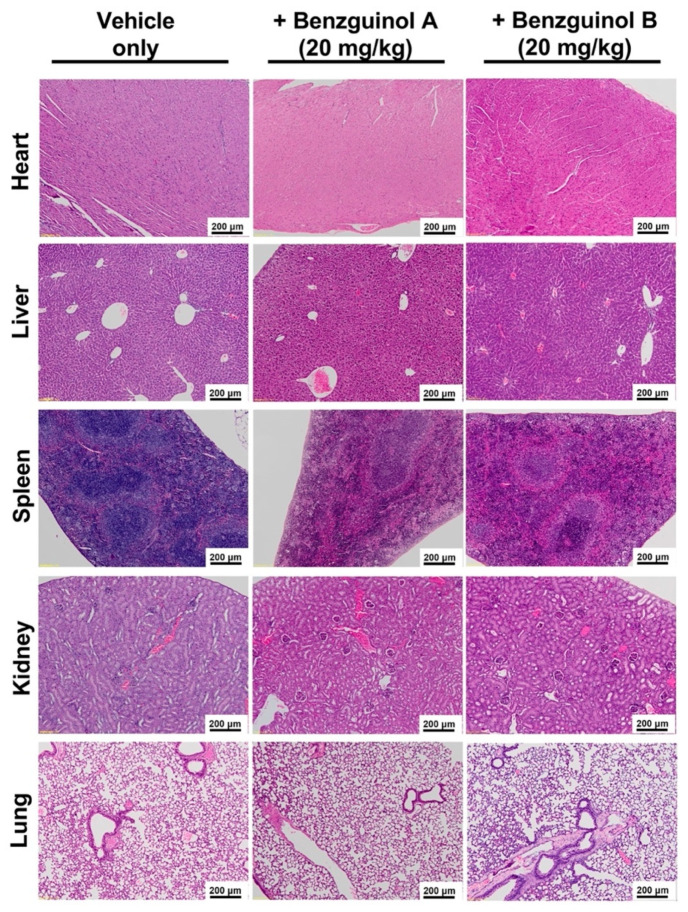
Representative histological images of heart, liver, spleen, lung, and kidneys from benzguinol-treated and control mice harvested at 72 h post-treatment. No morphological abnormalities or changes were observed in mice treated IP with 20 mg/kg benzguinol A, 20 mg/kg benzguinol B, or with vehicle alone. Scale bars: 200 μm.
Figure 6
Figure 6
Selected well diffusion of benzguinol A and benzguinol B formulations used in efficacy trial. Each well contained 100 μL of each formulation of benzguinol A or B (600 μg), daptomycin (180 μg) and 100 μL vehicle only. Xen29, bioluminescent S. aureus Xen29.
Figure 7
Figure 7
Benzguinol efficacy data. (A) Comparison of luminescence signals and (B) bacterial load in blood between groups of CD1 mice (n = 6) challenged IP with bioluminescent S. aureus ATCC 12600 (Xen29) and treated with the indicated drugs. Mice were subjected to bioluminescence imaging on IVIS Lumina XRMS Series III system at the indicated times. ns, not significant; *, p < 0.05; **, p < 0.01; Mann–Whitney U-test (one-tailed). (C) Survival analysis for mice treated with the indicated drugs. ns, not significant; *, p < 0.05; **, p < 0.01; Log-rank (Mantel–Cox test).
Figure 8
Figure 8
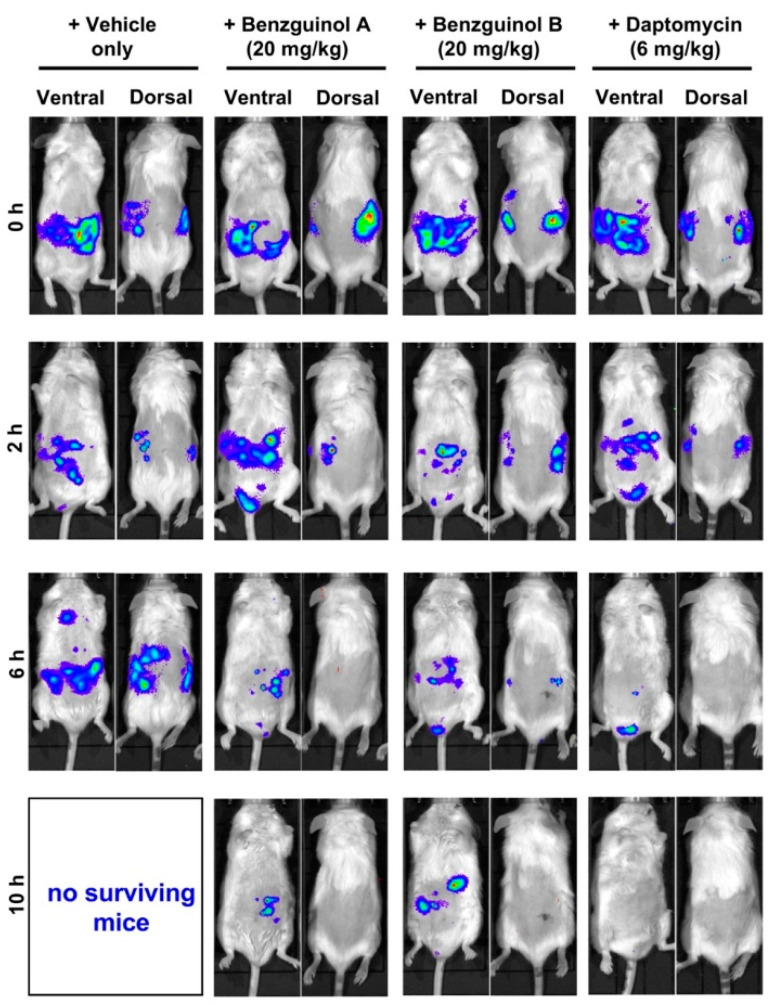
Ventral and dorsal images of representative CD1 mice challenged with approximately 6 × 10⁷ CFU of bioluminescent S. aureus ATCC 12600 (Xen29). Mice were treated with benzguinol A or benzguinol B (20 mg/kg), daptomycin (6 mg/kg), or vehicle at 2, 6, and 10 h. Mice were subjected to bioluminescence imaging on IVIS Lumina XRMS Series III system at the indicated times. At 8 h post-infection, all mice treated with vehicle only had become moribund, indicated by “no surviving mice” at 10 h.

References

    1. WHO . Antimicrobial Resistance. World Health Organization; Geneva, Switzerland: 2020.
    1. Chopra I., Schofield C., Everett M., O’Neill A., Miller K., Wilcox M., Frère J.-M., Dawson M., Czaplewski L., Urleb U., et al. Treatment of health-care-associated infections caused by Gram-negative bacteria: A consensus statement. Lancet Infect. Dis. 2008;8:133–139. doi: 10.1016/S1473-3099(08)70018-5. - DOI - PubMed
    1. Ergönül Ö., Aydin M., Azap A., Başaran S., Tekin S., Kaya Ş., Gülsün S., Yörük G., Kurşun E., Yeşilkaya A., et al. Healthcare-associated Gram-negative bloodstream infections: Antibiotic resistance and predictors of mortality. J. Hosp. Infect. 2016;94:381–385. doi: 10.1016/j.jhin.2016.08.012. - DOI - PubMed
    1. Bassetti M., Peghin M., Vena A., Giacobbe D.R. Treatment of infections due to MDR gram-negative bacteria. Front. Med. 2019;6:74. doi: 10.3389/fmed.2019.00074. - DOI - PMC - PubMed
    1. CDC . Antibiotic Resistance Threats in the United States, 2019. U.S. Department of Health and Human Services, Centers for Disease Control and Prevention; Atlanta, GA, USA: 2019. pp. 1–150.

LinkOut - more resources