


From Nanoparticles to Cancer Nanomedicine: Old Problems with New Solutions
- PMID: 34209111
- PMCID: PMC8308137
- DOI: 10.3390/nano11071727
From Nanoparticles to Cancer Nanomedicine: Old Problems with New Solutions
Abstract
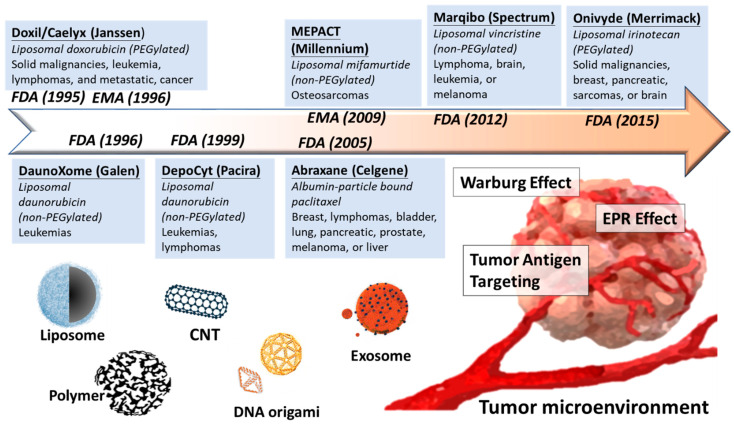
Anticancer nanomedicines have been studied over 30 years, but fewer than 10 formulations have been approved for clinical therapy today. Despite abundant options of anticancer drugs, it remains challenging to have agents specifically target cancer cells while reducing collateral toxicity to healthy tissue. Nanocompartments that can be selective toward points deeply within malignant tissues are a promising concept, but the heterogeneity of tumor tissue, inefficiency of cargo loading and releasing, and low uniformity of manufacture required from preclinical to commercialization are major obstacles. Technological advances have been made in this field, creating engineered nanomaterials with improved uniformity, flexibility of cargo loading, diversity of surface modification, and less inducible immune responses. This review highlights the developmental process of approved nanomedicines and the opportunities for novel materials that combine insights of tumors and nanotechnology to develop a more effective nanomedicine for cancer patients.
Keywords: nanomaterials; nanomedicines; nanoparticles; nanotechnology.
Conflict of interest statement
The authors declare no conflict of interest.
Figures
References
-
- Arvizo R.R., Miranda O.R., Moyano D.F., Walden C.A., Giri K., Bhattacharya R., Robertson J.D., Rotello V.M., Reid J.M., Mukherjee P. Modulating pharmacokinetics, tumor uptake and biodistribution by engineered nanoparticles. PLoS ONE. 2011;6:e24374. doi: 10.1371/journal.pone.0024374. - DOI - PMC - PubMed
Publication types
Grants and funding
LinkOut - more resources
Full Text Sources
