Review
. 2021 Jun 30;10(7):1645.
doi: 10.3390/cells10071645.

A Small Protein but with Diverse Roles: A Review of EsxA in Mycobacterium-Host Interaction

Affiliations
Review

A Small Protein but with Diverse Roles: A Review of EsxA in Mycobacterium-Host Interaction

Yanqing Bao et al. Cells. .

Abstract

As a major effector of the ESX-1 secretion system, EsxA is essential for the virulence of pathogenic mycobacteria, such as Mycobacterium tuberculosis (Mtb) and Mycobacterium marinum (Mm). EsxA possesses an acidic pH-dependent membrane permeabilizing activity and plays an essential role by mediating mycobacterial escape from the phagosome and translocation to the cytosol for intracellular replication. Moreover, EsxA regulates host immune responses as a potent T-cell antigen and a strong immunoregulator. EsxA interacts with multiple cellular proteins and stimulates several signal pathways, such as necrosis, apoptosis, autophagy, and antigen presentation. Interestingly, there is a co-dependency in the expression and secretion of EsxA and other mycobacterial factors, which greatly increases the complexity of dissecting the precise roles of EsxA and other factors in mycobacterium-host interaction. In this review, we summarize the current understandings of the roles and functions of EsxA in mycobacterial infection and discuss the challenges and future directions.

Keywords: EsxA; Mycobacterium tuberculosis; host–pathogen interaction; immunoregulator; membrane-permeabilizing activity.


Conflict of interest statement

The authors declare no conflict of interests.

Figures
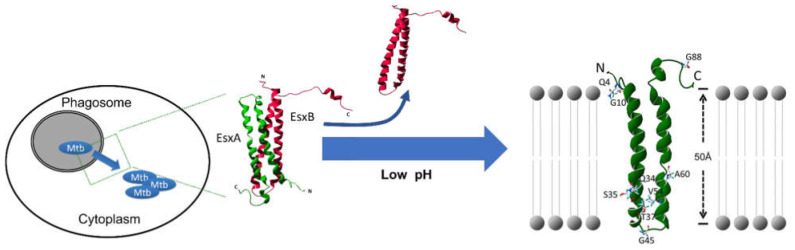
Figure 1
Figure 1
The model of EsxA-mediated Mtb cytosolic translocation. Mtb is internalized into the phagosome of macrophage. Upon acidification, the secreted EsxAB heterodimer is dissociated, and EsxA inserts into the membrane, which facilitates Mtb escape from the phagosome and translocation into the cytosol for intracellular replication. The figure is modified from [61].
Figure 2
Figure 2
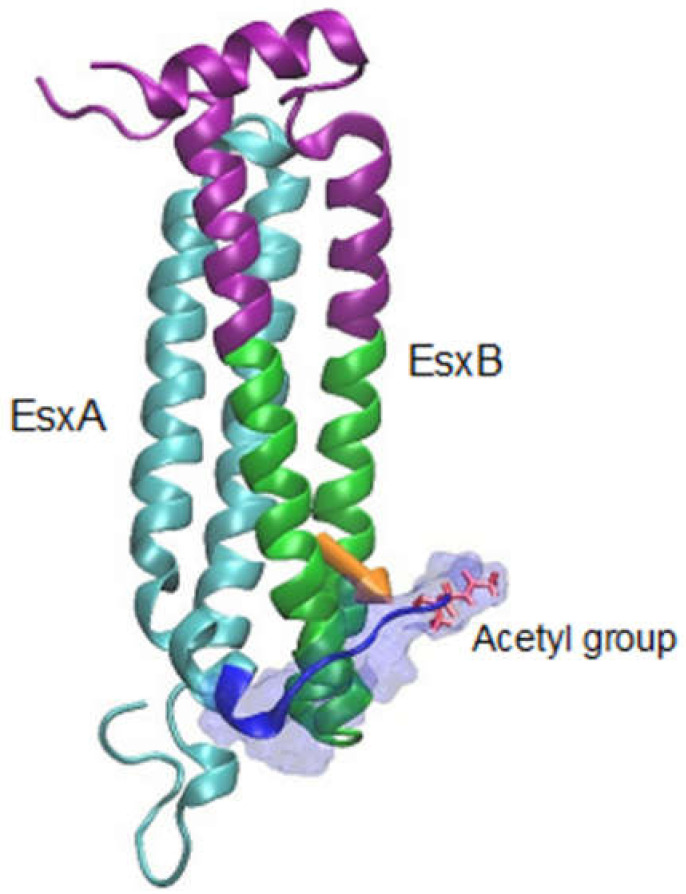
Interaction between the Nα-acetylated EsxA and EsxB at pH 4. The structure of Mtb EsxAB heterodimer with Nα-acetylation was analyzed by molecular dynamic simulation. The figure was generated from snapshots of 20 ns molecular dynamic (MD) simulations at pH 4. EsxA is colored in cyan; the N-terminus of EsxA is colored in blue and shown in transparent surface representation. The acetylated Thr-2 residue is shown in bond representation and colored in red. The residues in EsxB within 20 Å of the N-terminus of EsxA are colored in green, and the residues beyond 20 Å are shown in purple. The orange arrows represent the electrostatic interaction between two sets of residues: the residues in the N-terminus of EsxA (blue) and the residues in EsxB within 20 Å of the N-terminus of EsxA (green). The MD simulation shows that the acetylated N-terminal arm of EsxA makes direct contracts with EsxB in a frequent “bind-and-release” mode, which generates a force of 44 pN to pull EsxB away from EsxA. The figure is modified from [86].

References

    1. Barksdale L., Kim K.-S. Mycobacterium. Bacteriol. Rev. 1977;41:217. doi: 10.1128/br.41.1.217-372.1977. - DOI - PMC - PubMed
    1. Tortoli E. Microbiological features and clinical relevance of new species of the genus Mycobacterium. Clin. Microbiol. Rev. 2014;27:727–752. doi: 10.1128/CMR.00035-14. - DOI - PMC - PubMed
    1. Pfyffer G.E. Mycobacterium: General characteristics, laboratory detection, and staining procedures. Man. Clin. Microbiol. 2015:536–569.
    1. Gupta R.S., Lo B., Son J. Phylogenomics and comparative genomic studies robustly support division of the genus Mycobacterium into an emended genus Mycobacterium and four novel genera. Front. Microbiol. 2018;9:67. doi: 10.3389/fmicb.2018.00067. - DOI - PMC - PubMed
    1. Glickman M.S., Jacobs W.R. Microbial pathogenesis of Mycobacterium tuberculosis: Dawn of a discipline. Cell. 2001;104:477–485. doi: 10.1016/S0092-8674(01)00236-7. - DOI - PubMed

Publication types

Substances

LinkOut - more resources