


Subcritical Water Extraction of Natural Products
- PMID: 34209151
- PMCID: PMC8271798
- DOI: 10.3390/molecules26134004
Subcritical Water Extraction of Natural Products
Abstract
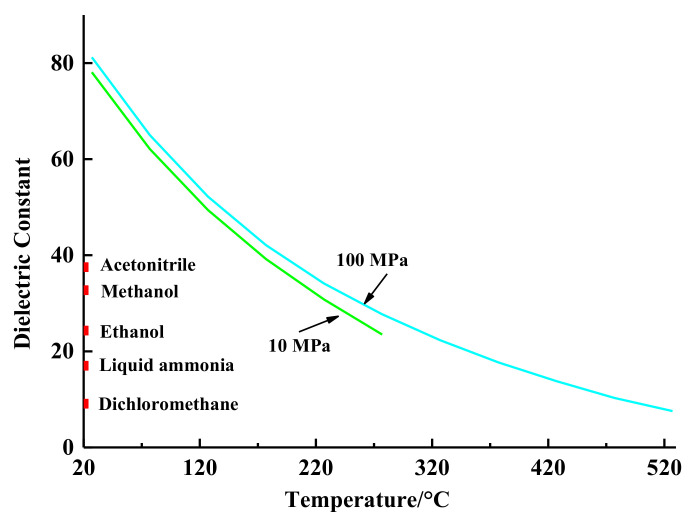
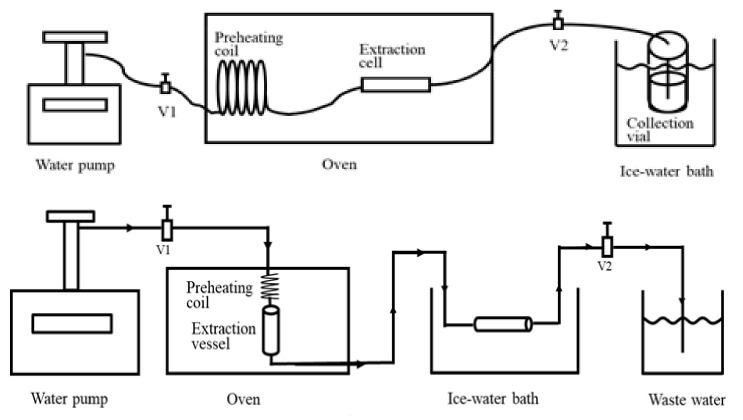
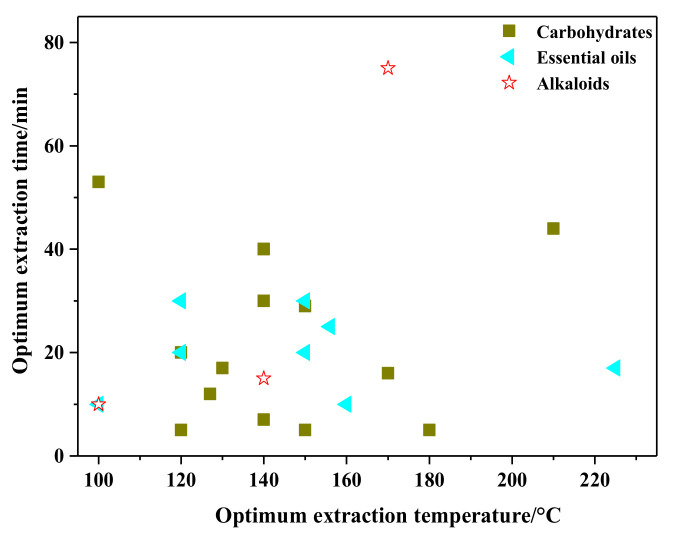
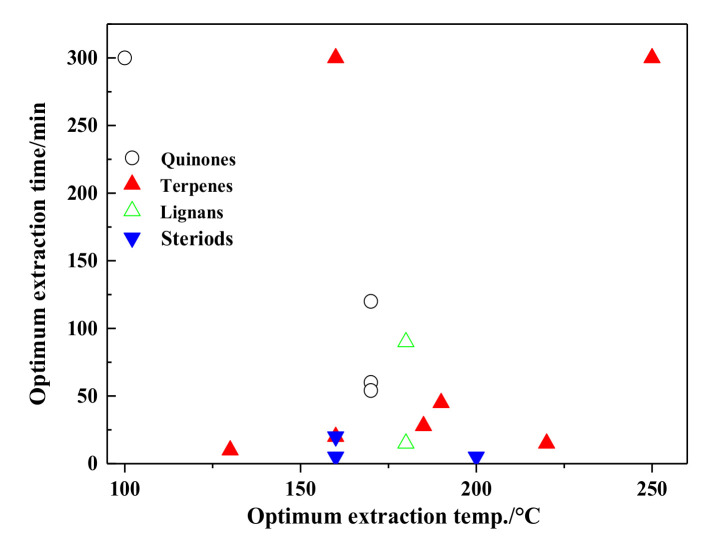
Subcritical water refers to high-temperature and high-pressure water. A unique and useful characteristic of subcritical water is that its polarity can be dramatically decreased with increasing temperature. Therefore, subcritical water can behave similar to methanol or ethanol. This makes subcritical water a green extraction fluid used for a variety of organic species. This review focuses on the subcritical water extraction (SBWE) of natural products. The extracted materials include medicinal and seasoning herbs, vegetables, fruits, food by-products, algae, shrubs, tea leaves, grains, and seeds. A wide range of natural products such as alkaloids, carbohydrates, essential oil, flavonoids, glycosides, lignans, organic acids, polyphenolics, quinones, steroids, and terpenes have been extracted using subcritical water. Various SBWE systems and their advantages and drawbacks have also been discussed in this review. In addition, we have reviewed co-solvents including ethanol, methanol, salts, and ionic liquids used to assist SBWE. Other extraction techniques such as microwave and sonication combined with SBWE are also covered in this review. It is very clear that temperature has the most significant effect on SBWE efficiency, and thus, it can be optimized. The optimal temperature ranges from 130 to 240 °C for extracting the natural products mentioned above. This review can help readers learn more about the SBWE technology, especially for readers with an interest in the field of green extraction of natural products. The major advantage of SBWE of natural products is that water is nontoxic, and therefore, it is more suitable for the extraction of herbs, vegetables, and fruits. Another advantage is that no liquid waste disposal is required after SBWE. Compared with organic solvents, subcritical water not only has advantages in ecology, economy, and safety, but also its density, ion product, and dielectric constant can be adjusted by temperature. These tunable properties allow subcritical water to carry out class selective extractions such as extracting polar compounds at lower temperatures and less polar ingredients at higher temperatures. SBWE can mimic the traditional herbal decoction for preparing herbal medication and with higher extraction efficiency. Since SBWE employs high-temperature and high-pressure, great caution is needed for safe operation. Another challenge for application of SBWE is potential organic degradation under high temperature conditions. We highly recommend conducting analyte stability checks when carrying out SBWE. For analytes with poor SBWE efficiency, a small number of organic modifiers such as ethanol, surfactants, or ionic liquids may be added.
Keywords: alkaloids; carbohydrates; essential oils; flavonoids; glycosides; lignans; natural products; organic acids; polyphenolics; quinones; steroids; subcritical water extraction; terpenes.
Conflict of interest statement
The authors declare no conflict of interest.
Figures
References
-
- Colegate S.M., Molyneux R.J. Bioactive Natural Products. CRC Press; Boca Raton, FL, USA: 1993.
-
- Fernández D.P., Goodwin A.R.H., Lemmon E.W., Sengers J.M.H.L., Williams R.C. A formulation for the static permittivity of water and steam at temperatures from 238 K to 873 K at pressures up to 1200 MPa, including derivatives and Debye–Hückel coefficients. J. Phys. Chem. Ref. Data. 1997;26:1125–1166. doi: 10.1063/1.555997. - DOI
-
- Zhang J., Wen C., Zhang H., Duan Y., Ma H. Recent advances in the extraction of bioactive compounds with subcritical water: A review. Trends Food Sci. Technol. 2020;95:183–195. doi: 10.1016/j.tifs.2019.11.018. - DOI
-
- Yang Y., Hawthorne S.B., Miller D.J. Class-selective extraction of polar, moderately polar, and nonpolar organics from hydrocarbon wastes using subcritical water. Environ. Sci. Technol. 1997;31:430–437. doi: 10.1021/es960242s. - DOI
Publication types
MeSH terms
Substances
Grants and funding
LinkOut - more resources
Full Text Sources
Other Literature Sources
