. 2021 Jun 30;19(7):380.
doi: 10.3390/md19070380.

Electrophysiological Evaluation of Pacific Oyster (Crassostrea gigas) Sensitivity to Saxitoxin and Tetrodotoxin

Affiliations

Electrophysiological Evaluation of Pacific Oyster (Crassostrea gigas) Sensitivity to Saxitoxin and Tetrodotoxin

Floriane Boullot et al. Mar Drugs. .

Abstract

Pacific oysters (Crassostrea gigas) may bio-accumulate high levels of paralytic shellfish toxins (PST) during harmful algal blooms of the genus Alexandrium. These blooms regularly occur in coastal waters, affecting oyster health and marketability. The aim of our study was to analyse the PST-sensitivity of nerves of Pacific oysters in relation with toxin bio-accumulation. The results show that C. gigas nerves have micromolar range of saxitoxin (STX) sensitivity, thus providing intermediate STX sensitivity compared to other bivalve species. However, theses nerves were much less sensitive to tetrodotoxin. The STX-sensitivity of compound nerve action potential (CNAP) recorded from oysters experimentally fed with Alexandrium minutum (toxic-alga-exposed oysters), or Tisochrysis lutea, a non-toxic microalga (control oysters), revealed that oysters could be separated into STX-resistant and STX-sensitive categories, regardless of the diet. Moreover, the percentage of toxin-sensitive nerves was lower, and the STX concentration necessary to inhibit 50% of CNAP higher, in recently toxic-alga-exposed oysters than in control bivalves. However, no obvious correlation was observed between nerve sensitivity to STX and the STX content in oyster digestive glands. None of the nerves isolated from wild and farmed oysters was detected to be sensitive to tetrodotoxin. In conclusion, this study highlights the good potential of cerebrovisceral nerves of Pacific oysters for electrophysiological and pharmacological studies. In addition, this study shows, for the first time, that C. gigas nerves have micromolar range of STX sensitivity. The STX sensitivity decreases, at least temporary, upon recent oyster exposure to dinoflagellates producing PST under natural, but not experimental environment.

Keywords: Alexandrium minutum; Crassostrea gigas; compound nerve action potential; paralytic shellfish toxins.


Conflict of interest statement

The authors declare no conflict of interest. The funders had no role in the design of the study; in the collection, analyses, or interpretation of data; in the writing of the manuscript, or in the decision to publish the results.

Figures
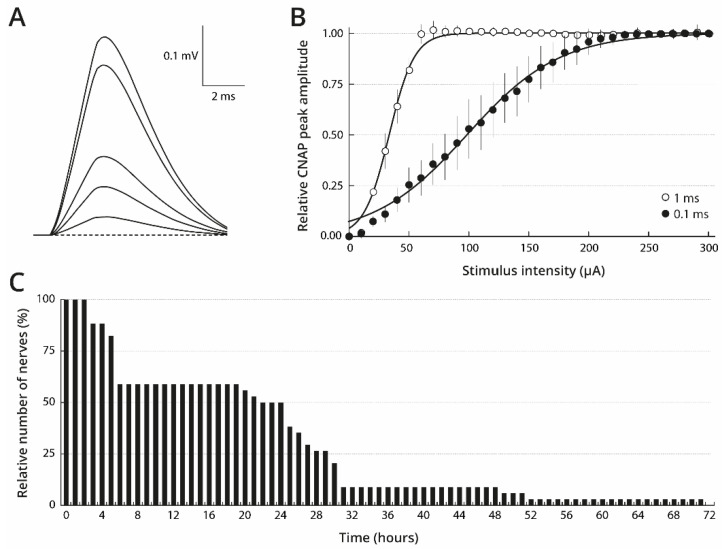
Figure 1
Figure 1
Stimulation and keeping oyster nerve conditions to obtain consistent CNAP. (A) Superimposed traces of typical CNAP recorded from the cerebrovisceral nerve stimulated with pulse intensities of 20, 50, 80, 170 and 300 µA and 1-ms duration. (B) CNAP peak amplitude (mean ± SE of 22–34 nerves) as function of the intensity of 0.1-ms (●) and 1-ms (○) duration stimulus. For each nerve, the peak amplitude is expressed relatively to its maximal amplitude. The curves correspond to data fits according to the Boltzmann equation with I50 = 99 ± 8 µA and S = 39 ± 7 µA−1 (●) and I50 = 33 ± 3 µA and S = 10 ± 1 µA−1 (○). (C) Number of nerves able to produce a CNAP in response to electrical stimulation, expressed as the percentage of total number of functional nerves at time zero (n = 34), as function of time after their dissection. The nerves were kept in standard physiological solution at 4 °C between recording sessions.
Figure 2
Figure 2
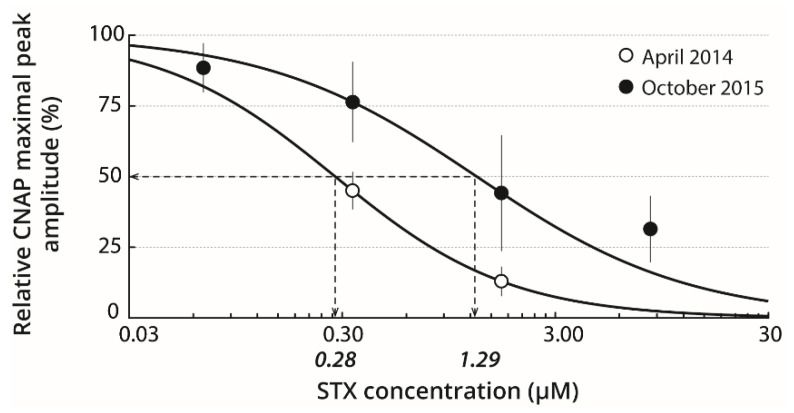
STX sensitivity of nerves isolated from wild oysters. Concentration-response curves of STX effects on the CNAP maximal peak amplitude recorded from wild oysters collected on April 2014 (○) and October 2015 (●). Each value represents the mean ± SE of data obtained from 2 to 9 nerves, and is expressed as percentage of its value obtained in absence of toxin. The curves were calculated from typical sigmoid nonlinear regressions through data points, according to the Hill equation, with IC50 values (italic numbers) of 0.28 and 1.29 µM and nH values of 1.06 and 0.87 for nerves isolated from oysters collected on April 2014 and October 2015, respectively.
Figure 3
Figure 3
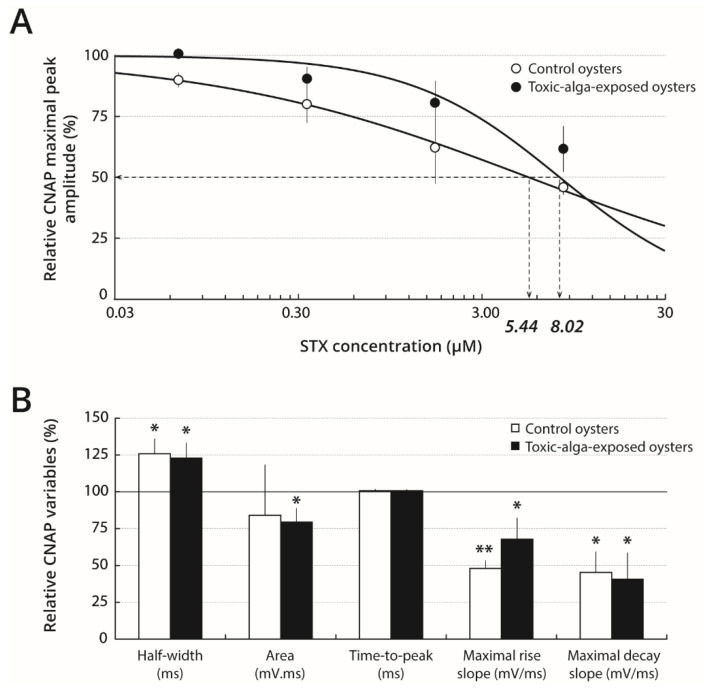
STX effects on relatively sensitive nerves of farmed oysters fed with A. minutum (toxic-alga-exposed oysters) or with Tisochrysis lutea (control oysters). (A) Concentration-response curves of STX effects on the CNAP maximal peak amplitude recorded from toxic-alga-exposed (●) and control (○) oysters. Each value represents the mean ± SE of data obtained from 2–8 nerves, and is expressed as percentage of its value obtained in absence of toxin. The curves were calculated from typical sigmoid nonlinear regressions through data points, according to the Hill equation, with IC50 values (italic numbers) of 8.02 and 5.44 µM and nH values of 1.06 and 0.49 for nerves isolated from toxic-alga-exposed and control oysters, respectively. (B) Histogram of variables characterising the CNAP kinetics of nerves isolated from toxic-alga-exposed (■) and control (□) oysters and pre-treated with 8.39 µM STX. Each value represents the mean ± SE of data obtained from 6–8 nerves, and is expressed as percentage of its value measured in absence of toxin. * 0.01 < p < 0.05 and ** 0.001 < p < 0.01, compared with values determined before pre-treatment of nerves with STX.
Figure 4
Figure 4
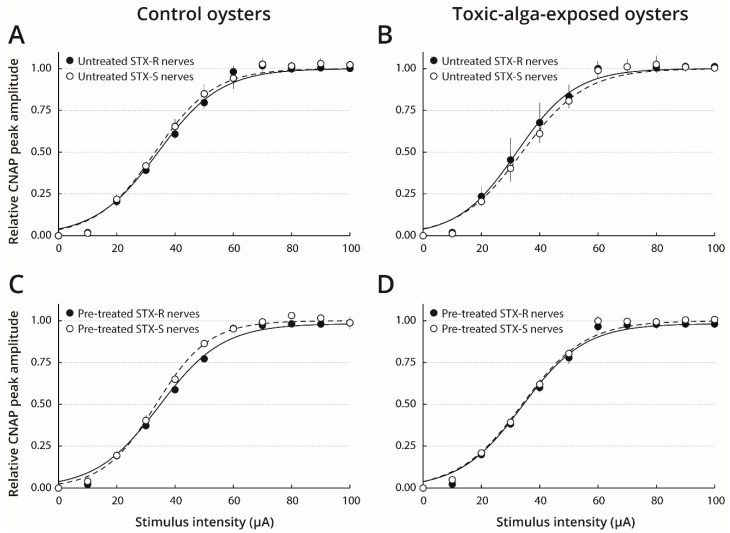
Response-intensity relationships of nerves isolated from farmed oysters. Response-intensity relationships of relatively sensitive (STX-S, ○) and relatively resistant (STX-R, ●) nerves isolated from farmed oysters fed with T. lutea (control oysters, A,C) or A. minutum (toxic-alga-exposed oysters, B,D), before (untreated, A,B) and after (pre-treated, C,D) their pre-treatment with 8.39 µM STX. CNAP peak amplitudes (means ± SE of 6–12 nerves) were expressed relatively to their respective maximal amplitude, as a function of the intensity of 1-ms duration stimulus. The curves correspond to data fits according to the Boltzmann equation with the I50 and S values indicated in Table 3.
Figure 5
Figure 5
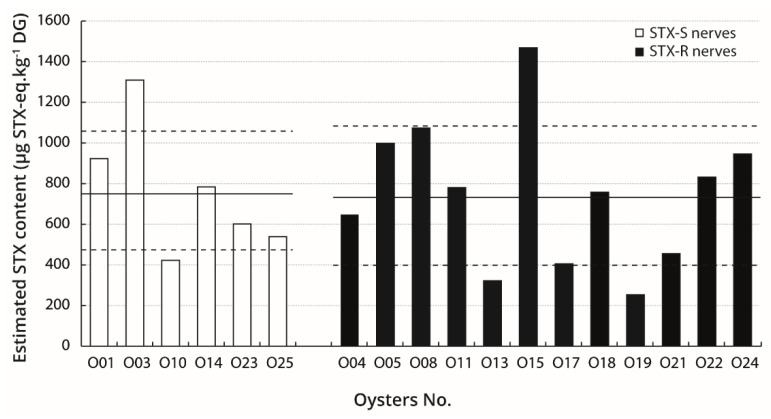
Individual levels of bio-accumulated PST in farmed oysters fed with A. minutum (toxic-alga-exposed oysters). Histogram of individual estimated STX contents in digestive glands of toxic-alga-exposed oysters possessing STX-sensitive (STX-S) nerves (□, n = 6) and STX-resistant (STX-R) nerves (■, n = 12). In each case, full and dashed lines indicate mean and SE values, respectively, i.e., 760 ± 290 µg STX-eq.kg−1 DG (□) and 740 ± 340 µg STX-eq.kg−1 DG (■).
Figure 6
Figure 6
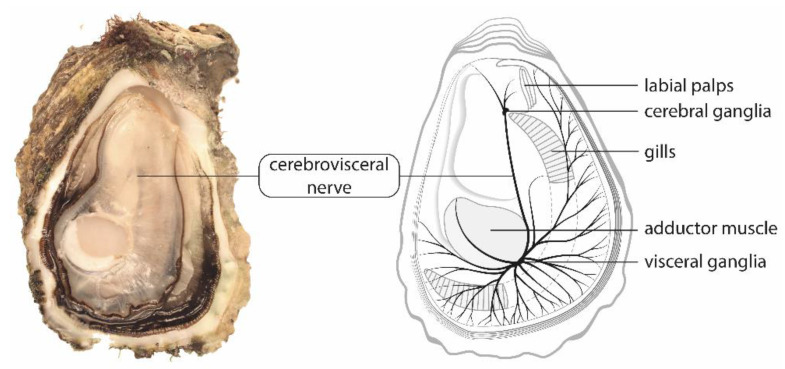
The cerebrovisceral nerves of the Pacific oyster, C. gigas, in the left valve. This pair of nerves, which rises from the posterior side of cerebral ganglia to the anterior side of visceral ganglia, is embedded in the connective tissue of the visceral mass. The visceral ganglia, located on the anteroventral side of the adductor muscle, at the junction between smooth and striated muscles, sends nerves to the adductor muscle, the posterior part of the mantle, the gills, the heart, the gonad and the digestive gland.

References

    1. Anderson D.M., Alpermann T.J., Cembella A.D., Collos Y., Masseret E., Montresor M. The globally distributed genus Alexandrium: Multifaceted roles in marine ecosystems and impacts on human health. Harmful Algae. 2012;14:10–35. doi: 10.1016/j.hal.2011.10.012. - DOI - PMC - PubMed
    1. Van Dolah F.M. Marine algal toxins: Origins, health effects, and their increased occurrence. Environ. Health Perspect. 2000;108:133–141. doi: 10.1289/ehp.00108s1133. - DOI - PMC - PubMed
    1. Guallar C., Bacher C., Chapelle A. Global and local factors driving the phenology of Alexandrium minutum (Halim) blooms and its toxicity. Harmful Algae. 2017;67:44–60. doi: 10.1016/j.hal.2017.05.005. - DOI - PubMed
    1. Lassus P., Baron R., Garen P., Truquet P., Masselin P., Bardouil M., Leguay D., Amzil Z. Paralytic shellfish poison outbreaks in the Penzé estuary: Environmental factors affecting toxin uptake in the oyster. Crassostrea gigas. Aquat. Living Resour. 2004;17:207–214. doi: 10.1051/alr:2004012. - DOI
    1. Wang D.-Z., Zhang S.-F., Zhang Y., Lin L. Paralytic shellfish toxin biosynthesis in cyanobacteria and dinoflagellates: A molecular overview. J. Proteom. 2016;135:132–140. doi: 10.1016/j.jprot.2015.08.008. - DOI - PubMed

LinkOut - more resources