


C9orf72 Intermediate Repeats Confer Genetic Risk for Severe COVID-19 Pneumonia Independently of Age
- PMID: 34209673
- PMCID: PMC8268051
- DOI: 10.3390/ijms22136991
C9orf72 Intermediate Repeats Confer Genetic Risk for Severe COVID-19 Pneumonia Independently of Age
Abstract
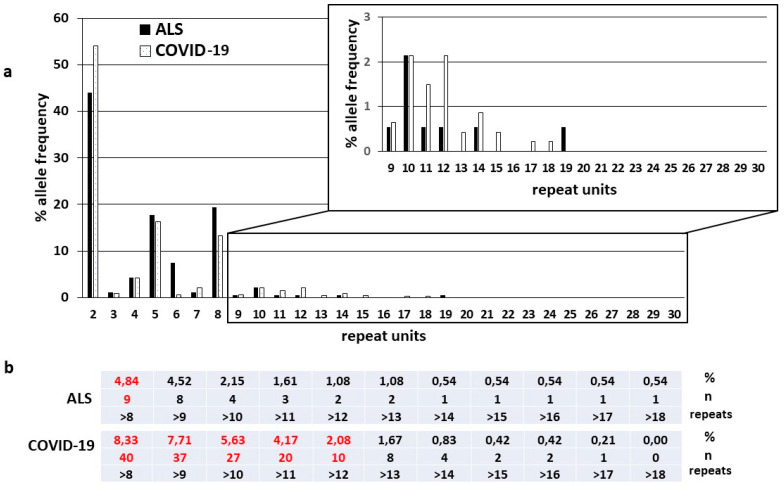
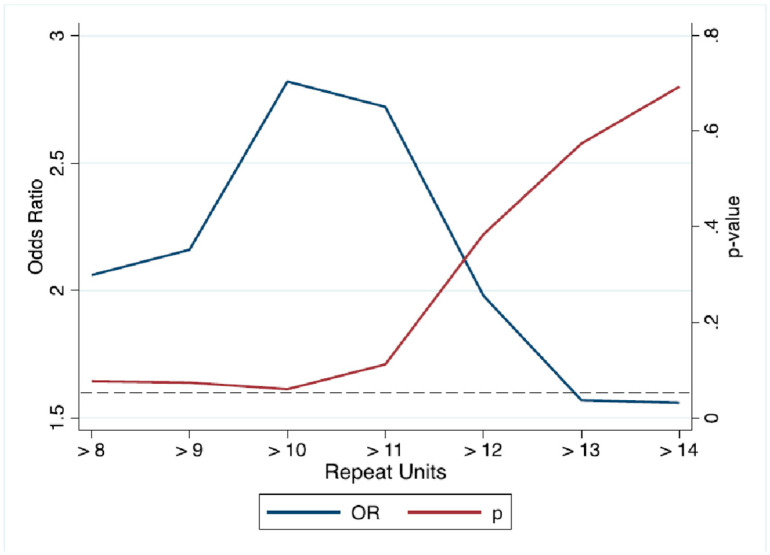
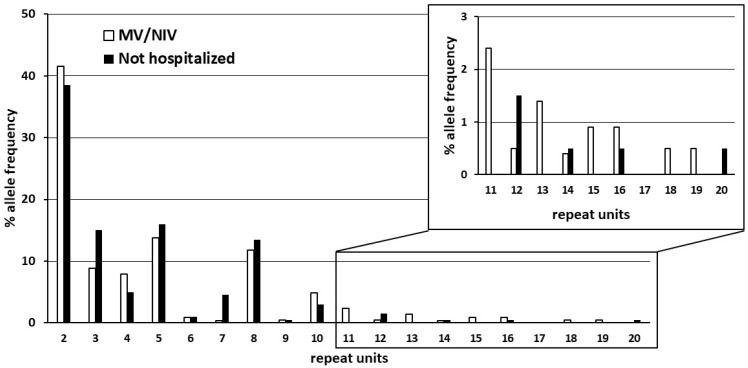
A cytokine storm, autoimmune features and dysfunctions of myeloid cells significantly contribute to severe coronavirus disease 2019 (COVID-19), caused by the severe acute respiratory syndrome coronavirus 2 (SARS-CoV-2) infection. Genetic background of the host seems to be partly responsible for severe phenotype and genes related to innate immune response seem critical host determinants. The C9orf72 gene has a role in vesicular trafficking, autophagy regulation and lysosome functions, is highly expressed in myeloid cells and is involved in immune functions, regulating the lysosomal degradation of mediators of innate immunity. A large non-coding hexanucleotide repeat expansion (HRE) in this gene is the main genetic cause of frontotemporal dementia (FTD) and amyotrophic lateral sclerosis (ALS), both characterized by neuroinflammation and high systemic levels of proinflammatory cytokines, while HREs of intermediate length, although rare, are more frequent in autoimmune disorders. C9orf72 full mutation results in haploinsufficiency and intermediate HREs seem to modulate gene expression as well and impair autophagy. Herein, we sought to explore whether intermediate HREs in C9orf72 may be a risk factor for severe COVID-19. Although we found intermediate HREs in only a small portion of 240 patients with severe COVID-19 pneumonia, the magnitude of risk for requiring non-invasive or mechanical ventilation conferred by harboring intermediate repeats >10 units in at least one C9orf72 allele was more than twice respect to having shorter expansions, when adjusted for age (odds ratio (OR) 2.36; 95% confidence interval (CI) 1.04-5.37, p = 0.040). The association between intermediate repeats >10 units and more severe clinical outcome (p = 0.025) was also validated in an independent cohort of 201 SARS-CoV-2 infected patients. These data suggest that C9orf72 HREs >10 units may influence the pathogenic process driving more severe COVID-19 phenotypes.
Keywords: C9orf72; COVID-19; SARS-CoV-2; autophagy; genetic risk; innate immunity; intermediate alleles.
Conflict of interest statement
The authors declare no conflict of interest. The funders had no role in the design of the study; in the collection, analyses, or interpretation of data; in the writing of the manuscript, or in the decision to publish the results.
Figures
References
-
- DeJesus-Hernandez M., Mackenzie I.R., Boeve B.F., Boxer A.L., Baker M., Rutherford N.J., Nicholson A.M., Finch N.A., Flynn H., Adamson J., et al. Expanded GGGGCC Hexanucleotide Repeat in Noncoding Region of C9ORF72 Causes Chromosome 9p-Linked FTD and ALS. Neuron. 2011;72:245–256. doi: 10.1016/j.neuron.2011.09.011. - DOI - PMC - PubMed
-
- Renton A.E., Majounie E., Waite A., Simón-Sánchez J., Rollinson S., Gibbs J.R., Schymick J.C., Laaksovirta H., van Swieten J.C., Myllykangas L., et al. A Hexanucleotide Repeat Expansion in C9ORF72 Is the Cause of Chromosome 9p21-Linked ALS-FTD. Neuron. 2011;72:257–268. doi: 10.1016/j.neuron.2011.09.010. - DOI - PMC - PubMed
-
- Theuns J., Verstraeten A., Sleegers K., Wauters E., Gijselinck I., Smolders S., Crosiers D., Corsmit E., Elinck E., Sharma M., et al. Global investigation and meta-analysis of the C9orf72 (G4C2) n repeat in Parkinson disease. Neurology. 2014;83:1906–1913. doi: 10.1212/WNL.0000000000001012. - DOI - PMC - PubMed
-
- Cannas A., Solla P., Borghero G., Floris G.L., Chiò A., Mascia M.M., Modugno N., Muroni A., Orofino G., Di Stefano F., et al. C9ORF72 intermediate repeat expansion in patients affected by atypical parkinsonian syndromes or Parkinson’s disease complicated by psychosis or dementia in a Sardinian population. J. Neurol. 2015;262:2498–2503. doi: 10.1007/s00415-015-7873-6. - DOI - PubMed
MeSH terms
Substances
Grants and funding
- unconditional grant (E.Q-R)/ViiV Healthcare
- ex 60% (I.Z.)/Università degli Studi di Brescia
- project "Dipartimenti di Eccellenza 2018-2020" to the Department of Medical Biotechnologies University of Siena, Italy (Italian D.L. n.18 March 17, 2020)/Ministero dell'Istruzione, dell'Università e della Ricerca
- for COVID-19 research/private donors
- "Bando Ricerca COVID-19 Toscana"/Azienda Ospedaliero-Universitaria Senese
LinkOut - more resources
Full Text Sources
Medical
Miscellaneous
