


Interventional Radiology in the Coronavirus Disease 2019 Pandemic: Impact on Practices and Wellbeing
- PMID: 34210612
- PMCID: PMC8185184
- DOI: 10.1016/j.acra.2021.05.025
Interventional Radiology in the Coronavirus Disease 2019 Pandemic: Impact on Practices and Wellbeing
Abstract
Purpose: To report the impact of the coronavirus disease 2019 (COVID-19) pandemic on interventional radiology (IR).
Materials and methods: A 78-question survey was distributed to practicing interventional radiologists and IR trainees. The survey consisted of demographic and practice environment queries. Anxiety symptoms were evaluated using the Generalized Anxiety Disorder-7 (GAD-7) screener, and coping strategies were assessed using the Brief-Coping Orientation to Problems Experienced (Brief-COPE) questionnaire.
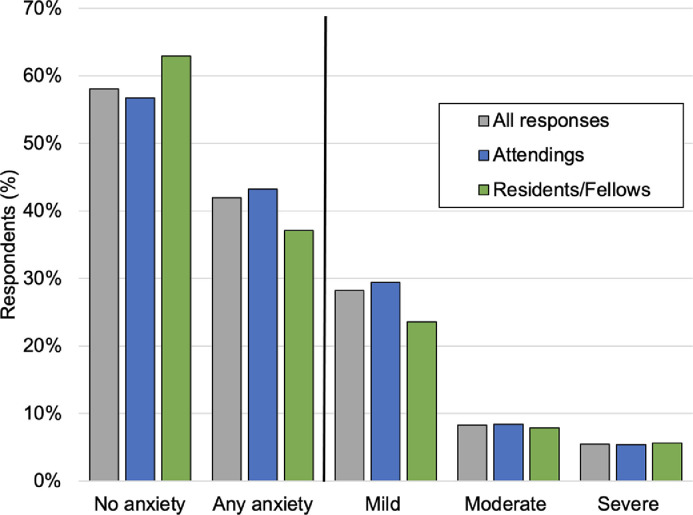
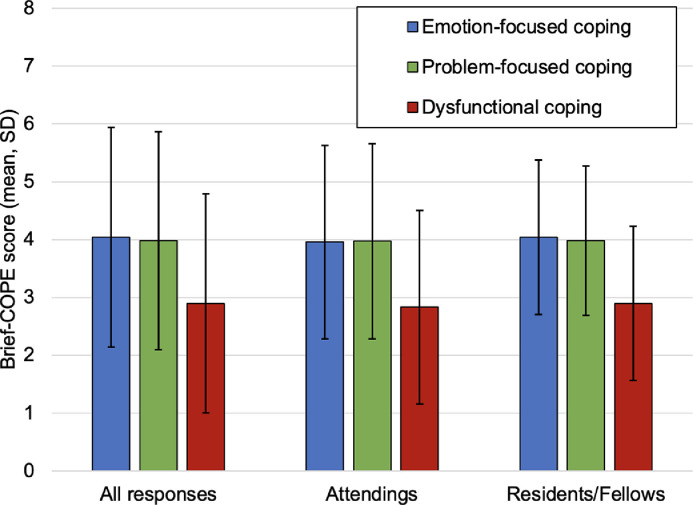
Results: There were 422 respondents including 333 (78.9%) attending interventional radiologists and 89 (21.1%) interventional radiologists-in-training from 15 counties. Most respondents were from academic medical centers (n = 218; 51.7%). A large majority (n = 391; 92.7%) performed a procedure on a patient with confirmed COVID-19 infection. An N95 mask was the most common (n = 366; 93.6%) safety measure employed. Cancellation or limitation of elective procedures were reported by 276 (65.4%) respondents. Many respondents (n = 177; 41.9%) had self-reported anxiety (GAD-7 score >5) with an overall mean GAD-7 score of 4.64 ± 4.63 (range: 0-21). Factors associated with reporting anxiety included female gender (p = 0.045), increased call coverage (p = 0.048), lack of adequate departmental adjustments (p <0.0001), and lack of adjustments in a timely manner (p <0.0001). The most utilized coping strategy was acceptance (mean of 5.49 ± 1.88), while the most employed dysfunctional coping strategy was self-distraction (mean of 4.16 ± 1.67). The odds of reporting anxiety increased by >125% with adoption of dysfunctional strategies.
Conclusion: The COVID-19 pandemic induced practice alterations and high rates of self-reported anxiety in IR. Female gender, increased call coverage, and lack of adequate or timely departmental adjustments were associated with increased anxiety levels.
Keywords: Anxiety; Burnout; COVID-19; Coping strategies; Coronavirus disease 2019 pandemic; GAD-7, Brief-COPE; IR; Interventional radiology; Practices; Wellbeing.
Copyright © 2021 The Association of University Radiologists. Published by Elsevier Inc. All rights reserved.
Figures



Comment in
-
Synchronous Video-Based Virtual Visits in Interventional Radiology During the COVID-19 Pandemic - A Double-Edged Sword: Challenges and Opportunities for Improving Care.Acad Radiol. 2021 Dec;28(12):1824-1825. doi: 10.1016/j.acra.2021.09.006. Epub 2021 Sep 22. Acad Radiol. 2021. PMID: 34690050 Free PMC article. No abstract available.
-
Evaluating the Methods of Surveying Interventional Radiologists' Practices and Wellbeing During COVID-19.Acad Radiol. 2021 Nov;28(11):1641-1642. doi: 10.1016/j.acra.2021.09.022. Epub 2021 Sep 30. Acad Radiol. 2021. PMID: 34696969 Free PMC article. No abstract available.
References
-
- COVID-19 Map. Johns Hopkins Coronavirus Resource Center. Accessed December 18, 2020. Available at: https://coronavirus.jhu.edu/map.html
MeSH terms
LinkOut - more resources
Full Text Sources
Medical
Miscellaneous
