Review
. 2021 Aug 21;50(16):9121-9151.
doi: 10.1039/d0cs01065k. Epub 2021 Jul 2.

A critical overview of computational approaches employed for COVID-19 drug discovery

Affiliations
Review

A critical overview of computational approaches employed for COVID-19 drug discovery

Eugene N Muratov et al. Chem Soc Rev. .

Abstract

COVID-19 has resulted in huge numbers of infections and deaths worldwide and brought the most severe disruptions to societies and economies since the Great Depression. Massive experimental and computational research effort to understand and characterize the disease and rapidly develop diagnostics, vaccines, and drugs has emerged in response to this devastating pandemic and more than 130 000 COVID-19-related research papers have been published in peer-reviewed journals or deposited in preprint servers. Much of the research effort has focused on the discovery of novel drug candidates or repurposing of existing drugs against COVID-19, and many such projects have been either exclusively computational or computer-aided experimental studies. Herein, we provide an expert overview of the key computational methods and their applications for the discovery of COVID-19 small-molecule therapeutics that have been reported in the research literature. We further outline that, after the first year the COVID-19 pandemic, it appears that drug repurposing has not produced rapid and global solutions. However, several known drugs have been used in the clinic to cure COVID-19 patients, and a few repurposed drugs continue to be considered in clinical trials, along with several novel clinical candidates. We posit that truly impactful computational tools must deliver actionable, experimentally testable hypotheses enabling the discovery of novel drugs and drug combinations, and that open science and rapid sharing of research results are critical to accelerate the development of novel, much needed therapeutics for COVID-19.


Conflict of interest statement

G. S. declares a potential financial conflict of interest as a founder of inSili.com GmbH, Zurich, and in his role as consultant to the pharmaceutical industry.

Figures
Fig. 1
Fig. 1. Summary of key developments in CADD for COVID-19.
Fig. 2
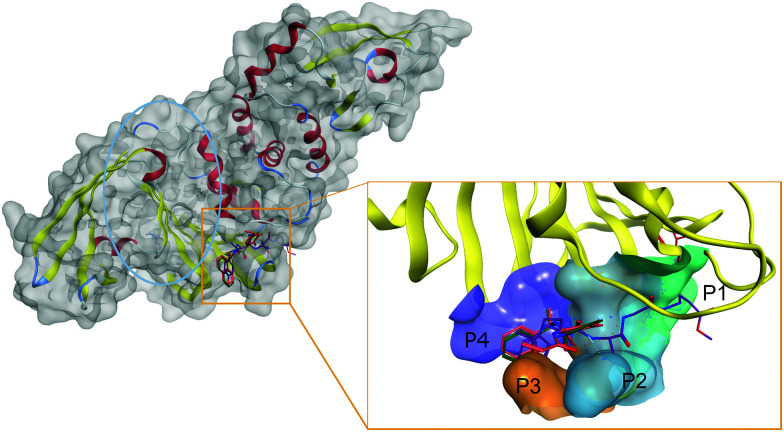
Fig. 2. Structure of SARS-CoV-2 PLpro and inhibitors in its catalytic site. In PLpro (left), the proximity of the ubiquitin binding site (circled in blue) to the catalytic site (squared in red) offers unique inhibition opportunities to target both activities of PLpro. The active site can be divided into subpockets (right) to guide drug design against SARS-CoV-2 PLpro. The four main pockets P1, P2, P3, and P4 (colored teal, blue, orange, and purple, respectively) need to be occupied for optimal inhibition. Ligands are represented in colored sticks. VIR251: purple; PLP_Snyder530: pink; GRL-0617: green. Parts of the pocket's surface were omitted for easier visualization.
Fig. 3
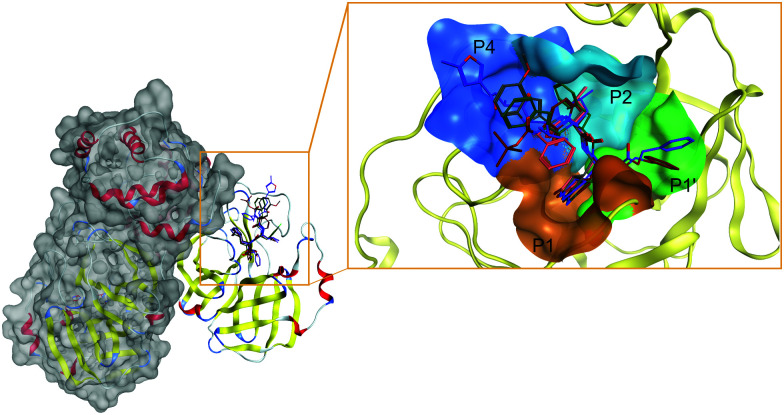
Fig. 3. Structure of SARS-CoV-2 Mpro and inhibitors in its active site. The unique dimer structure of Mpro (left) offers one distinct path to block its catalytic activity through the substrate-binding pocket. The active site can be partitioned into subpockets (right) to rationalize the design strategy against SARS-CoV-2 Mpro. The four main pockets P4, P2, P1, and P1′ (colored blue, teal, orange, and green, respectively) need to be occupied for optimal inhibition of Mpro. Ligands are represented in colored sticks in the active site. PF-00835231: grey; GC376: orange; 11b: green; N3: purple; 13: red.
Fig. 4
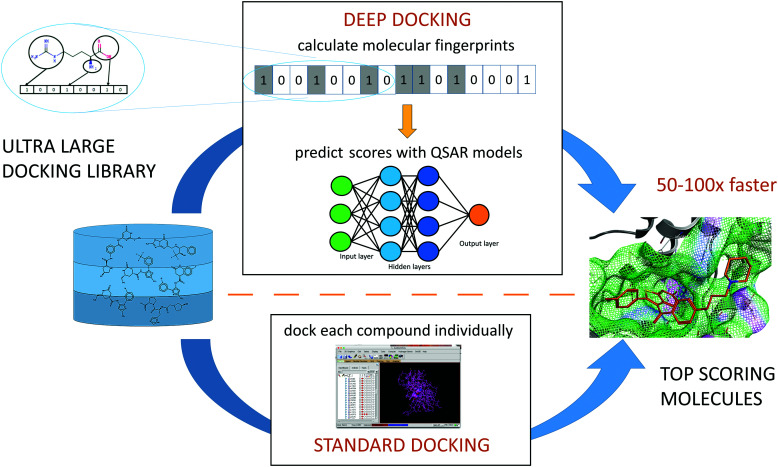
Fig. 4. Schematic representation of a Deep Docking (DD) workflow.
Fig. 5
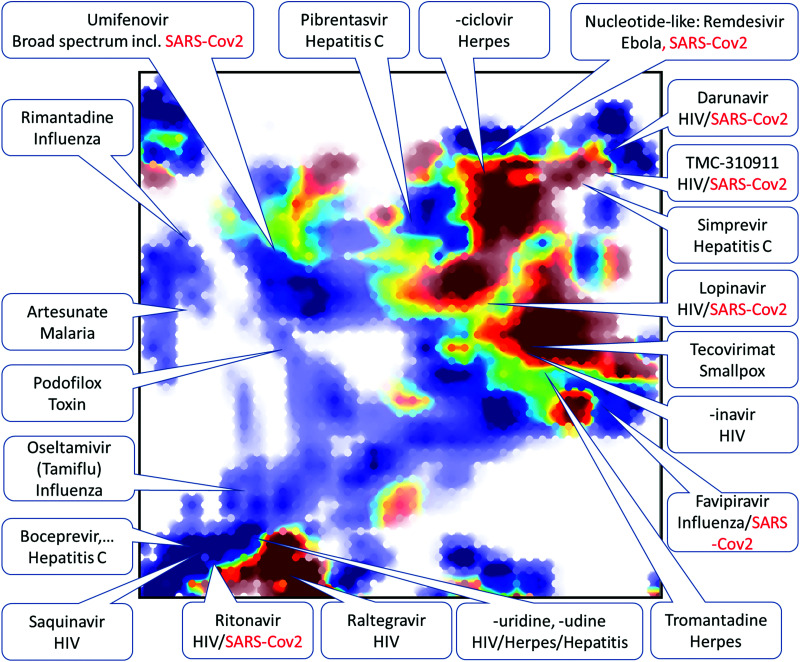
Fig. 5. Pool of 1000 compounds predicted to inhibit the 3CL proteinase of the novel SARS-CoV-2 (red) mapped against the SARS-CoV (betacoronavirus) compounds (blue). Location of several “antiviral” DrugBank molecules color-coded by their approval status (not-yet approved in red) is shown. Reproduced from ref. with permission from the WILEY, copyright 2021.
Fig. 6
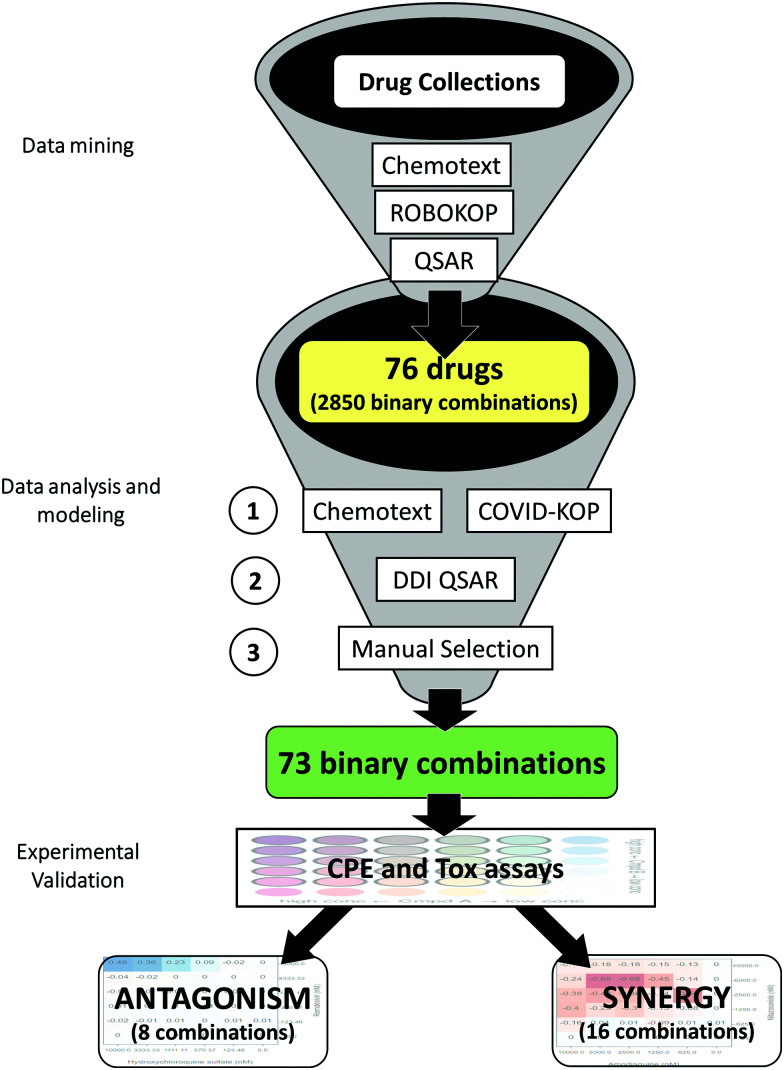
Fig. 6. Study design for identifying drug combinations. Reproduced from ref. with permission from the Cell Press, copyright 2021.
Fig. 7
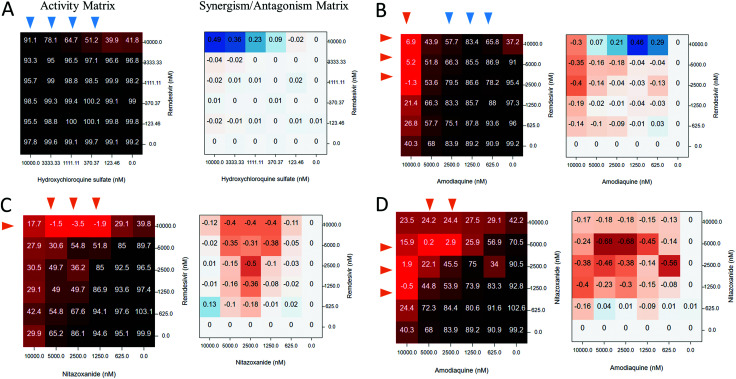
Fig. 7. Activity and synergy/antagonism matrices for selected drug combinations (A: Remdesivir + Hydroxychloroquine; B: Remdesivir + Amodiaquine; C: Nitazoxanide + Remdesivir; D; Nitazoxanide + Amodiaquine). Reproduced from ref. with permission from the Cell Press, copyright 2021.
Fig. 8
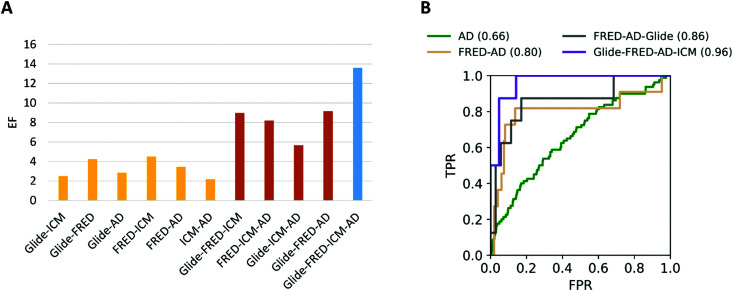
Fig. 8. (A) Enrichment factors for different consensus docking schemes applied to SARS-CoV-1 Mpro test set. (B) Receiver operating curves (ROC) for virtual screening using one software for docking and ranking (Autodock-GPU, AD, in green), and consensus docking using two (gold), three (grey) and four (purple) programs followed by ranking using the scoring function of the last indicate program for each strategy. Area under the curve (AUC) values are reported in brackets.
None
Artem Cherkasov
None
Alexander Tropsha

References

    1. Coronavirus Update (Live): 87,457,764 Cases and 1,887,064 Deaths from COVID-19 Virus Pandemic – Worldometer, https://www.worldometers.info/coronavirus/, accessed 17 June 2021

    1. SARS-CoV-2 Resources – NCBI, https://www.ncbi.nlm.nih.gov/sars-cov-2/, accessed 17 April 2021

    1. bioRxiv COVID-19 SARS-CoV-2 preprints from medRxiv and bioRxiv, https://connect.biorxiv.org/relate/content/181, accessed 3 June 2021

    1. Kwon D. Nature. 2020;581:130–131. - PubMed
    1. Dong Y. Dai T. Wei Y. Zhang L. Zheng M. Zhou F. Signal Transduction Targeted Ther. 2020;5:1–14. - PMC - PubMed

Substances