


Screening tools to expedite assessment of frailty in people receiving haemodialysis: a diagnostic accuracy study
- PMID: 34215211
- PMCID: PMC8252257
- DOI: 10.1186/s12877-021-02356-x
Screening tools to expedite assessment of frailty in people receiving haemodialysis: a diagnostic accuracy study
Abstract
Background: Frailty is associated with multiple adverse outcomes in stage-5 chronic kidney disease (CKD-5) and upwards of one third of people receiving haemodialysis (HD) are frail. While many frailty screening methods are available in both uremic and non-uremic populations, their implementation in clinical settings is often challenged by time and resource constraints. In this study, we explored the diagnostic accuracy of time-efficient screening tools in people receiving HD.
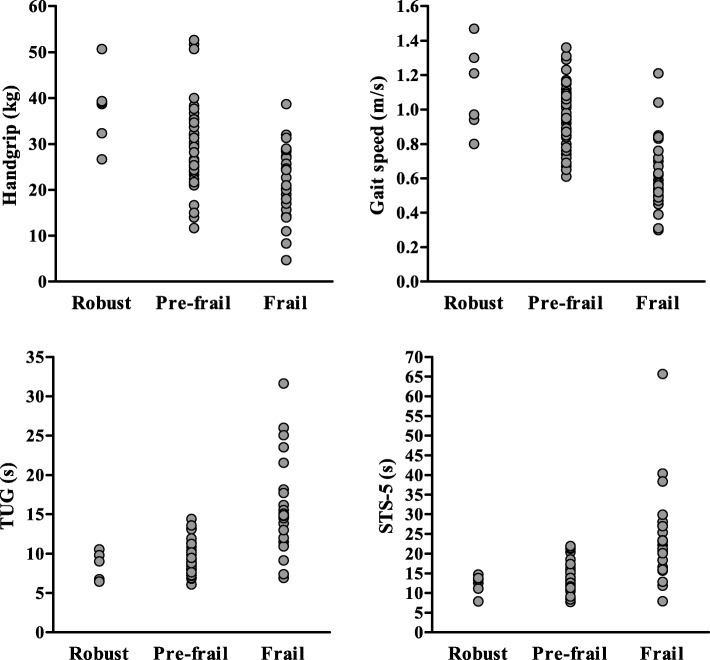
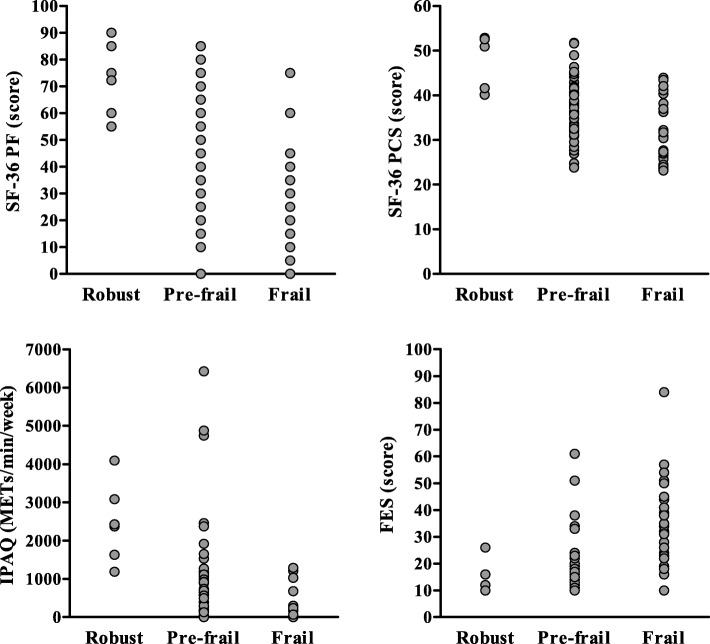
Methods: A convenience sample of 76 people receiving HD [mean age = 61.1 years (SD = 14), 53.9% male] from three Renal Units were recruited for this cross-sectional study. Frailty was diagnosed by means of the Fried phenotype. Physical performance-based screening tools encompassed handgrip strength, 15-ft gait speed, timed up and go (TUG), and five-repetition sit to stand (STS-5) tests. In addition, participants completed the SF-36 Health Survey, the short-form international physical activity questionnaire and the Tinetti falls efficacy scale (FES) as further frailty-related measures. Outcome measures included the area under the curve (AUC), sensitivity, specificity, positive (PPV) and negative predictive values (NPV). The diagnostic performance of screening tools in assessing fall-risk was also investigated.
Results: Overall, 36.8% of participants were classified as frail. All the examined instruments could significantly discriminate frailty status in the study population. Gait speed [AUC = 0.89 (95%CI: 0.81-0.98), sensitivity = 75%, specificity = 93%] and TUG [AUC = 0.90 (95%CI: 0.80-0.99), sensitivity = 89%, specificity = 85%] exhibited the highest diagnostic accuracy. There was a significant difference in gait speed AUC (20%, p = 0.013) between participants aged 65 years or older (n = 36) and those under 65 years of age (n = 40), with better discriminating performance in the younger sub-group. The Tinetti FES was the only instrument showing good diagnostic accuracy (AUCs≥0.80) for both frailty (sensitivity = 82%, specificity = 79%) and fall-risk (sensitivity = 82%, specificity = 71%) screening.
Conclusions: This cross-sectional study revealed that time- and cost-efficient walking performance measures can accurately be used for frailty-screening purposes in people receiving HD. While self-selected gait speed had an excellent performance in people under 65 years of age, TUG may be a more suitable screening method for elderly patients (≥65 years). The Tinetti FES may be a clinically useful test when physical testing is not achievable.
Keywords: Accidental falls; Elderly, frail; Frailty; Hemodialysis; Kidney failure, chronic.
Conflict of interest statement
The authors declare that they have no competing interests.
Figures
References
Publication types
MeSH terms
LinkOut - more resources
Full Text Sources
Miscellaneous
