. 2021 Jul 6;118(27):e2026152118.
doi: 10.1073/pnas.2026152118.

Loss of function of a DMR6 ortholog in tomato confers broad-spectrum disease resistance

Affiliations

Loss of function of a DMR6 ortholog in tomato confers broad-spectrum disease resistance

Daniela Paula de Toledo Thomazella et al. Proc Natl Acad Sci U S A. .

Abstract

Plant diseases are among the major causes of crop yield losses around the world. To confer disease resistance, conventional breeding relies on the deployment of single resistance (R) genes. However, this strategy has been easily overcome by constantly evolving pathogens. Disabling susceptibility (S) genes is a promising alternative to R genes in breeding programs, as it usually offers durable and broad-spectrum disease resistance. In Arabidopsis, the S gene DMR6 (AtDMR6) encodes an enzyme identified as a susceptibility factor to bacterial and oomycete pathogens. Here, we present a model-to-crop translational work in which we characterize two AtDMR6 orthologs in tomato, SlDMR6-1 and SlDMR6-2. We show that SlDMR6-1, but not SlDMR6-2, is up-regulated by pathogen infection. In agreement, Sldmr6-1 mutants display enhanced resistance against different classes of pathogens, such as bacteria, oomycete, and fungi. Notably, disease resistance correlates with increased salicylic acid (SA) levels and transcriptional activation of immune responses. Furthermore, we demonstrate that SlDMR6-1 and SlDMR6-2 display SA-5 hydroxylase activity, thus contributing to the elucidation of the enzymatic function of DMR6. We then propose that SlDMR6 duplication in tomato resulted in subsequent subfunctionalization, in which SlDMR6-2 specialized in balancing SA levels in flowers/fruits, while SlDMR6-1 conserved the ability to fine-tune SA levels during pathogen infection of the plant vegetative tissues. Overall, this work not only corroborates a mechanism underlying SA homeostasis in plants, but also presents a promising strategy for engineering broad-spectrum and durable disease resistance in crops.

Keywords: CRISPR/Cas9 technology; DMR6; crop engineering; disease resistance; salicylic acid.


Conflict of interest statement

The authors declare no competing interest.

Figures
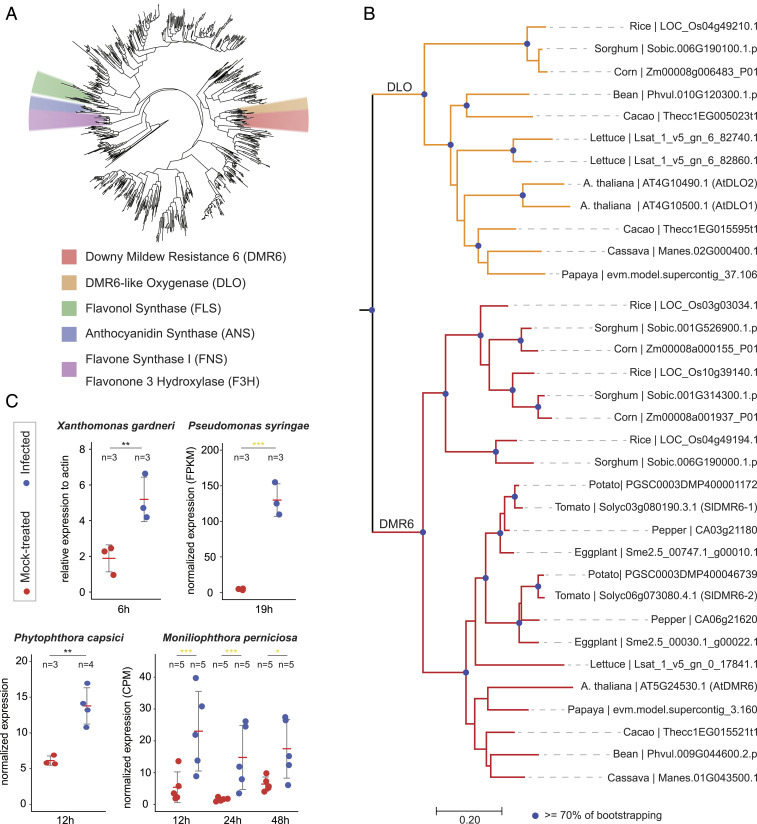
Fig. 1.
Fig. 1.
Identification and expression analyses of AtDMR6 orthologs in tomato. (A) Phylogenetic tree of the 2-ODD in plants. The 2-ODD homologs collected from 13 different plant species were used to infer the tree. The clades that contain functionally known 2-ODD members, including DMR6, DLO, FLS, ANS, FNS, and F3H, are annotated in different colors. (B) Phylogenetic tree of the DMR6 and DLO clades. The DMR6 and DLO clades were zoomed in from the phylogenetic tree given in A. The blue dots on the nodes indicate bootstrap values ≥ 70. (C) Up-regulation of SlDMR6-1 gene in response to different pathogens: X. gardneri (P = 0.0012), P. syringae (FDR = 2.69E-95), P. capsici (P = 0.00419), and M. perniciosa (FDR12h = 6E-4, FDR24h = 3.27E-7, FDR48h = 0.045). SlDMR6-2 was not expressed or did not appear among the DEGs under the tested conditions. FDRs and P values are represented by yellow and gray asterisks, respectively. ns, not significant, P/FDR ≥ 0.05; *P/FDR < 0.05; **P/FDR < 0.01; ***P/FDR <0.001. Gene-expression values for P. syringae, P. capsici, and M. perniciosa were obtained from public transcriptome data (–45) and were differentially normalized. X. gardneri gene expression was obtained by qPCR (SI Appendix, Materials and Methods).
Fig. 2.
Fig. 2.
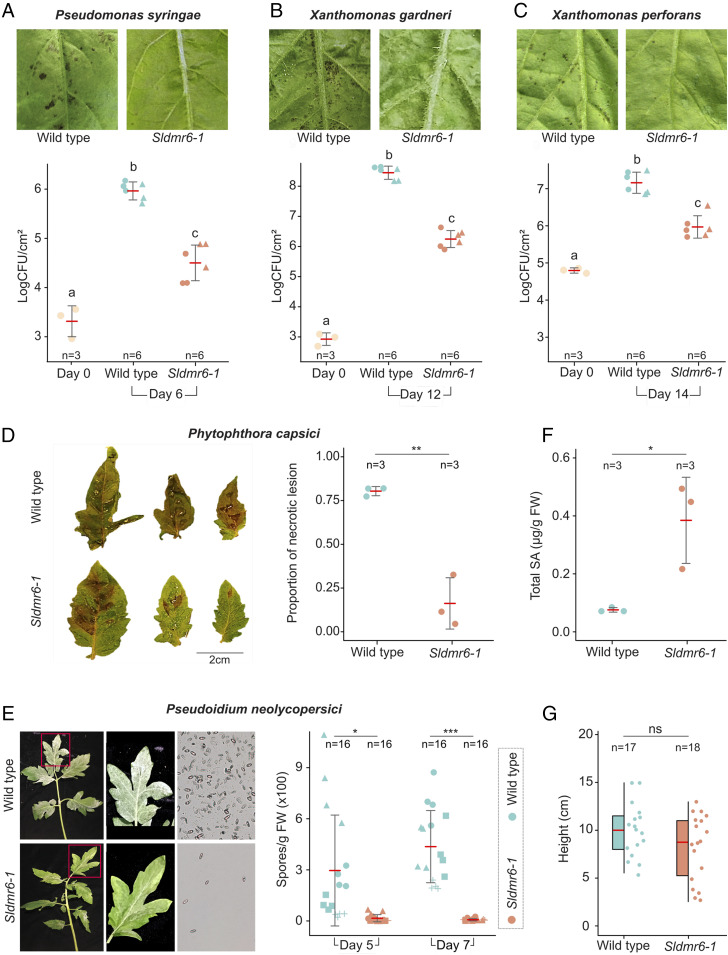
SlDMR6-1 inactivation in tomato leads to broad-spectrum disease resistance. Disease symptoms and resistance assays with the bacterial pathogens (A) P. syringae pv. tomato DC3000, (B) X. gardneri 153, and (C) X. perforans 4b, (D) the oomycete P. capsici LT1534 isolate (P = 0.00172), and (E) the fungus P. neolycopersici MF-1 isolate (PDay5 = 0.0037, PDay7 = 1.5E-06). Fungal spores in E were imaged using an epifluorescence microscope with 5× lens. All these pathogens show reduced growth or cause less disease symptoms in the Sldmr6-1 mutants. The letters indicate significant differences between the conditions as determined using a one-way ANOVA followed by a Tukey honest significant difference (HSD) test (P < 0.05). Symbols (circles, triangles, and squares) represent leaves from different plants. (F) Total SA content is shown for Fla. 8000 wild-type plants and Sldmr6-1 mutants (P value = 0.023) in response to X. gardneri infection. (G) Quantification of the heights of wild-type and Sldmr6-1 lines (P = 0.121) grown under laboratory conditions. Asterisks represent significant P values from t tests: ns, not significant, P ≥ 0.05; *P < 0.05; **P < 0.01; ***P < 0.001.
Fig. 3.
Fig. 3.
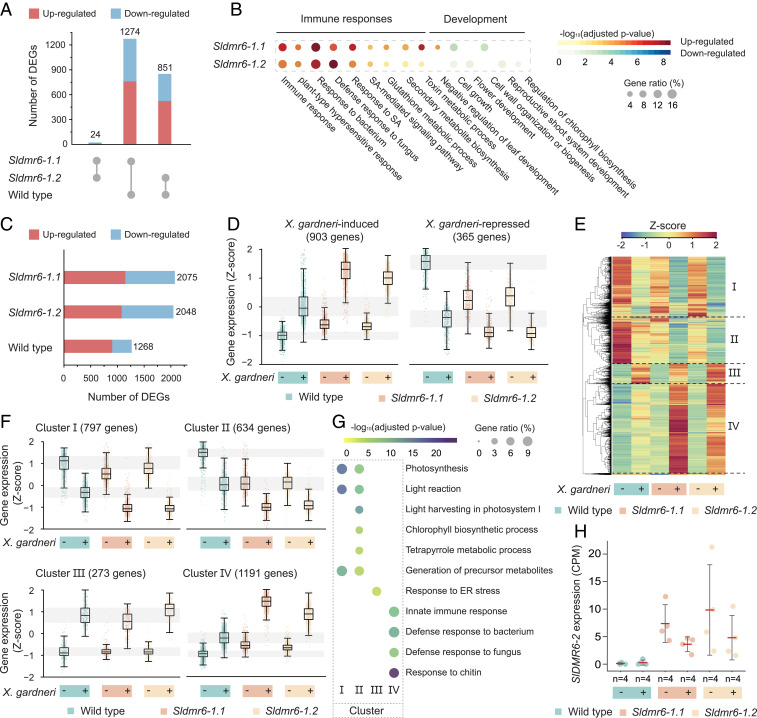
Large-scale reprogramming of the tomato transcriptome as a result of SlDMR6-1 inactivation. (A) Comparison of the number of DEGs among the wild-type, Sldmr6-1.1, and Sldmr6-1.2 lines. (B) Selected GO terms that are differentially represented in the Sldmr6-1 mutants. For a complete list of the GO enrichment analysis, please refer to Dataset S2. (C) Number of DEGs in the wild-type and Sldmr6-1 mutant lines in response to X. gardneri infection. (D) Genes up-regulated by pathogen infection are more expressed in the Sldmr6-1 lines than in wild-type plants. Similarly, down-regulated genes are less expressed in the mutants. (E) Hierarchical clustering showing groups of genes that respond to pathogen infection in the absence and presence of X. gardneri. The DEGs were classified into four clusters (I to IV). (F) Details of each hierarchical cluster. Clusters I and II consist of genes that are down-regulated by the pathogen infection in all three genotypes. In particular, genes in cluster II are repressed in the Sldmr6-1 mutants even before infection. Similarly, clusters III and IV show genes that are up-regulated by pathogen. Particularly, genes in cluster IV are slightly activated in the Sldmr6-1 mutants before infection and more expressed in response to pathogen infection. (G) Selected GO terms that are differentially represented in the four different clusters from E and F. For a complete list of the GO enrichment analysis, please refer to Dataset S5. (H) Comparison of SlDMR6-2 expression in the wild-type, Sldmr6-1.1, and Sldmr6-1.2 lines (FDR < 0.05). Units are shown as counts per millions (CPMs) normalized using the trimmed mean of M-values (TMM) in edgeR.
Fig. 4.
Fig. 4.
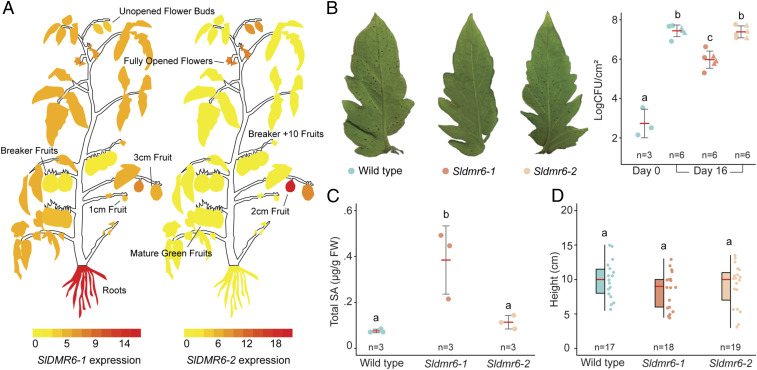
SlDMR6-2 does not have immunity-related functions. (A) Expression pattern of SlDMR6-1 and SlDMR6-2 in different tissues/organs of wild-type tomato plants. The figure was generated using the ePlant Tomato Tool (bar.utoronto.ca/eplant_tomato/). (B) Disease symptoms and resistance assay with the bacteria X. gardneri (strain 153) showing that SlDMR6-2 inactivation does not interfere with disease resistance. (C) Total SA content is shown for Fla. 8000 wild-type plants, Sldmr6-1 and Sldmr6-2 mutants, in response to X. gardneri infection. (D) Quantification of the heights of wild-type, Sldmr6-1, and Sldmr6-2 lines grown under laboratory conditions. The letters indicate significant differences between the conditions as determined using a one-way ANOVA followed by a Tukey HSD test (P < 0.05).
Fig. 5.
Fig. 5.
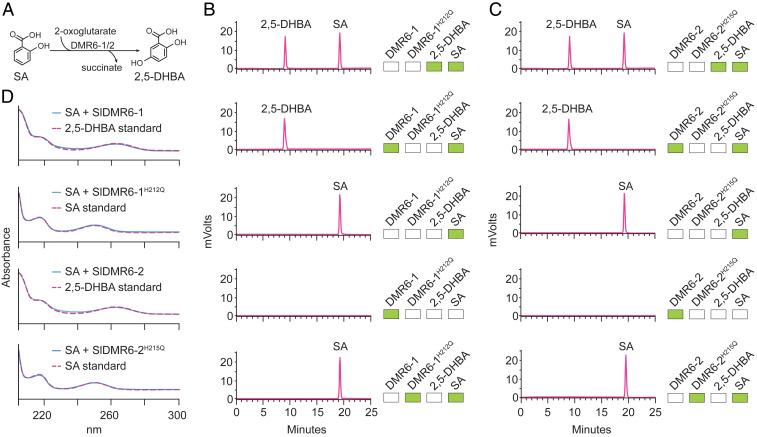
SlDMR6-1 and SlDMR6-2 catalyze the conversion of SA to 2,5-DHBA. (A) The reaction catalyzed by SlDMR6-1 and SlDMR6-2 showing the hydroxylation of SA at carbon 5 with the subsequent formation of 2,5-DHBA. (B) HPLC profile of the standards 2,5-DHBA and SA (first panel). SA is converted to 2,5-DHBA by the recombinant SlDMR6-1 protein (second panel), but not in the control reaction with no enzyme (third panel). Enzyme preparation contained no contaminants (fourth panel). Mutation of the active site of SlDMR6-1 (SlDMR6-1 H212Q) prevents the conversion of SA to 2,5-DHBA (fifth panel). (C) HPLC profile of the standards 2,5-DHBA and SA (first panel). SA is converted to 2,5-DHBA by the recombinant SlDMR6-2 protein (second panel), but not in the control reaction with no enzyme (third panel). Enzyme preparation contained no contaminants (fourth panel). Mutation of the active site of SlDMR6-2 (SlDMR6-2 H215Q) prevents the conversion of SA to 2,5-DHBA (fifth panel). The green boxes in B and C indicate the presence of that compound in the reaction mixture. (D) Comparison of the absorbance spectra of SA/2,5-DHBA standards to the products of the enzyme assays. The absorbance spectra of the enzymatic product 2,5-DHBA from B and C are identical to that of the 2,5-DHBA standards. All reactions were repeated at least three times and representative data are shown.
Fig. 6.
Fig. 6.
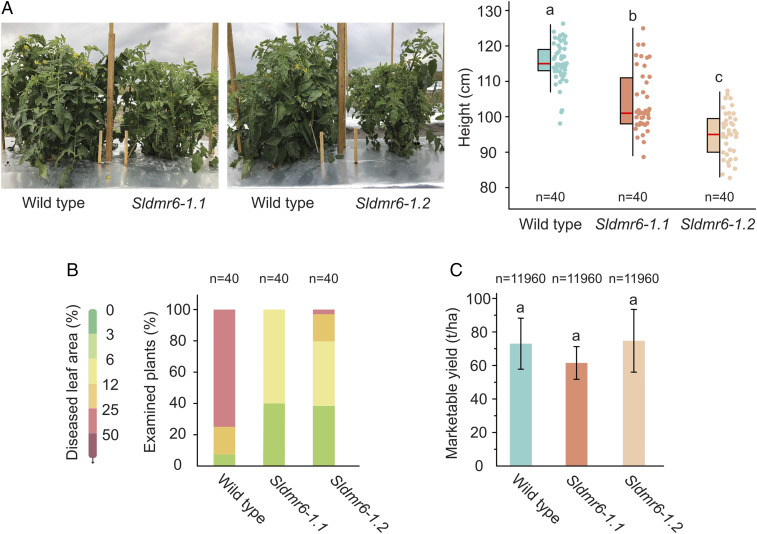
Sldmr6-1 mutants are resistant to Xanthomonas infection in the field. (A) Growth phenotype and quantification of the heights of wild-type, Sldmr6-1.1, and Sldmr6-1.2 lines. (B) Disease resistance assays with the bacteria X. perforans race T4 (106 CFU per milliliter of each of strains GEV904, GEV917, GEV1001, GEV1063). (C) Comparison of the total marketable yield of wild-type plants and Sldmr6-1.1 and Sldmr6-1.2 mutant lines. Total marketable yield includes the medium, large, and extra-large fruit categories, which are defined according to the US Department of Agriculture specifications (49). No significant differences in total marketable yield were observed in this field trial (P > 0.05). Error bars represent SD. The letters indicate significant differences between the conditions as determined using a one-way ANOVA followed by a Tukey HSD test (P < 0.05).

References

    1. Savary S., et al., The global burden of pathogens and pests on major food crops. Nat. Ecol. Evol. 3, 430–439 (2019). - PubMed
    1. van Esse H. P., Reuber T. L., van der Does D., Genetic modification to improve disease resistance in crops. New Phytol. 225, 70–86 (2020). - PMC - PubMed
    1. Dangl J. L., Horvath D. M., Staskawicz B. J., Pivoting the plant immune system from dissection to deployment. Science 341, 746–751 (2013). - PMC - PubMed
    1. Fuchs M., Pyramiding resistance-conferring gene sequences in crops. Curr. Opin. Virol. 26, 36–42 (2017). - PubMed
    1. Mundt C. C., Pyramiding for resistance durability: Theory and practice. Phytopathology 108, 792–802 (2018). - PubMed

Publication types

MeSH terms