. 2021 Nov;14(6):2288-2299.
doi: 10.1111/cts.13088. Epub 2021 Jul 3.

Pharmacometabolomics identifies candidate predictor metabolites of an L-carnitine treatment mortality benefit in septic shock

Collaborators, Affiliations

Pharmacometabolomics identifies candidate predictor metabolites of an L-carnitine treatment mortality benefit in septic shock

Michael A Puskarich et al. Clin Transl Sci. 2021 Nov.

Abstract

Sepsis-induced metabolic dysfunction contributes to organ failure and death. L-carnitine has shown promise for septic shock, but a recent phase II study of patients with vasopressor-dependent septic shock demonstrated a non-significant reduction in mortality. We undertook a pharmacometabolomics study of these patients (n = 250) to identify metabolic profiles predictive of a 90-day mortality benefit from L-carnitine. The independent predictive value of each pretreatment metabolite concentration, adjusted for L-carnitine dose, on 90-day mortality was determined by logistic regression. A grid-search analysis maximizing the Z-statistic from a binomial proportion test identified specific metabolite threshold levels that discriminated L-carnitine responsive patients. Threshold concentrations were further assessed by hazard ratio and Kaplan-Meier estimate. Accounting for L-carnitine treatment and dose, 11 1 H-NMR metabolites and 12 acylcarnitines were independent predictors of 90-day mortality. Based on the grid-search analysis numerous acylcarnitines and valine were identified as candidate metabolites of drug response. Acetylcarnitine emerged as highly viable for the prediction of an L-carnitine mortality benefit due to its abundance and biological relevance. Using its most statistically significant threshold concentration, patients with pretreatment acetylcarnitine greater than or equal to 35 µM were less likely to die at 90 days if treated with L-carnitine (18 g) versus placebo (p = 0.01 by log rank test). Metabolomics also identified independent predictors of 90-day sepsis mortality. Our proof-of-concept approach shows how pharmacometabolomics could be useful for tackling the heterogeneity of sepsis and informing clinical trial design. In addition, metabolomics can help understand mechanisms of sepsis heterogeneity and variable drug response, because sepsis induces alterations in numerous metabolite concentrations.


Conflict of interest statement

The authors declared no competing interests for this work.

Figures
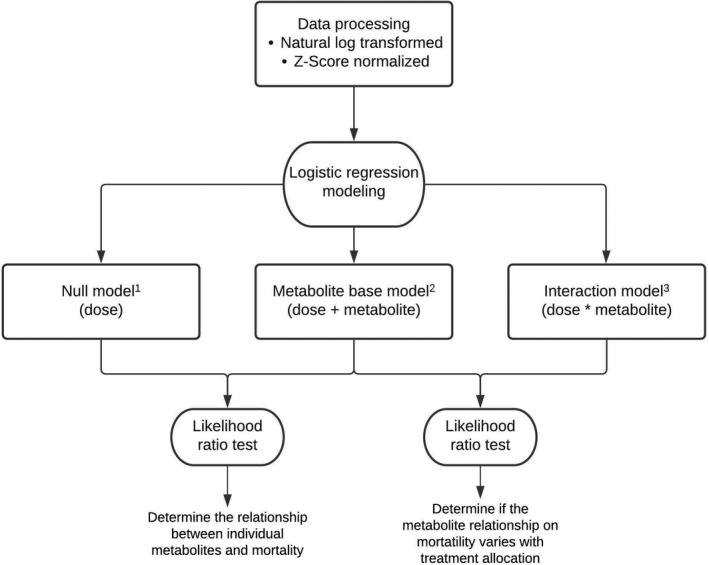
FIGURE 1
FIGURE 1
Statistical and logistic regression modeling workflow. We first natural log transformed and normalized each metabolite to have a mean of 0 and SD of 1. For each metabolite, we then considered a series of logistic regression models with an outcome of 90‐day mortality (p). The full model descriptions are provided below. In the metabolite base model, the p value corresponds to the likelihood ratio test for inclusion of the metabolite coefficient, BM, compared to the nested null model with only L‐carnitine dose (BD) as a predictor. For the interaction model, the p value corresponds to the likelihood ratio test for inclusion of the interaction coefficient, BMD, compared to a nested model with dose (BD) and metabolite concentration (BM) as predictors. 1Null model: logit(p) = B0 + BD * Dose. 2Metabolite base model: logit(p) = B0 + BD * Dose + BM * Metabolitei. 3Interaction model: logit(p) = B0 + BD * Dose + BM * Metabolitei + BMD * Metabolitei * Dose
FIGURE 2
FIGURE 2
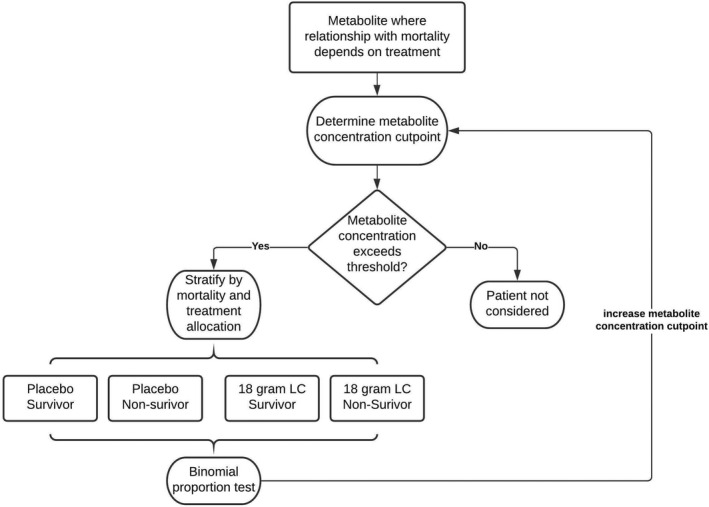
Grid‐search methodology workflow. After identifying metabolites with the strongest interaction in the logistic regression modeling, the metabolite concentration threshold or cut point that maximized the interaction was determined. For every possible threshold concentration, patients randomized to receive either placebo or 18 g L‐carnitine were considered. For patients whose values exceeded the concentration threshold, we stratified patients by treatment allocation and 90‐day mortality status and calculated the Z‐statistic from the two‐sample binomial proportion test. This was done iteratively for each metabolite, and the maximum Z‐statistic was identified from the grid‐search (see Table 4). LC, L‐carnitine
FIGURE 3
FIGURE 3
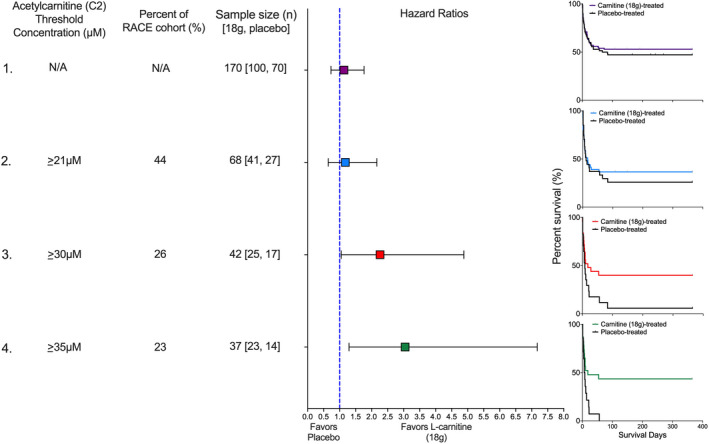
Pretreatment acetylcarnitine (C2) concentration as a predictive clinical trial enrichment strategy. Four scenarios illustrate how different threshold concentrations of acetylcarnitine (C2), a high abundant acylcarnitine would have impacted the outcome of the Rapid Administration of Carnitine (RACE) in Sepsis clinical trial in patients treated with either L‐carnitine (18 g) or placebo. In scenario one, no threshold concentration is used so the entire RACE cohort (n = 236) is eligible. The sample size of 170 patients represents those that received either L‐carnitine (18 g; n = 100) or placebo (n = 70). The hazard ratio is not significant, and consistent with the parent trial, the Kaplan‐Meier curve shows no mortality benefit of L‐carnitine (= 0.57). In scenario two, an acetylcarnitine (C2) threshold concentration of greater than 21 µM is used. Forty‐four percent (n = 104) of the RACE cohort met this criterion and of these, 68 patients received either L‐carnitine (18 g) or placebo. The hazard ratio is not improved, and the Kaplan‐Meier curve shows no mortality benefit of L‐carnitine (= 0.59). In scenario three, an acetylcarnitine (C2) threshold concentration of greater than 30 µM is used. Twenty‐seven percent (n = 64) of the RACE cohort met this criterion and of these, 42 patients received either L‐carnitine (18 g) or placebo. The hazard ratio is significant and favors L‐carnitine (18 g); the Kaplan‐Meier curve shows a mortality benefit of L‐carnitine (= 0.04). Finally, scenario four uses the acetylcarnitine (C2) concentration associated with the maximum Z‐statistic (Table S4), greater than 35 µM. Twenty‐three percent (n = 54) of the RACE cohort met this criterion and of these, 37 patients received either L‐carnitine (18 g) or placebo. The hazard ratio is significant, and the Kaplan‐Meier curve shows a mortality benefit of L‐carnitine (= 0.01). The number of patients at risk at each time point and the number of censored subjects, which was due to the end of the study (1 year), can be found here: https://doi.org/10.7302/vvqp‐ma61. N/A, not applicable
FIGURE 4
FIGURE 4
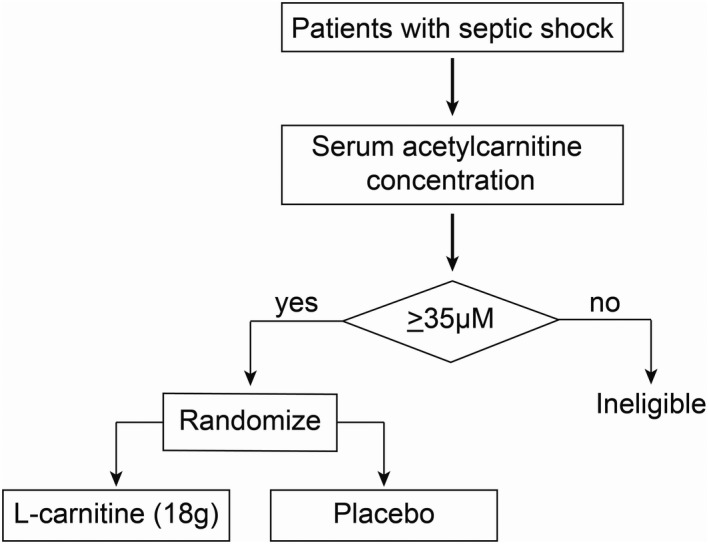
A clinical trial enrichment strategy could optimize clinical trial design for heterogeneous critical illnesses like sepsis. An example of a scheme for a hypothetical phase III clinical trial of supplement L‐carnitine for the treatment of septic shock that uses an a priori determined acetylcarnitine (C2) threshold concentration to determine whether a patient is enrolled and randomized to receive either L‐carnitine (18 g) or placebo

References

    1. Fleischmann C, Scherag A, Adhikari NKJ, et al. Assessment of global incidence and mortality of hospital‐treated sepsis. current estimates and limitations. Am J Respir Crit Care Med. 2016;193:259‐272. - PubMed
    1. Gaieski DF, Edwards JM, Kallan MJ, Carr BG. Benchmarking the incidence and mortality of severe sepsis in the United States. Crit Care Med. 2013;41:1167‐1174. - PubMed
    1. Rudd KE, Johnson SC, Agesa KM, et al. Global, regional, and national sepsis incidence and mortality, 1990–2017: analysis for the Global Burden of Disease Study. Lancet. 2020;395:200‐211. - PMC - PubMed
    1. Langley RJ, Tipper JL, Bruse S, et al. Integrative "omic" analysis of experimental bacteremia identifies a metabolic signature that distinguishes human sepsis from systemic inflammatory response syndromes. Am J Respir Crit Care Med. 2014;190:445‐455. - PMC - PubMed
    1. Singer M, Deutschman CS, Seymour CW, et al. The third international consensus definitions for sepsis and septic shock (Sepsis‐3). JAMA. 2016;315:801‐810. - PMC - PubMed

Publication types