. 2021 Oct 15:345:130372.
doi: 10.1016/j.snb.2021.130372. Epub 2021 Jun 29.

Development of an ultrasensitive fluorescent immunochromatographic assay based on multilayer quantum dot nanobead for simultaneous detection of SARS-CoV-2 antigen and influenza A virus

Affiliations

Development of an ultrasensitive fluorescent immunochromatographic assay based on multilayer quantum dot nanobead for simultaneous detection of SARS-CoV-2 antigen and influenza A virus

Chongwen Wang et al. Sens Actuators B Chem. .

Abstract

Rapid and accurate diagnosis of severe acute respiratory syndrome coronavirus 2 (SARS-CoV-2) and influenza A virus (FluA) antigens in the early stages of virus infection is the key to control the epidemic spread. Here, we developed a two-channel fluorescent immunochromatographic assay (ICA) for ultrasensitive and simultaneous qualification of the two viruses in biological samples. A high-performance quantum dot nanobead (QB) was fabricated by adsorption of multilayers of dense quantum dots (QDs) onto the SiO2 surface and used as the highly luminescent label of the ICA system to ensure the high-sensitivity and stability of the assay. The combination of monodispersed SiO2 core (∼180 nm) and numerous carboxylated QDs formed a hierarchical shell, which ensured that the QBs possessed excellent stability, superior fluorescence signal, and convenient surface functionalization. The developed ICA biosensor achieved simultaneous detection of SARS-CoV-2 and FluA in one test within 15 min, with detection limits reaching 5 pg/mL for SARS-CoV-2 antigen and 50 pfu/mL for FluA H1N1. Moreover, our method showed high accuracy and specificity in throat swab samples with two orders of magnitude improvement in sensitivity compared with traditional AuNP-based ICA method. Hence, the proposed method is a promising and convenient tool for detection of respiratory viruses.

Keywords: FluA; Immunochromatographic assay; Multilayer quantum dot; SARS-CoV-2; Simultaneous detection.


Conflict of interest statement

The authors declare that they have no known competing financial interests or personal relationships that could have appeared to influence the work reported in this paper.

Figures
Scheme 1
Scheme 1
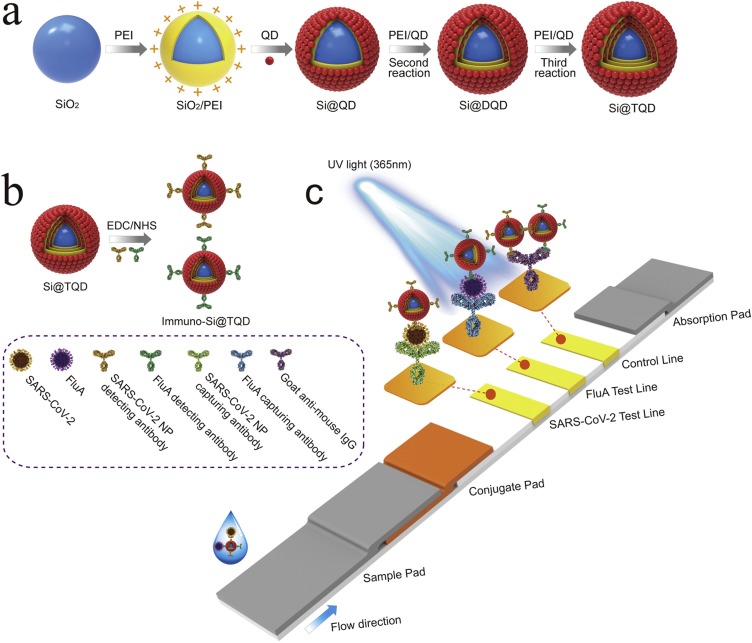
Fabrication of SiTQD probes and their application to ICA-based biosensor for simultaneous detection of SARS-CoV-2 and FluA. (a) Synthesis of SiTQD nanocomposite, (b) preparation of immuno-SiTQD probes, and (c) operating principle of SiTQD-ICA strip for detecting two target respiratory viruses.
Fig. 1
Fig. 1
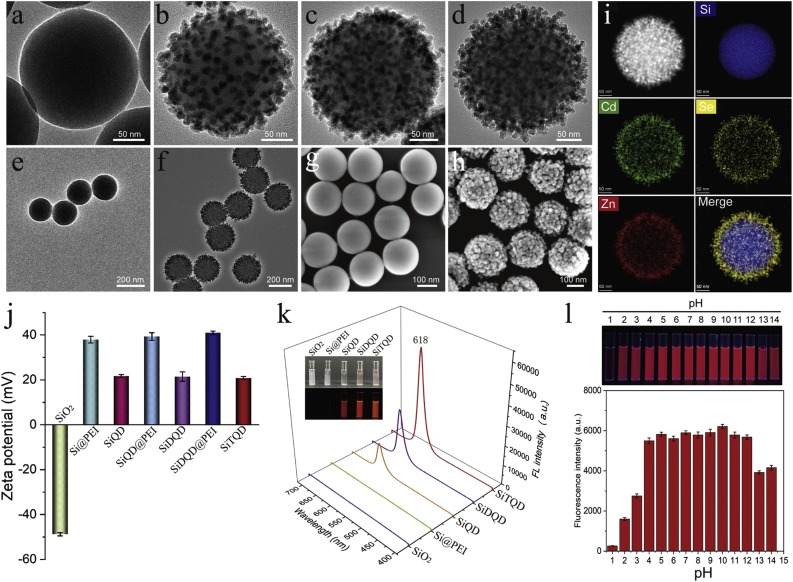
Characterization of the fabricated SiTQD nanocomposite. TEM images of (a) single SiO2 core, (b) SiQD, (c) SiDQD, and (d) SiTQD nanocomposite. TEM images of multiple (e) SiO2 NPs and (f) SiTQD NPs, and their corresponding SEM images (g) and (h), respectively. (i) EDS elemental (Si, Cd, Se, Zn) mapping images of a SiTQD NP. Zeta potentials (j) and fluorescence emission spectra (k) of the synthesized NPs from each stage. The inset in (k) displays the photographs of these NPs solution under visible (upper) and UV light (lower). (e) Fluorescence images and intensities of SiTQD at different pH values. (l) Photograph of SiTQD NPs at various pH values under UV light (upper) and their corresponding fluorescence intensities at maximum emission wavelength (lower).
Fig. 2
Fig. 2
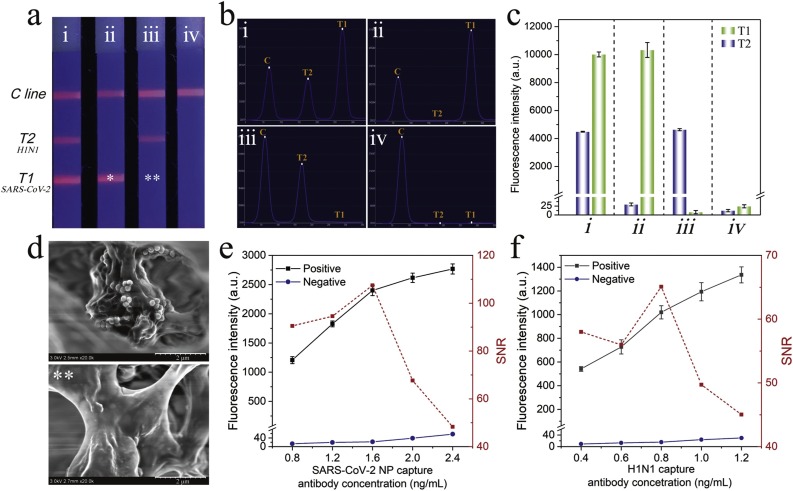
(a) Photograph, (b) corresponding scanning waveforms of fluorescence, (c) fluorescence intensity of SiTQD-based ICA with different concentration of SARS-CoV-2 NP antigen and FluA H1N1: (i) 10 ng/mL, 104 pfu/mL; (ii) 10 ng/mL, 0 pfu/mL; (iii) 0 ng/mL, 104 pfu/mL; and (iv) 0 ng/mL, 0 pfu/mL. (d) Typical SEM images of the test zone for SARS-CoV-2 NP antigen concentrations of 10 ng/mL (*) and 0 ng/mL (**). Optimization of (e) SARS-CoV-2 NP capture antibody and (f) FluA capture antibody concentration on the T line. The error bars showed standard deviations calculated from three tests.
Fig. 3
Fig. 3
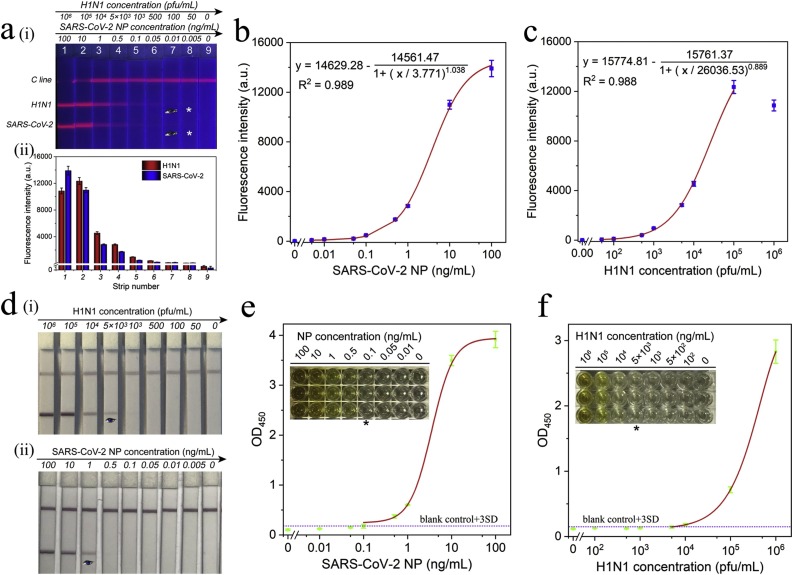
(a) Fluorescence pictures (i) and corresponding test line intensities (ii) of SiTQD-based ICA strip for SARS-CoV-2 NP antigen and H1N1 detection. Corresponding calibration curves for (b) SARS-CoV-2 NP antigen and (c) H1N1. The error bars represented standard deviations calculated from three experiments. (d) Photographs of colloidal gold-based ICA strips for different concentrations of (i) H1N1 and (ii) SARS-CoV-2 NP antigen detection. (e-f) ELISA analysis for SARS-CoV-2 NP antigen (e) and H1N1 detection (f). The insets are colorimetric results of ELISA plates for different concentrations of target virus antigens.
Fig. 4
Fig. 4
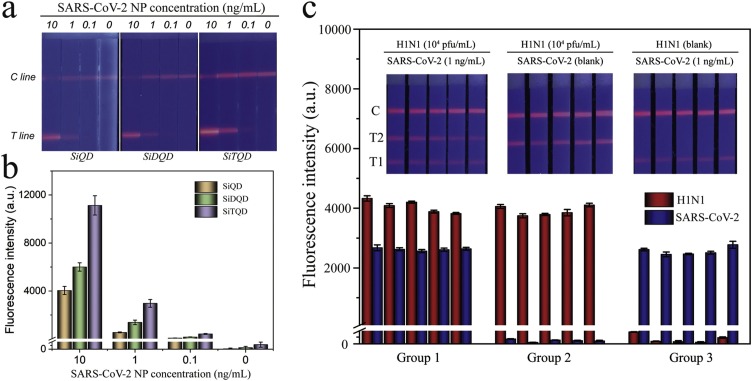
(a) Fluorescence pictures and (b) corresponding test line intensities of the SiQD-ICA, SiDQD-ICA and SiTQD-ICA strips for SARS-CoV-2 NP antigen detection. (c) Reproducibility of the SiTQD-ICA for H1N1 and SARS-CoV-2 NP.
Fig. 5
Fig. 5
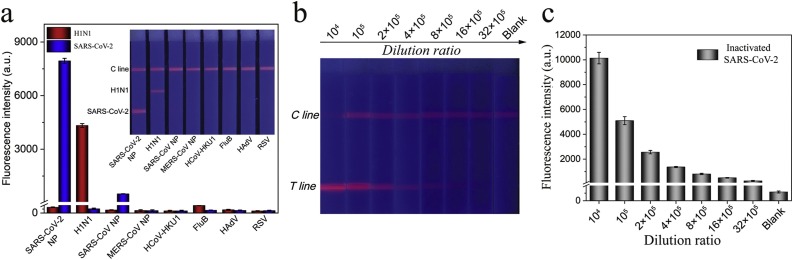
(a) Specificity of SiTQD-based ICA. (b) Fluorescence pictures and (c) corresponding test line intensities of SiTQD-based ICA for inactivated SARS-CoV-2 samples. Error bars are calculated from three experiments.

References

    1. Singh N.K., Ray P., Carlin A.F., Magallanes C., Morgan S.C., Laurent L.C., et al. Hitting the diagnostic sweet spot: point-of-care SARS-CoV-2 salivary antigen testing with an off-the-shelf glucometer. Biosens. Bioelectron. 2021;180 - PMC - PubMed
    1. WHO. Coronavirus Disease 2019 (COVID-19): weekly epidemiological update. https://www.who.int/publications/m/item/weekly-epidemiological-update-on... (Accessed 6 April 2021).
    1. Patchsung M., Jantarug K., Pattama A., Aphicho K., Suraritdechachai S., Meesawat P., et al. Clinical validation of a Cas13-based assay for the detection of SARS-CoV-2 RNA. Nat. Biomed. Eng. 2020;4:1140–1149. - PubMed
    1. Wölfel R., Corman V.M., Guggemos W., Seilmaier M., Zange S., Müller M.A., et al. Virological assessment of hospitalized patients with COVID-2019. Nature. 2020;581:465–469. - PubMed
    1. Cui F., Zhou H.S. Diagnostic methods and potential portable biosensors for coronavirus disease 2019. Biosens. Bioelectron. 2020;165 - PMC - PubMed