An Overview of Reviews on Interprofessional Collaboration in Primary Care: Effectiveness
- PMID: 34220395
- PMCID: PMC8231476
- DOI: 10.5334/ijic.5588
An Overview of Reviews on Interprofessional Collaboration in Primary Care: Effectiveness
Abstract
Introduction: Interprofessional collaboration (IPC) is increasingly used but diversely implemented in primary care. We aimed to assess the effectiveness of IPC in primary care settings.
Methods: An overview (review of systematic reviews) was carried out. We searched nine databases and employed a double selection and data extraction method. Patient-related outcomes were categorized, and results coded as improvement (+), worsening (-), mixed results (?) or no change (0).
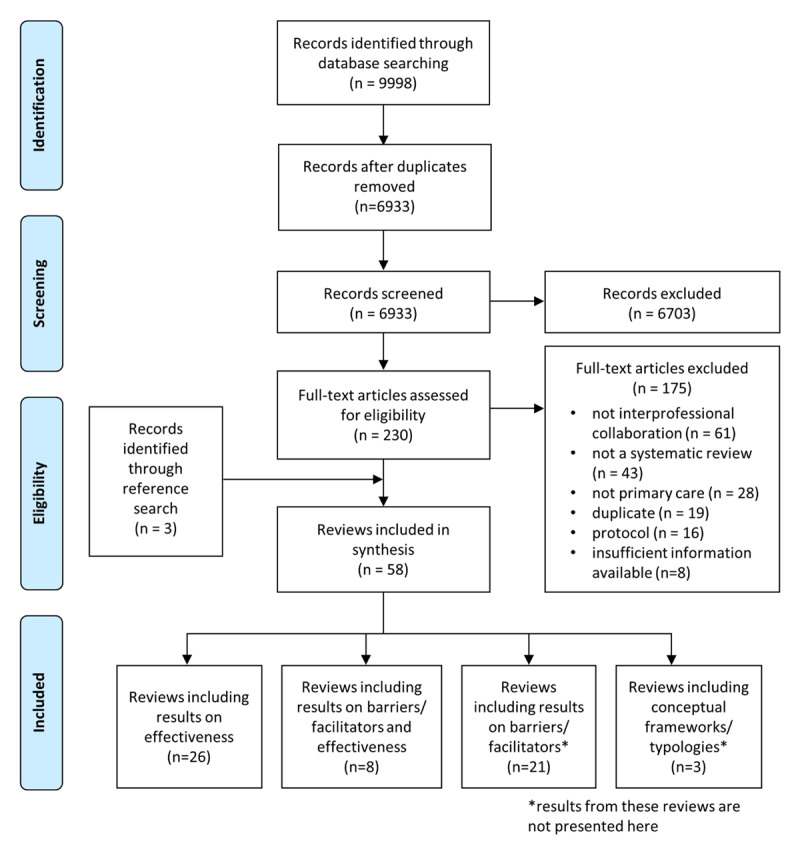
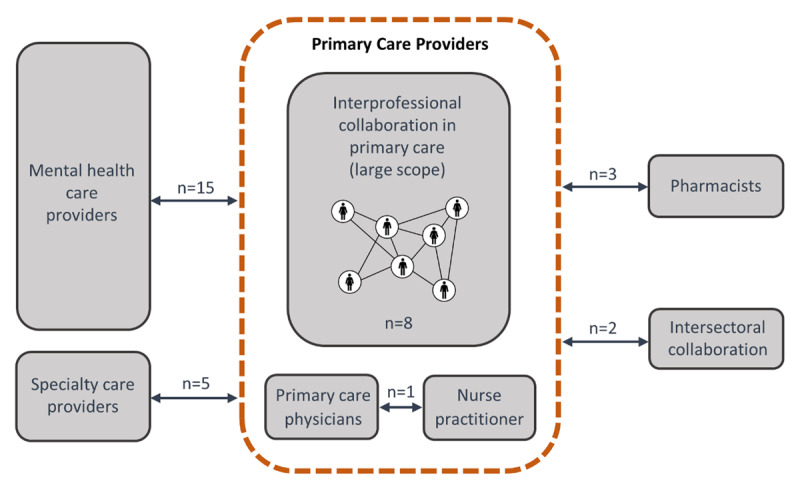
Results: 34 reviews were included. Six types of IPC were identified: IPC in primary care (large scope) (n = 8), physician-nurse in primary care (n = 1), primary care physician (PCP)-specialty care provider (n = 5), PCP-pharmacist (n = 3), PCP-mental healthcare provider (n = 15), and intersectoral collaboration (n = 2). In general, IPC in primary care was beneficial for patients with variation between types of IPC. Whereas reviews about IPC in primary care (large scope) showed better processes of care and higher patient satisfaction, other types of IPC reported mixed results for clinical outcomes, healthcare use and patient-reported outcomes. Also, reviews focusing on interventions based on pre-existing and well-defined models, such as collaborative care, overall reported more benefits. However, heterogeneity between the included primary studies hindered comparison and often led to the report of mixed results. Finally, professional- and organizational-related outcomes were under-reported, and cost-related outcomes showed some promising results for IPC based on pre-existing models; results were lacking for other types.
Conclusions: This overview suggests that interprofessional collaboration can be effective in primary care. Better understanding of the characteristics of IPC processes, their implementation, and the identification of effective elements, merits further attention.
Keywords: collaboration; effectiveness; interprofessional; overview; primary care; review.
Copyright: © 2021 The Author(s).
Conflict of interest statement
The authors have no competing interests to declare.
Figures
References
-
- Institute of Medicine. Committee on Quality of Health Care in America. Crossing the quality chasm: a new health system for the 21st century. National Academies Press. 2001.
-
- World Health Organization. Framework for action on interprofessional education & collaborative practice. 2010. - PubMed
-
- Way D, Jones L, Busing N. Implementation strategies: collaboration in primary care—family doctors & nurse practitioners delivering shared care. Toronto: Ontario College of family physicians. 2000; 8.
LinkOut - more resources
Full Text Sources