. 2021 Jun 18:15:706713.
doi: 10.3389/fnint.2021.706713. eCollection 2021.

The Paraventricular Thalamus as a Critical Node of Motivated Behavior via the Hypothalamic-Thalamic-Striatal Circuit

Affiliations

The Paraventricular Thalamus as a Critical Node of Motivated Behavior via the Hypothalamic-Thalamic-Striatal Circuit

Amanda G Iglesias et al. Front Integr Neurosci. .

Abstract

In this review, we highlight evidence that supports a role for the paraventricular nucleus of the thalamus (PVT) in motivated behavior. We include a neuroanatomical and neurochemical overview, outlining what is known of the cellular makeup of the region and its most prominent afferent and efferent connections. We discuss how these connections and distinctions across the anterior-posterior axis correspond to the perceived function of the PVT. We then focus on the hypothalamic-thalamic-striatal circuit and the neuroanatomical and functional placement of the PVT within this circuit. In this regard, the PVT is ideally positioned to integrate information regarding internal states and the external environment and translate it into motivated actions. Based on data that has emerged in recent years, including that from our laboratory, we posit that orexinergic (OX) innervation from the lateral hypothalamus (LH) to the PVT encodes the incentive motivational value of reward cues and thereby alters the signaling of the glutamatergic neurons projecting from the PVT to the shell of the nucleus accumbens (NAcSh). The PVT-NAcSh pathway then modulates dopamine activity and resultant cue-motivated behaviors. As we and others apply novel tools and approaches to studying the PVT we will continue to refine the anatomical, cellular, and functional definitions currently ascribed to this nucleus and further elucidate its role in motivated behaviors.

Keywords: associative learning; incentive salience; lateral hypothalamus; motivation; nucleus accumbens; paraventricular thalamus; reward.


Conflict of interest statement

The authors declare that the research was conducted in the absence of any commercial or financial relationships that could be construed as a potential conflict of interest.

Figures
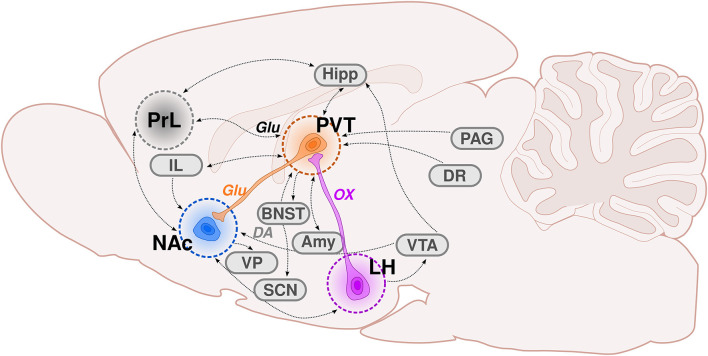
Figure 1
Figure 1
The PVT as a critical node of the hypothalamic-thalamic-striatal circuit. This graphic illustrates the afferents and efferents associated with the paraventricular nucleus of the thalamus (PVT), with an emphasis on the hypothalamic-thalamic-striatal circuit. The purple neuron represents orexinergic (OX) innervation from the lateral hypothalamus (LH)-PVT. The orange neuron is illustrating glutamatergic (Glu) innervation from the PVT-nucleus accumbens (NAc). The blue circle depicts the NAc, which receives substantial innervation from the PVT. The gray circle represents the anatomical location of the prelimbic cortex (PrL), which sends dense glutamatergic innervation to the PVT. The dotted black lines throughout the schematic depict neuronal connections, some of which are reciprocal (double arrow). Amy, amygdala; BNST, bed nucleus of the stria terminalis; DR, dorsal raphe; Hipp, hippocampus; IL, infralimbic cortex; LH, lateral hypothalamus; NAc, nucleus accumbens; PAG, periaqueductal gray; PrL, prelimbic cortex; PVT, paraventricular thalamic nucleus; SCN, suprachiasmatic nucleus; VP, ventral pallidum; VTA, ventral tegmental area; DA, dopamine; Glu, glutamate; OX, orexin.
Figure 2
Figure 2
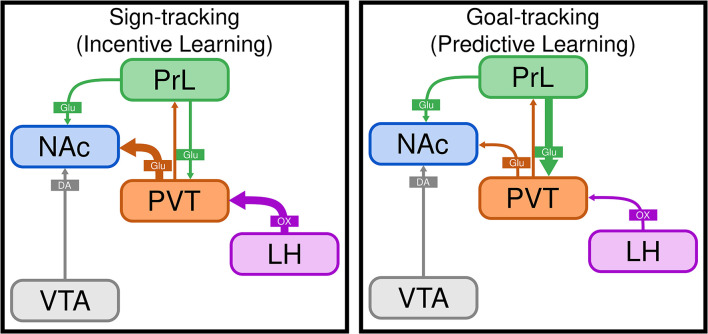
The PVT differentially mediates sign- and goal-tracking behavior. Schematic illustrating the paraventricular nucleus of the thalamus (PVT) as a central locus that acts to differentially regulate sign-tracking and goal-tracking behavior. Sign-tracking is a result of incentive cue-reward learning, whereas goal-tracking is the result of predictive cue-reward learning. We hypothesize that the incentive value of reward cues is encoded in the LH-PVT-NAc circuit (as indicated by thick purple and orange arrows), which is engaged to a greater degree in sign-trackers. In contrast, goal-trackers rely on top-down cortical control mechanisms (as indicated by thick green arrow) to encode the predictive value of reward cues and inhibit incentive motivational processes. LH, lateral hypothalamus; NAc, nucleus accumbens; PrL, prelimbic cortex; PVT, paraventricular thalamic nucleus; VTA, ventral tegmental area; DA, dopamine; Glu, glutamate; OX, orexin.

References

    1. Alamilla J., Aguilar-Roblero R. (2010). Glutamate and GABA neurotransmission from the paraventricular thalamus to the suprachiasmatic nuclei in the rat. J. Biol. Rhythms 25, 28–36. 10.1177/0748730409357771 - DOI - PubMed
    1. Anand B. K., Brobeck J. R. (1951). Localization of a “feeding center” in the hypothalamus of the rat. Proc. Soc. Exp. Biol. Med. 77, 323–324. 10.3181/00379727-77-18766 - DOI - PubMed
    1. Barroso-Chinea P., Castle M., Aymerich M. S., Pérez-Manso M., Erro E., Tuñon T., et al. . (2007). Expression of the mRNAs encoding for the vesicular glutamate transporters 1 and 2 in the rat thalamus. J. Comp. Neurol. 501, 703–715. 10.1002/cne.21265 - DOI - PubMed
    1. Barson J. R., Ho H. T., Leibowitz S. F. (2015). Anterior thalamic paraventricular nucleus is involved in intermittent access ethanol drinking: role of orexin receptor 2. Addict. Biol. 20, 469–481. 10.1111/adb.12139 - DOI - PMC - PubMed
    1. Barson J. R., Leibowitz S. F. (2015). GABA-induced inactivation of dorsal midline thalamic subregions has distinct effects on emotional behaviors. Neurosci. Lett. 609, 92–96. 10.1016/j.neulet.2015.10.029 - DOI - PMC - PubMed