. 2021 Jun 18:12:685187.
doi: 10.3389/fpls.2021.685187. eCollection 2021.

An Efficient Brome mosaic virus-Based Gene Silencing Protocol for Hexaploid Wheat (Triticum aestivum L.)

Affiliations

An Efficient Brome mosaic virus-Based Gene Silencing Protocol for Hexaploid Wheat (Triticum aestivum L.)

Yongqin Wang et al. Front Plant Sci. .

Abstract

Virus-induced gene silencing (VIGS) is a rapid and powerful method to evaluate gene function, especially for species like hexaploid wheat that have large, redundant genomes and are difficult and time-consuming to transform. The Brome mosaic virus (BMV)-based VIGS vector is widely used in monocotyledonous species but not wheat. Here we report the establishment of a simple and effective VIGS procedure in bread wheat using BMVCP5, the most recently improved BMV silencing vector, and wheat genes PHYTOENE DESATURASE (TaPDS) and PHOSPHATE2 (TaPHO2) as targets. Time-course experiments revealed that smaller inserts (~100 nucleotides, nt) were more stable in BMVCP5 and conferred higher silencing efficiency and longer silencing duration, compared with larger inserts. When using a 100-nt insert and a novel coleoptile inoculation method, BMVCP5 induced extensive silencing of TaPDS transcript and a visible bleaching phenotype in the 2nd to 5th systemically-infected leaves from nine to at least 28 days post inoculation (dpi). For TaPHO2, the ability of BMVCP5 to simultaneously silence all three homoeologs was demonstrated. To investigate the feasibility of BMV VIGS in wheat roots, ectopically expressed enhanced GREEN FLUORESCENT PROTEIN (eGFP) in a transgenic wheat line was targeted for silencing. Silencing of eGFP fluorescence was observed in both the maturation and elongation zones of roots. BMVCP5 mediated significant silencing of eGFP and TaPHO2 mRNA expression in roots at 14 and 21 dpi, and TaPHO2 silencing led to the doubling of inorganic phosphate concentration in the 2nd through 4th systemic leaves. All 54 wheat cultivars screened were susceptible to BMV infection. BMVCP5-mediated TaPDS silencing resulted in the expected bleaching phenotype in all eight cultivars examined, and decreased TaPDS transcript was detected in all three cultivars examined. This BMVCP5 VIGS technology may serve as a rapid and effective functional genomics tool for high-throughput gene function studies in aerial and root tissues and in many wheat cultivars.

Keywords: BMV-VIGS; Brome mosaic virus; PHOSPHATE2; PHYTOENE DESATURASE; Wheat (Triticum aestivum); functional genomics; insert stability; virus-induced gene silencing.


Conflict of interest statement

The authors declare that the research was conducted in the absence of any commercial or financial relationships that could be construed as a potential conflict of interest.

Figures
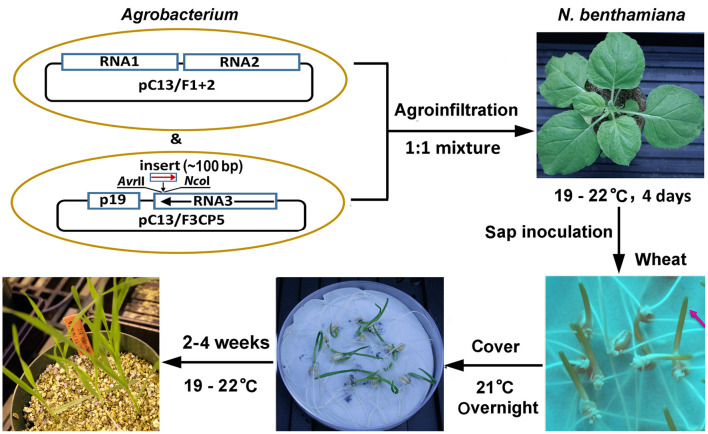
Figure 1
Figure 1
Protocol for BMVCP5-mediated gene silencing in wheat. Binary vectors pC13/F1 + 2 and pC13/F3CP5 contain sequences allowing expression of RNAs 1 and 2 and RNA 3, respectively, of the BMVCP5 silencing vector. For VIGS, a host gene fragment, optimally of ~100-bp, is inserted into the NcoI and AvrII sites in RNA3 sequence of pC13/F3CP5 in an antisense orientation. Agrobacterium containing the binary vectors with BMVCP5 are infiltrated into Nicotiana benthamiana leaves for multiplication of the viral silencing vector. N. benthamiana leaves are harvested at 4 days post infiltration, and crude sap is prepared for mechanical (rub) inoculation to wheat coleoptiles at 3 days post germination (or wheat leaves at 7–9 days post germination). Red arrow points to coleoptile for inoculation. Inoculated wheat seedlings are covered, kept at room temperature (21°C) overnight, and then transferred to solid media (or a hydroponic growth system) and grown in a greenhouse at 19–22°C for 2–4 weeks for target gene silencing.
Figure 2
Figure 2
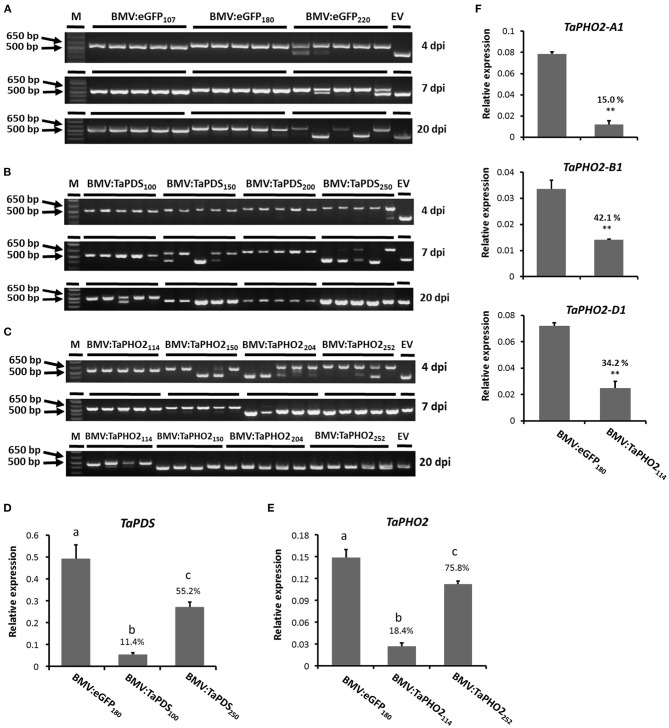
Stability of insert fragments and gene silencing in wheat leaves with BMVCP5. RT-PCR products from wheat leaves of plants inoculated with BMVCP5 harboring gene fragments in length from 100 to 252 nt from eGFP (A), TaPDS (B), and TaPHO2 (C). Subscript numbers after target gene designation indicate the insert size in the BMV vector. The 1st or 2nd inoculated leaf or 3rd systemic leaf were harvested, respectively, at 4, 7, and 20 dpi, and total RNA extracted for RT-PCR amplification using primers flanking the cloning site (P4-F/P4-R). Each lane represents an RT-PCR product from an individual plant. Similar results were obtained in three independent experiments. A 1 kb plus DNA ladder (M, Invitrogen) and a 427-bp PCR product amplified from plasmid pC13/F3CP5 with no insert (EV) serve as size markers. (D–F) Relative expression levels of target gene mRNA in the 3rd systemic leaf at 20 dpi were determined by RT-qPCR using the same cDNA analyzed for insert stability in Panels (A–C) and primers specific for the host target mRNA (but not the relevant insert fragment). PCR product quantities for target genes were normalized against the levels of wheat translation elongation factor subunit EF1α (TaEF1α) mRNA. (D) Relative expression levels of TaPDS mRNA in plants infected with BMV:eGFP180, BMV:TaPDS100 or BMV:TaPDS250. (E) Relative expression levels of TaPHO2 mRNA in plants infected with BMV:eGFP180, BMV:TaPHO2114 or BMV:TaPHO2252. (F) Relative expression levels of TaPHO2-A1, TaPHO2-B1, TaPHO2-D1 mRNA in plants infected with BMV:eGFP180 or BMV:TaPHO2114. Values in panels (D–F) represent means + SE of four or five biological replicates. Significant differences between treatment mean values in panels (D,E) are indicated by different letters above bars for each treatment (P < 0.05, significant ANOVA followed by LSD analysis); treatment values in panel (F) were compared by t-test (**P < 0.01). Percentage values are relative to the BMV:eGFP180 control.
Figure 3
Figure 3
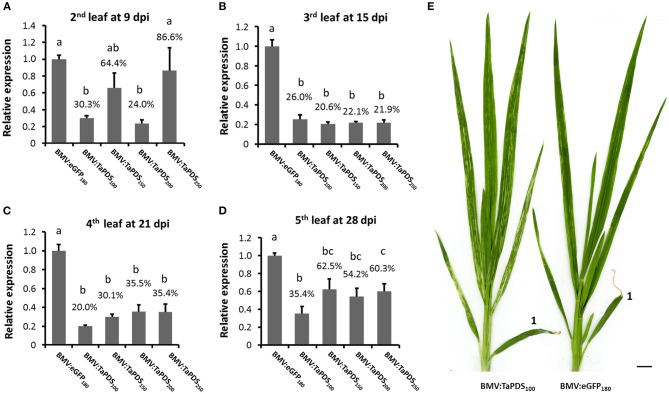
Time-course analysis of BMVCP5-mediated silencing of TaPDS in wheat leaves. (A–D) Groups of five wheat plants were inoculated with BMVCP5 containing TaPDS fragments of 100, 150, 200, or 250 nt, or a 180-nt eGFP fragment using the coleoptile inoculation method. Relative expression levels of TaPDS mRNA in various systemically-infected leaves at various dpi were determined by RT-qPCR with values across treatments normalized against relative TaEF1α mRNA levels. Expression percentages are given relative to the BMV:eGFP180 control. Values represent means + SE of five biological replicates for all treatments except BMV:TaPDS150, in which four biological replicates were used. Different letters denote significant difference between treatments (P < 0.05, significant ANOVA followed by LSD analysis). (E) Plants infected by BMV:PDS100 or BMV:eGFP180 at 28 dpi. The first leaf above the inoculated coleoptile is marked with “1.” Bar = 1 cm. A consistent bleaching phenotype and silencing of TaPDS transcripts were detected in the 2nd to 5th systemic leaves of wheat plants infected with BMV:PDS100. Similar results were obtained in two independent experiments.
Figure 4
Figure 4
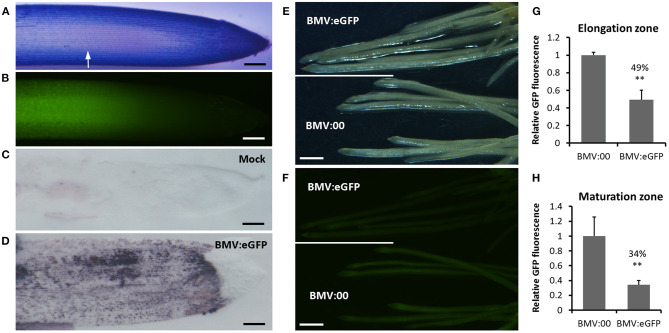
Silencing transgenically-expressed GFP in wheat roots with BMVCP5. (A) Root apical region from transgenic OsRCg2GFP wheat (cv. fielder) seedlings expressing GFP stained with toluidine blue. White arrow indicates the start of the elongation zone. (B) Green fluorescence from GFP detected in the elongation zone of the same root as in panel (A). Accumulation of BMV in a wheat root from plants inoculated with sap of N. benthamiana leaves without virus (Mock, C), or containing BMV:eGFP (180-nt insert; D), detected by tissue-print assay using a polyclonal antibody against the BMV CP. Purple color indicates presence of virus. Bars in (A–D) = 200 μm. (E) Bright-field image of roots at 21 dpi from plants infected with BMV:eGFP or BMV:00 (no insert control). (F) Fluorescence from roots in panel E showing silencing of GFP in transgenic OsRCg2GFP wheat roots after infection with BMV:eGFP, but not BMV:00. Images taken with an Olympus SZX 12 fluorescence microscope. Bars (E,F) = 1 mm. Similar results were obtained in three independent experiments. Quantification of GFP fluorescence in the elongation zone (G) and maturation zone (H) of roots at 21 dpi from plants infected with BMV:00 or BMV:eGFP. Values represent means + SD of six to eight biological replicates, and treatment values compared (t-test; **P < 0.01). Percentage values are relative to the BMV:00 treatment.
Figure 5
Figure 5
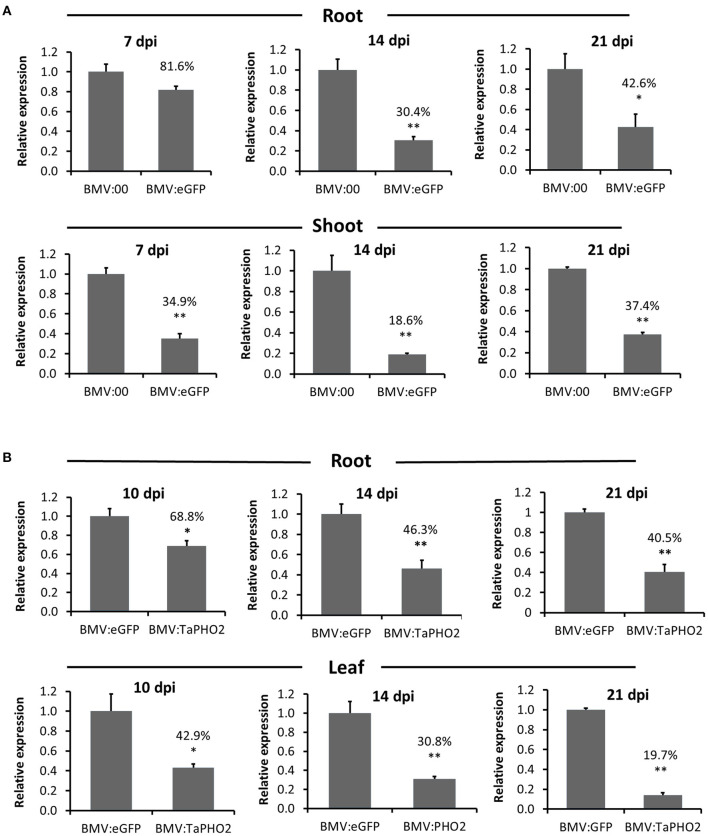
Comparison over time of BMVCP5-mediated silencing of eGFP and TaPHO2 in wheat root and aerial tissues. (A) Relative expression levels of eGFP mRNA in roots and shoots from transgenic OsRCg2GFP wheat (cv. Fielder) plants infected with BMV:eGFP (180-nt insert) or BMV:00 (no insert control) at 7, 14, and 21 dpi. Percentage values are relative to the BMV:00 control. Values represent means + SE of four to seven biological replicates, and treatment values compared (t-test: *P < 0.05; **P < 0.01). (B) Relative expression levels of TaPHO2 mRNA in roots and leaves from wheat plants (cv. Overley) inoculated with BMV:TaPHO2 (114-nt insert) or BMV:eGFP (107-nt insert) at 10, 14, and 21 dpi. Target gene mRNA levels were analyzed by RT-qPCR, and values normalized against relative TaEF1α mRNA levels. Percentage values are relative to the BMV:eGFP (107-nt insert) control. Values represent means + SE from three to six biological replicates, and treatment values compared (t test; *P < 0.05; **P < 0.01). Similar results were obtained in two independent experiments.
Figure 6
Figure 6
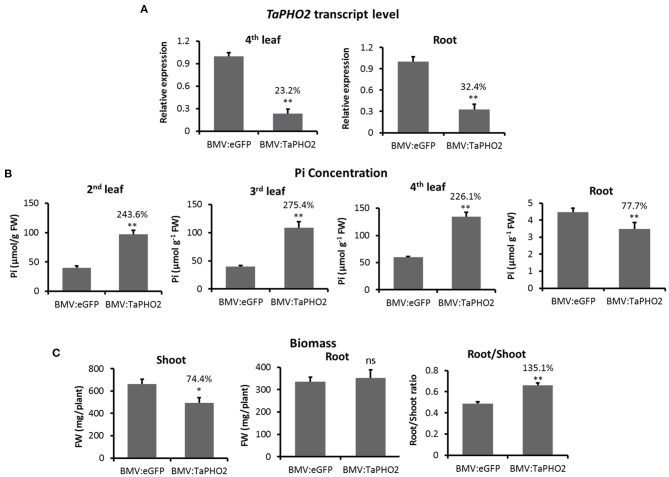
Inorganic phosphate concentration and biomass of wheat plants silenced for TaPHO2 expression with BMV:TaPHO2114 infection. Wheat (cv. Overley) plants inoculated with BMV:TaPHO2 (114-nt insert) or BMV:eGFP (107-nt insert; control) were grown under a low phosphate condition (20 μM Pi). Samples were collected at 24 dpi. (A) TaPHO2 expression levels in the 4th systemic leaf or roots, determined by RT-qPCR with values across treatments normalized against relative TaEF1α mRNA levels. (B) Pi concentrations in the 2nd, 3rd, or 4th systemic leaves or roots of plants inoculated with BMV:TaPHO2 or BMV:eGFP. (C) Shoot biomass, root biomass and Root/Shoot ratio of plants inoculated with viruses. Percentage values are relative to the BMV:eGFP control. Values represent means + SE of five biological replicates and treatment values compared (t-test; *P < 0.05; **P < 0.01). Similar results were obtained in two independent experiments. ns, not significant.
Figure 7
Figure 7
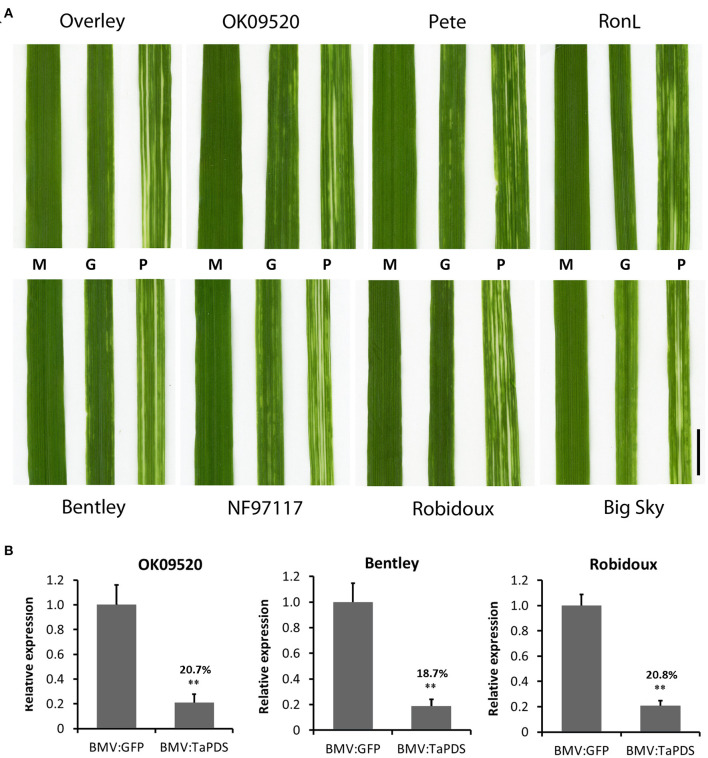
BMVCP5-induced TaPDS silencing in eight winter wheat cultivars. (A) Images show a representative phenotype of the 3rd systemic leaf at 22 dpi from plants infected with mock (M), BMV:eGFP107 (G) or BMV:TaPDS100 (P). Bar = 1 cm. (B) TaPDS mRNA expression levels in the 3rd systemic leaf at 22 dpi from plants infected with BMV:eGFP (107-nt insert) or BMV:TaPDS (100–nt insert) in cultivars OK09520, Bentley and Robidoux, analyzed by RT-qPCR with values across treatments normalized against the transcript level of TaEF1α. Expression percentages are given relative to the BMV:eGFP control. Values represent means + SD of five biological replicates, and treatments compared (t-test; **P < 0.01). Similar results were obtained in two independent experiments.

References

    1. Adamski N. M., Borrill P., Brinton J., Harrington S. A., Marchal C., Bentley A. R., et al. . (2020). A roadmap for gene functional characterisation in crops with large genomes: lessons from polyploid wheat. elife 9:e55646. 10.7554/eLife.55646 - DOI - PMC - PubMed
    1. Aung K., Lin S. I., Wu C. C., Huang Y. T., Su C. L., Chiou T. J. (2006). pho2, a phosphate overaccumulator, is caused by a nonsense mutation in a microRNA399 target gene. Plant Physiol. 141, 1000–1011. 10.1104/pp.106.078063 - DOI - PMC - PubMed
    1. Avesani L., Marconi G., Morandini F., Albertini E., Bruschetta M., Bortesi L., et al. . (2007). Stability of Potato virus X expression vectors is related to insert size: implications for replication models and risk assessment. Transgenic Res. 16, 587–597. 10.1007/s11248-006-9051-1 - DOI - PubMed
    1. Babu P., Baranwal D. K., Harikrishna Pal D., Bharti H., Joshi P., et al. . (2020). Application of genomics tools in wheat breeding to attain durable rust resistance. Front. Plant Sci. 11:567147. 10.3389/fpls.2020.567147 - DOI - PMC - PubMed
    1. Bari R., Pant B. D., Stitt M., Scheible W. R. (2006). PHO2, microRNA399, and PHR1 define a phosphate-signaling pathway in plants. Plant Physiol. 141, 988–999. 10.1104/pp.106.079707 - DOI - PMC - PubMed