Review
. 2020 Dec 14;14(5):1307-1316.
doi: 10.1093/ckj/sfaa244. eCollection 2021 May.

Pharmacoepidemiology for nephrologists (part 1): concept, applications and considerations for study design

Affiliations
Review

Pharmacoepidemiology for nephrologists (part 1): concept, applications and considerations for study design

Marco Trevisan et al. Clin Kidney J. .

Abstract

Randomized controlled trials on drug safety and effectiveness are the foundation of medical evidence, but they may have limited generalizability and be unpowered to detect rare and long-term kidney outcomes. Observational studies in routine care data can complement and expand trial evidence on the use, safety and effectiveness of medications and aid with clinical decisions in areas where evidence is lacking. Access to routinely collected large healthcare data has resulted in the proliferation of studies addressing the effect of medications in patients with kidney diseases and this review provides an introduction to the science of pharmacoepidemiology to critically appraise them. In this first review we discuss the concept and applications of pharmacoepidemiology, describing methods for drug-utilization research and discussing the strengths and caveats of the most commonly used study designs to evaluate comparative drug safety and effectiveness.

Keywords: adverse effects; biostatistics; drugs; epidemiology; nephrotoxicity.


Figures

FIGURE 1
FIGURE 1
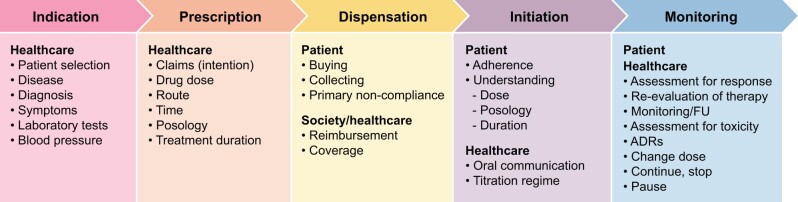
Steps in the process of drug use and interplay between different players (i.e. healthcare, society and patients).
FIGURE 2
FIGURE 2
Assessment of drug persistence/discontinuation based on the refill-gap method. In this example there is a treatment discontinuation during follow-up because the third prescription of the treatment occurred after the pill supply + time gap period from the second prescription.
FIGURE 3
FIGURE 3
Assessment of persistence/discontinuation based on the treatment anniversary method. In this example there is a treatment discontinuation during follow-up because the third prescription of the treatment occurred after the predefined ‘anniversary’ (including also a time gap).
FIGURE 4
FIGURE 4
Schematic representation of a hypothetical casecontrol design investigating the association between NSAIDs and AKI. Cases are selected at the time of AKI. Controls are selected from the remaining population of individuals who did not experience AKI at the same point in time. Exposure to NSAIDs is compared between cases and controls.
FIGURE 5
FIGURE 5
Schematic representation of a hypothetical case-crossover design investigating the association between NSAIDs and AKI. Cases are selected at the time of AKI. The exposure to NSAIDs in the period right before the AKI is compared with a similar period earlier in time.
FIGURE 6
FIGURE 6
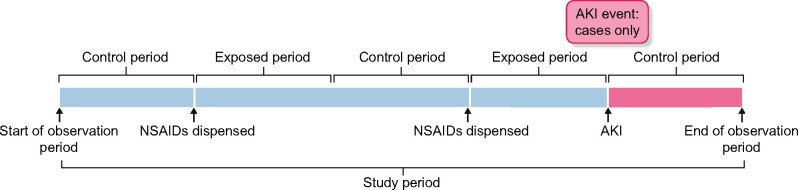
Schematic representation of a hypothetical self-controlled case-series design investigating the association between NSAIDs and AKI. The self-controlled case-series design consists of three steps: (i) cases are selected at the time of AKI, (ii) a particular observation period is selected (in this case the study period from NSAIDs dispensed to end of study) and (iii) the entire exposure history inside this observation period is classified as exposed or unexposed periods. The periods of exposure to NSAIDs are compared with all available control periods within the observation period.
FIGURE 7
FIGURE 7
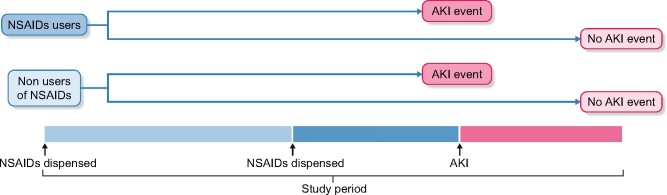
Schematic representation of a hypothetical cohort design investigating the association between NSAIDs and AKI. NSAID users are selected when they start therapy. A group of controls is selected at the same point in time among those who were not using the drug or were using another drug (active comparator). Both users and non-users are followed until the AKI event or end of follow-up.

References

    1. Rehman W, Arfons LM, Lazarus HM.. The rise, fall and subsequent triumph of thalidomide: lessons learned in drug development. Ther Adv Hematol 2011; 2: 291–308 - PMC - PubMed
    1. Onakpoya IJ, Heneghan CJ, Aronson JK.. Post-marketing withdrawal of 462 medicinal products because of adverse drug reactions: a systematic review of the world literature. BMC Med 2016; 14: 10. - PMC - PubMed
    1. McNaughton R, Huet G, Shakir S.. An investigation into drug products withdrawn from the EU market between 2002 and 2011 for safety reasons and the evidence used to support the decision-making. BMJ Open 2014; 4: e004221 - PMC - PubMed
    1. Herbst AL, Ulfelder H, Poskanzer DC.. Adenocarcinoma of the vagina—association of maternal stilbestrol therapy with tumor appearance in young women. N Engl J Med 1971; 284: 878–881 - PubMed
    1. Fink JC, Brown J, Hsu VD. et al. CKD as an underrecognized threat to patient safety. Am J Kidney Dis 2009; 53: 681–688 - PMC - PubMed