


Insight into chemical basis of traditional Chinese medicine based on the state-of-the-art techniques of liquid chromatography-mass spectrometry
- PMID: 34221863
- PMCID: PMC8245813
- DOI: 10.1016/j.apsb.2021.02.017
Insight into chemical basis of traditional Chinese medicine based on the state-of-the-art techniques of liquid chromatography-mass spectrometry
Abstract
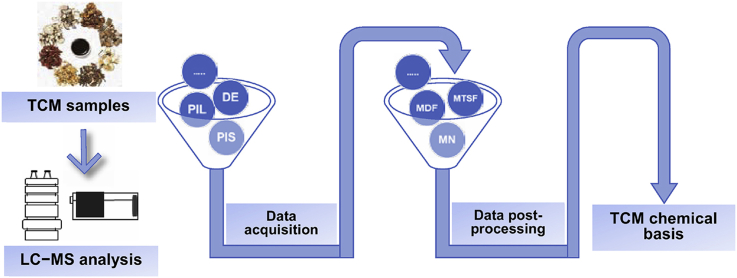
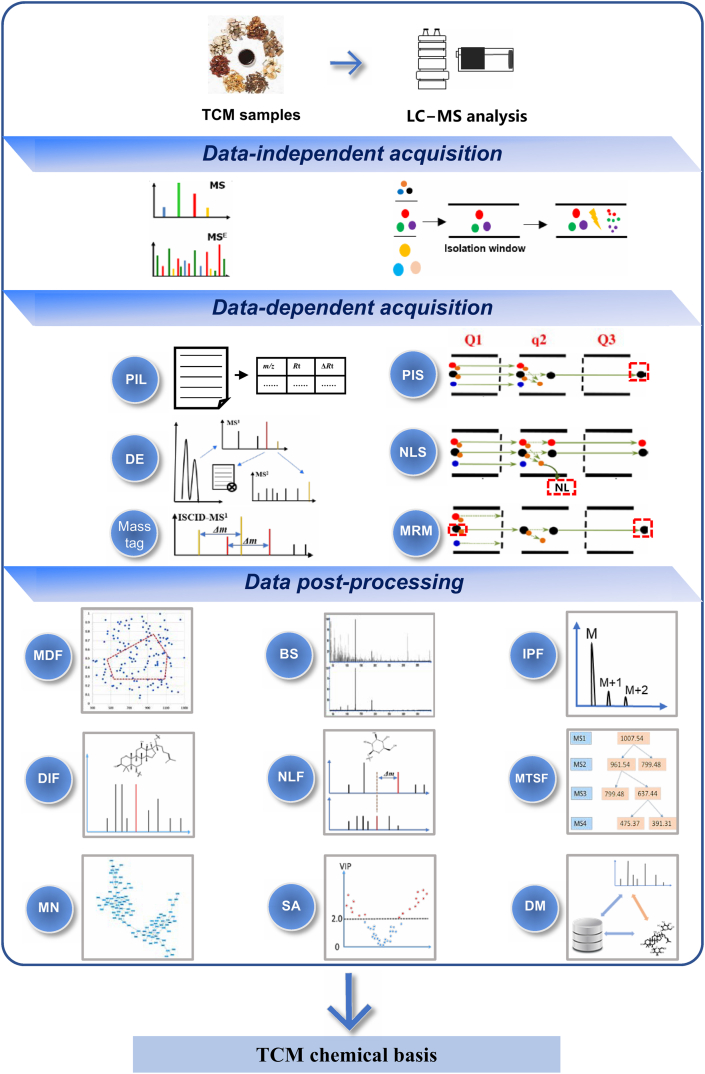
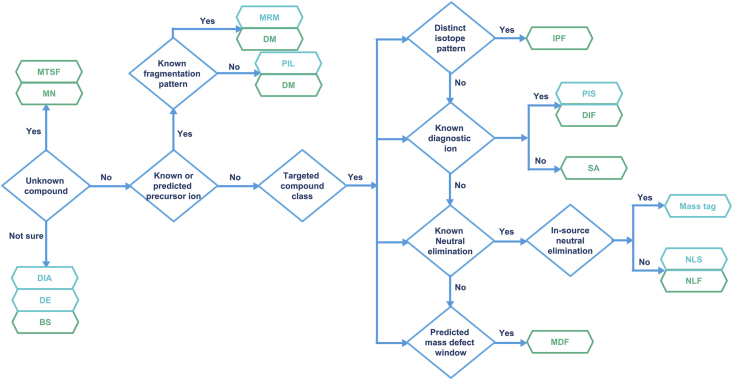
Traditional Chinese medicine (TCM) has been an indispensable source of drugs for curing various human diseases. However, the inherent chemical diversity and complexity of TCM restricted the safety and efficacy of its usage. Over the past few decades, the combination of liquid chromatography with mass spectrometry has contributed greatly to the TCM qualitative analysis. And novel approaches have been continuously introduced to improve the analytical performance, including both the data acquisition methods to generate a large and informative dataset, and the data post-processing tools to extract the structure-related MS information. Furthermore, the fast-developing computer techniques and big data analytics have markedly enriched the data processing tools, bringing benefits of high efficiency and accuracy. To provide an up-to-date review of the latest techniques on the TCM qualitative analysis, multiple data-independent acquisition methods and data-dependent acquisition methods (precursor ion list, dynamic exclusion, mass tag, precursor ion scan, neutral loss scan, and multiple reaction monitoring) and post-processing techniques (mass defect filtering, diagnostic ion filtering, neutral loss filtering, mass spectral trees similarity filter, molecular networking, statistical analysis, database matching, etc.) were summarized and categorized. Applications of each technique and integrated analytical strategies were highlighted, discussion and future perspectives were proposed as well.
Keywords: BS, background subtraction; CCS, collision cross section; CE, collision energy; CID, collision-induced dissociation; DDA, data-dependent acquisition; DE, dynamic exclusion; DIA, data-independent acquisition; DIF, diagnostic ion filtering; DM, database matching; Data acquisition; Data post-processing; EL, exclusion list; EMS, enhanced mass spectrum; EPI, enhanced product ion; FS, full scan; HCD, high-energy C-trap dissociation; IDA, information dependent acquisition; IM, ion mobility; IPF, isotope pattern filtering; ISCID, in-source collision-induced dissociation; LC, liquid chromatography; LTQ-Orbitrap, linear ion-trap/orbitrap; Liquid chromatography−mass spectrometry; MDF, mass defect filtering; MIM, multiple ion monitoring; MN, molecular networking; MRM, multiple reaction monitoring; MS, mass spectrometry; MTSF, mass spectral trees similarity filter; NL, neutral loss; NLF, neutral loss filtering; NLS, neutral loss scan; NRF, nitrogen rule filtering; PCA, principal component analysis; PIL, precursor ion list; PIS, precursor ion scan; PLS-DA, partial least square-discriminant analysis; Q-TRAP, hybrid triple quadrupole-linear ion trap; QSRR, quantitative structure retention relationship; QqQ, triple quadrupole; Qualitative analysis; RT, retention time; SA, statistical analysis; TCM, traditional Chinese medicine; Traditional Chinese medicine; UHPLC, ultra-high performance liquid chromatography; cMRM, conventional multiple reaction monitoring; sMRM, scheduled multiple reaction monitoring.
© 2021 Chinese Pharmaceutical Association and Institute of Materia Medica, Chinese Academy of Medical Sciences. Production and hosting by Elsevier B.V.
Conflict of interest statement
The authors declare no conflicts of interest.
Figures
References
-
- Harvey A.L. Natural products in drug discovery. Drug Discov Today. 2008;13:894–901. - PubMed
-
- Zhao J., Jiang P., Zhang W.D. Molecular networks for the study of TCM pharmacology. Briefings Bioinf. 2010;11:417–430. - PubMed
-
- Wu H.F., Guo J., Chen S.L., Liu X., Zhou Y., Zhang X.P. Recent developments in qualitative and quantitative analysis of phytochemical constituents and their metabolites using liquid chromatography−mass spectrometry. J Pharmaceut Biomed Anal. 2013;72:267–291. - PubMed
-
- Jin H.L., Liu Y.F., Guo Z.M., Wang J.X., Zhang X.L., Wang C.R. Recent development in liquid chromatography stationary phases for separation of Traditional Chinese Medicine components. J Pharmaceut Biomed Anal. 2016;130:336–346. - PubMed
Publication types
LinkOut - more resources
Full Text Sources
Miscellaneous
