


COVID-19-Related Downscaling of In-Hospital Liver Care Decreased Patient Satisfaction and Increased Liver-Related Mortality
- PMID: 34222742
- PMCID: PMC8239672
- DOI: 10.1002/hep4.1758
COVID-19-Related Downscaling of In-Hospital Liver Care Decreased Patient Satisfaction and Increased Liver-Related Mortality
Abstract
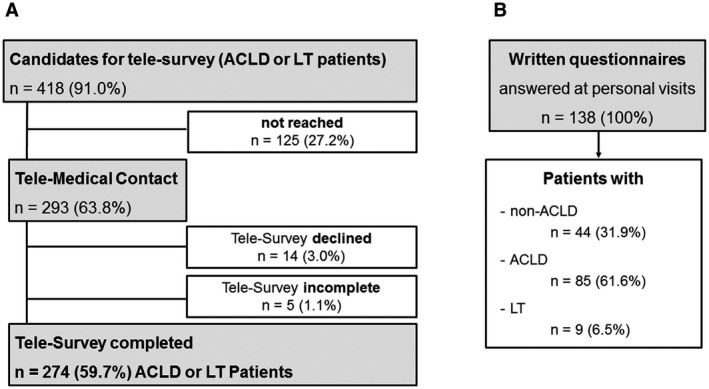
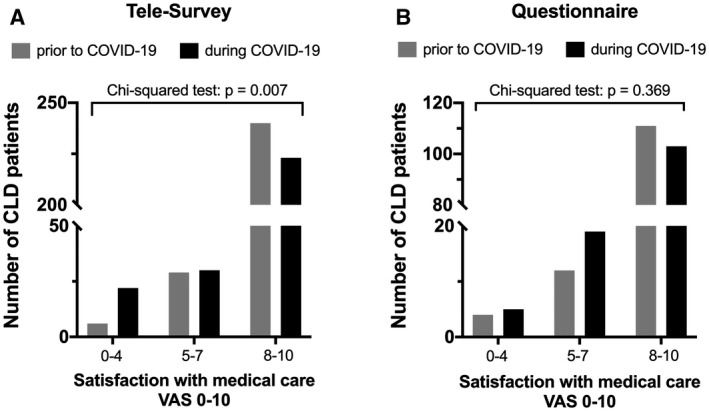
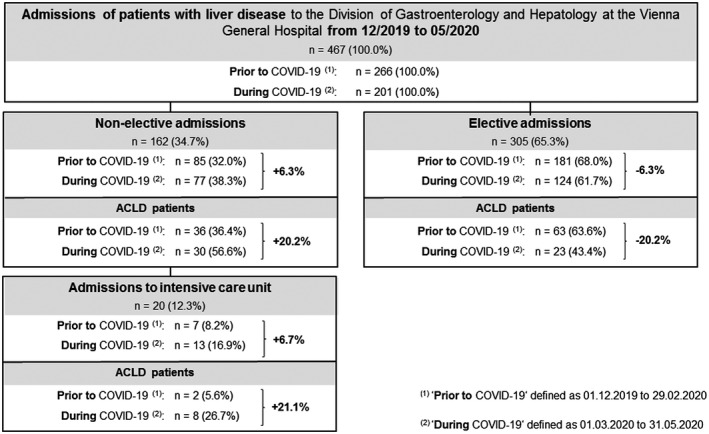
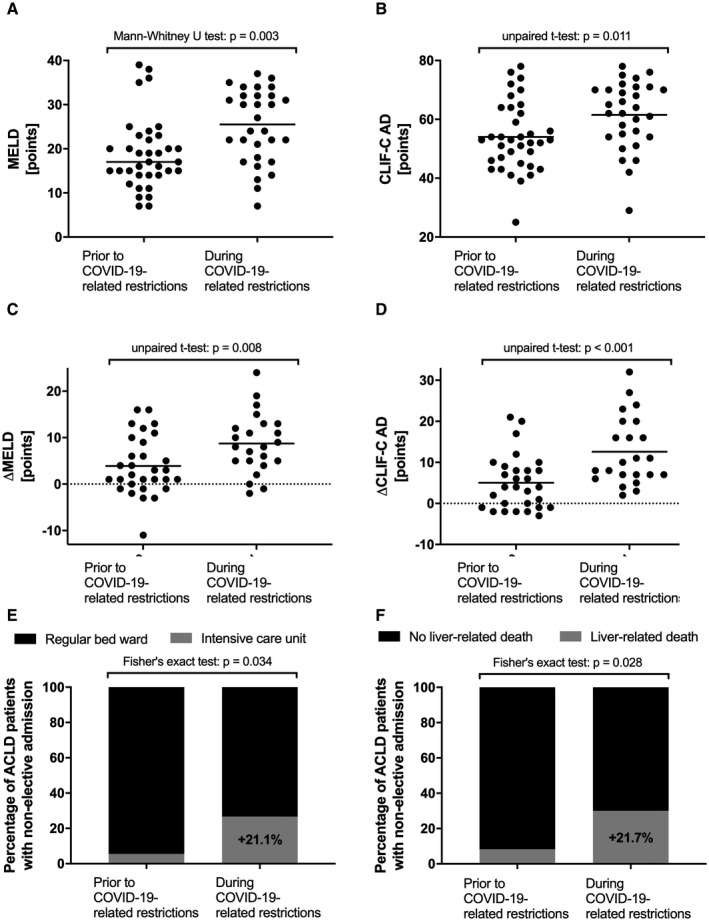
The coronavirus disease 2019 (COVID-19) pandemic necessitated down-scaling of in-hospital care to prohibit the spread of severe acute respiratory syndrome-coronavirus-2. We (1) assessed patient perceptions on quality of care by telesurvey (cohort 1) and written questionnaire (cohort 2), and (2) analyzed trends in elective and nonelective admissions before (December 2019 to February 2020) and during (March to May 2020) the COVID-19 pandemic in Austria. A total of 279 outpatients were recruited into cohort 1 and 138 patients into cohort 2. All admissions from December 2019 to May 2020 to the Division of Gastroenterology/Hepatology at the Vienna General Hospital were analyzed. A total of 32.6% (n = 91 of 279) of cohort 1 and 72.5% (n = 95 of 131) of cohort 2 had telemedical contact, whereas 59.5% (n = 166 of 279) and 68.2% (n = 90 of 132) had face-to-face visits. A total of 24.1% (n = 32 of 133) needed acute medical help during health care restrictions; however, 57.3% (n = 51 of 89) reported that contacting their physician during COVID-19 was difficult or impossible. Patient-reported satisfaction with treatment decreased significantly during restrictions in cohort 1 (visual analog scale [VAS] 0-10: 9.0 ± 1.6 to 8.6 ± 2.2; P < 0.001) and insignificantly in cohort 2 (VAS 0-10: 8.9 ± 1.6 to 8.7 ± 2.1; P = 0.182). Despite fewer hospital admissions during COVID-19, the proportion of nonelective admissions (+6.3%) and intensive care unit admissions (+6.7%) increased. Patients with cirrhosis with nonelective admissions during COVID-19 had significantly higher Model for End-Stage Liver Disease (MELD) (25.5 [14.2] vs. 17.0 [interquartile range: 8.8]; P = 0.003) and ΔMELD (difference from last MELD: 3.9 ± 6.3 vs. 8.7 ± 6.4; P = 0.008), required immediate intensive care more frequently (26.7% vs. 5.6%; P = 0.034), and had significantly increased 30-day liver-related mortality (30.0% vs. 8.3%; P = 0.028). Conclusion: The COVID-19 pandemic's effects on quality of liver care is evident from decreased patient satisfaction, hospitalization of sicker patients with advanced chronic liver disease, and increased liver-related mortality. Strategies for improved telemedical liver care and preemptive treatment of cirrhosis-related complications are needed to counteract the COVID-19-associated restrictions of in-hospital care.
© 2021 The Authors. Hepatology Communications published by Wiley Periodicals LLC on behalf of the American Association for the Study of Liver Diseases.
Figures
References
Publication types
MeSH terms
Grants and funding
LinkOut - more resources
Full Text Sources
Medical
