


A hypothetical implementation of 'Termination of Resuscitation' protocol for out-of-hospital cardiac arrest
- PMID: 34223357
- PMCID: PMC8244430
- DOI: 10.1016/j.resplu.2021.100092
A hypothetical implementation of 'Termination of Resuscitation' protocol for out-of-hospital cardiac arrest
Abstract
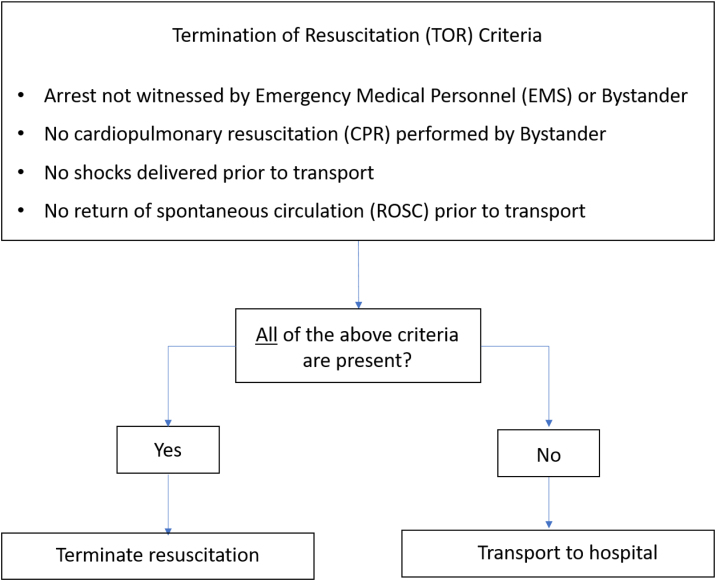
Background: Out-of-hospital cardiac arrests with negligible chance of survival are routinely transported to hospital and many are pronounced dead thereafter. This leads to some potentially avoidable costs. The 'Termination of Resuscitation' protocol allows paramedics to terminate resuscitation efforts onsite for medically futile cases. This study estimates the changes in frequency of costly events that might occur when the protocol is applied to out-of-hospital cardiac arrests, as compared to existing practice.
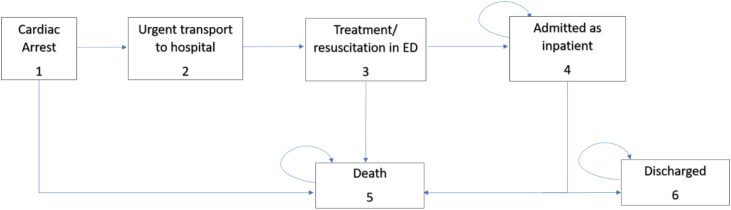
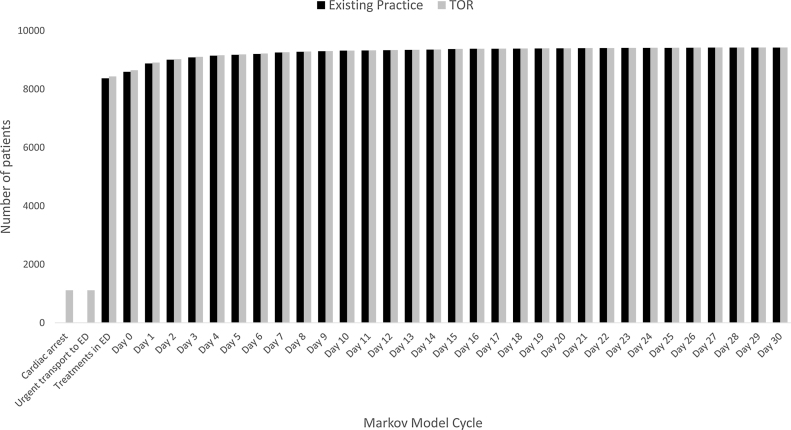
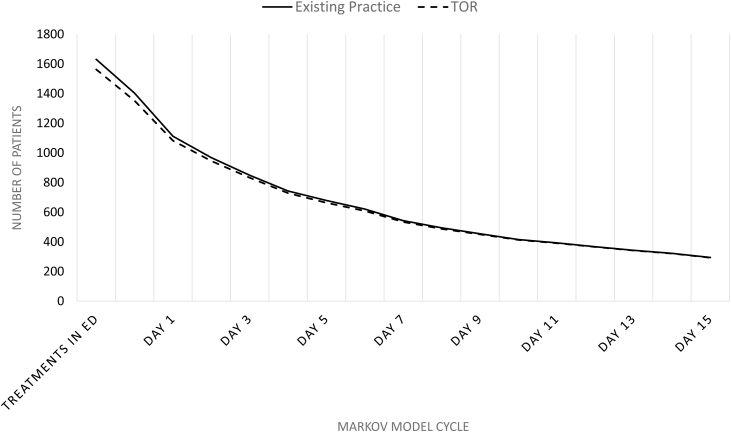
Methods: We used Singapore data from the Pan-Asian Resuscitation Outcomes Study, from 1 Jan 2014 to 31 Dec 2017. A Markov model was developed to summarise the events that would occur in two scenarios, existing practice and the implementation of a Termination of Resuscitation protocol. The model was evaluated for 10,000 hypothetical patients with a cycle duration of 30 days after having a cardiac arrest. Probabilistic sensitivity analysis accounted for uncertainties in the outcomes: number of urgent transports and emergency treatments, inpatient bed days, and total number of deaths.
Results: For every 10,000 patients, existing practice resulted in 1118 (95% Uncertainty Interval 1117 to 1119) additional urgent transports to hospital and subsequent emergency treatments. There were 93 (95% Uncertainty Interval 66 to 120) extra inpatient bed days used, and 3 fewer deaths (95% Uncertainty Interval 2 to 4) in comparison to using the protocol.
Conclusion: The findings provide some evidence for adopting the Termination of Resuscitation protocol. This policy could lead to a reduction in costs and non-beneficial hospital admissions, however there may be a small increase in the number of avoidable deaths.
Keywords: Emergency medical services; Markov model; Out-of-hospital cardiac arrest; Termination of Resuscitation.
© 2021 The Author(s).
Conflict of interest statement
The authors declare that they have no known competing financial interests or personal relationships that could have appeared to influence the work reported in this paper.The authors report no declarations of interest.
Figures
References
-
- CARES . 2017. United States: cardiac arrest registry to enhance survival. Available from: https://mycares.net/sitepages/uploads/2018/2017flipbook/index.html?page=26 [13.01.21]
-
- Gräsner J.-T., Lefering R., Koster R.W., Masterson S., Böttiger B.W., Herlitz J. EuReCa ONE-27 Nations, ONE Europe ONE Registry: a prospective one month analysis of out-of-hospital cardiac arrest outcomes in 27 countries in Europe. Resuscitation. 2016;105:188–195. doi: 10.1016/j.resuscitation.2016.06.004. - DOI - PubMed
LinkOut - more resources
Full Text Sources
Research Materials
