


Cerebrovascular Response to Phenylephrine in Traumatic Brain Injury: A Scoping Systematic Review of the Human and Animal Literature
- PMID: 34223530
- PMCID: PMC8240891
- DOI: 10.1089/neur.2020.0008
Cerebrovascular Response to Phenylephrine in Traumatic Brain Injury: A Scoping Systematic Review of the Human and Animal Literature
Abstract
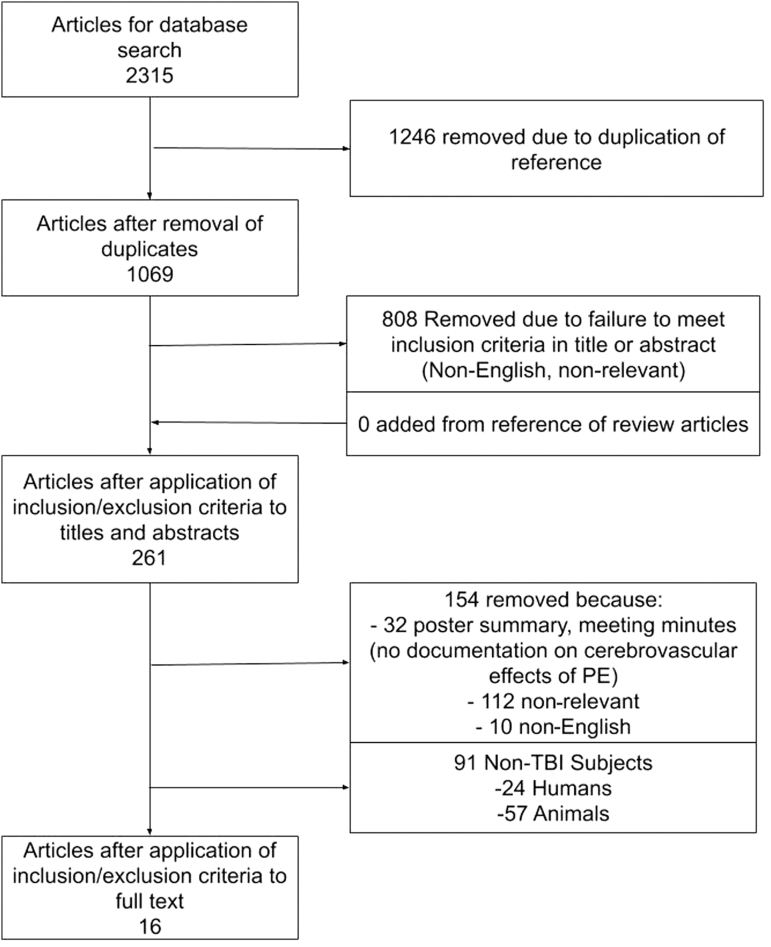
Intravenous phenylephrine (PE) is utilized commonly in critical care for cardiovascular support. Its impact on the cerebrovasculature is unclear and its use may have important implications during states of critical neurological illness. The aim of this study was to perform a scoping review of the literature on the cerebrovascular/cerebral blood flow (CBF) effects of PE in traumatic brain injury (TBI), evaluating both animal models and human studies. We searched MEDLINE, BIOSIS, EMBASE, Global Health, SCOPUS, and the Cochrane Library from inception to January 2020. We identified 12 studies with various animal models and 4 studies in humans with varying TBI pathology. There was a trend toward a consistent increase in mean arterial pressure (MAP) by the injection of PE systemically, and by proxy, an increase of the cerebral perfusion pressure (CPP). There was a consistent constriction of cerebral vessels by PE reported in the small number of studies documenting such a response. However, the heterogeneity of the literature on the CBF/cerebral blood volume (CBV) response makes the strength of the conclusions on PE limited. Studies were heterogeneous in design and had significant limitations, with most failing to adjust for confounding factors in cerebrovascular/CBF response. This review highlights the significant knowledge gap on the cerebrovascular/CBF effects of PE administration in TBI, calling for further study on the impact of PE on the cerebrovasculature both in vivo and in experimental settings.
Keywords: cerebral blood flow; cerebral blood volume; cerebrovascular reactivity; cerebrovascular response; phenylephrine.
© Logan Froese et al., 2020; Published by Mary Ann Liebert, Inc.
Conflict of interest statement
This work was supported directly through the University of Manitoba, Department of Surgery GFT Research Grant (L.F.), and the University of Manitoba Office of Research Services (ORS), University Research Grant Program (URGP; L.F.).
Figures
References
-
- Kellum, J.A., and Pinsky, M.R. (2002). Use of vasopressor agents in critically ill patients. Curr. Opin. Crit. Care 8, 236. - PubMed
-
- Hollenberg, S.M. (2011). Vasoactive drugs in circulatory shock. Am. J. Respir. Crit. Care Med. 183, 847–855 - PubMed
-
- Kochanek, P.M., Tasker, R.C., Bell, M.J., Adelson, P.D., Carney, N., Vavilala, M.S., Selden, N.R., Bratton, S.L., Grant, G.A., Kissoon, N., Reuter-Rice, K.E., and Wainwright, M.S. (2019). Management of Pediatric Severe Traumatic Brain Injury: 2019 Consensus and Guidelines-Based Algorithm for First and Second Tier Therapies. Pediatr. Crit. Care Med. 20, 269–279 - PubMed
-
- Carney, N., Totten, A.M., O'Reilly, C., Ullman, J.S., Hawryluk, G.W.J., Bell, M.J., Bratton, S.L., Chesnut, R., Harris, O.A., Kissoon, N., Rubiano, A.M., Shutter, L., Tasker, R.C., Vavilala, M.S., Wilberger, J., Wright, D.W., and Ghajar, J. (2017). Guidelines for the Management of Severe Traumatic Brain Injury, Fourth Edition. Neurosurgery 80, 6–15 - PubMed
Publication types
LinkOut - more resources
Full Text Sources
Miscellaneous