


Violent Infant Surrogate Shaking: Continuous High-Magnitude Centripetal Force and Abrupt Shift in Tangential Acceleration May Explain High Risk of Subdural Hemorrhage
- PMID: 34223553
- PMCID: PMC8240836
- DOI: 10.1089/neur.2021.0013
Violent Infant Surrogate Shaking: Continuous High-Magnitude Centripetal Force and Abrupt Shift in Tangential Acceleration May Explain High Risk of Subdural Hemorrhage
Abstract
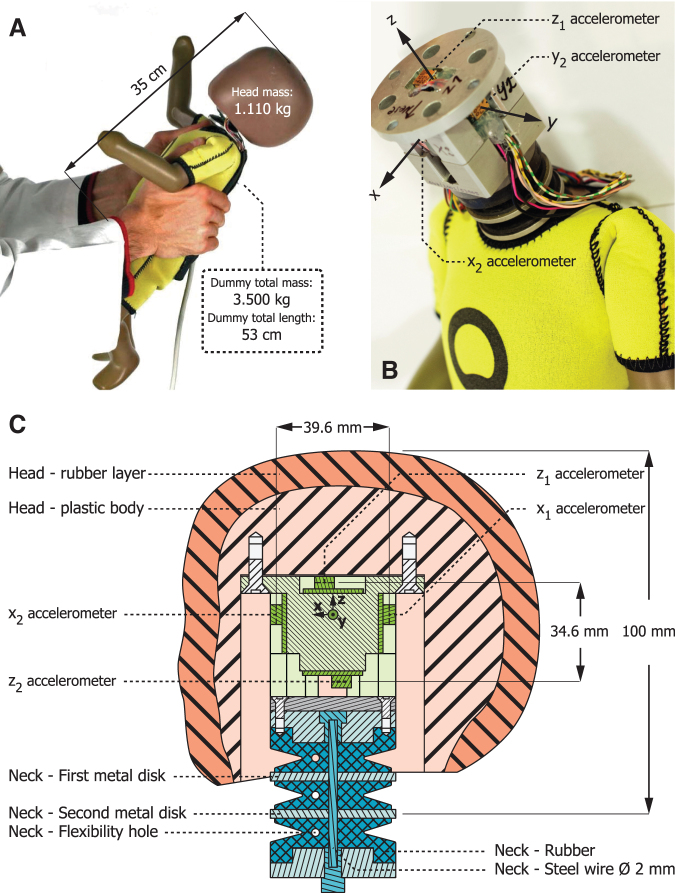
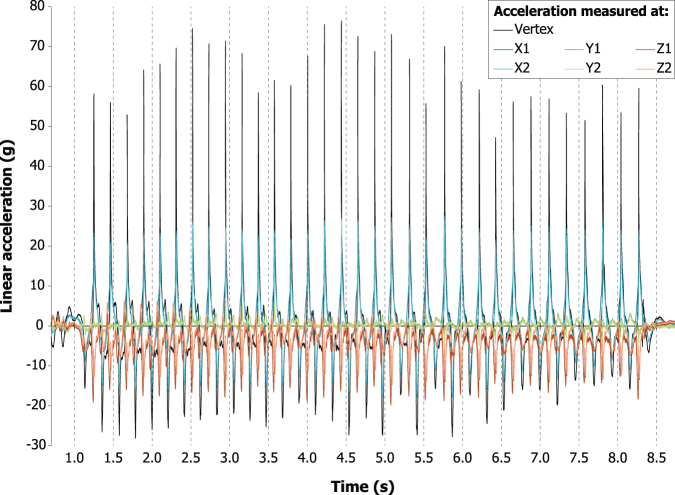
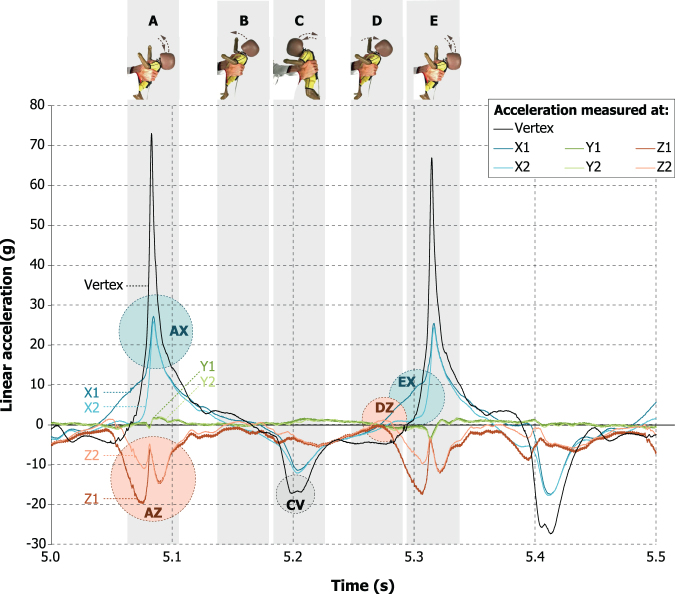
Violent shaking is believed to be a common mechanism of injury in pediatric abusive head trauma. Typical intracranial injuries include subdural and retinal hemorrhages. Using a laboratory surrogate model we conducted experiments evaluating the head motion patterns that may occur in violent shaking. An anthropomorphic test device (ATD; Q0 dummy) matching an infant of 3.5 kg was assembled. The head interior was equipped with accelerometers enabling assessment of three-axial accelerations. Fifteen volunteers were asked to shake the surrogate vigorously holding a firm grip around the torso. We observed the volunteers performing manual shaking of the surrogate at a median duration of 15.5 sec (range 5-54 sec). Typical acceleration/deceleration patterns were produced after 2-3 shakes with a steady-state shaking motion at a pace of 4-6 cycles (back and forth) per second. Mean peak sagittal tangential accelerations at the vertex were 45.7g (range 14.2-105.1g). The acceleration component in the orthogonal direction, the radial acceleration, fluctuated around a negative mean of more than 4g showing that the surrogate head was continuously subjected to centripetal forces caused by rotations. This surrogate experiment showed that violent shaking may induce high peak tangential accelerations and concomitantly a continuous high-magnitude centripetal force. We hypothesize that the latter component may cause increased pressure in the subdural compartment in the cranial roof and may cause constant compression of the brain and possibly increased stretching or shearing of the bridging veins. This may contribute to the mechanism accountable for subdural hematoma in abusive head trauma.
Keywords: abusive head trauma; biomechanical model; infant; injury; shaken baby.
© Arne Stray-Pedersen et al., 2021; Published by Mary Ann Liebert, Inc.
Conflict of interest statement
Drs. Stray-Pedersen and Rognum have testified in courts of law regarding abusive head trauma.
Figures
References
-
- Christian, C.W., Block, R., Committee on Child Abuse and Neglect, and American Academy of Pediatrics. (2009). Abusive head trauma in infants and children. Pediatrics 123, 1409–1411 - PubMed
-
- Berger, R.P., Fromkin, J.B., Stutz, H., Makoroff, K., Scribano, P.V., Feldman, K., Tu, L.C., and Fabio, A. (2011). Abusive head trauma during a time of increased unemployment: a multicenter analysis. Pediatrics 128, 637–643 - PubMed
-
- Choudhary, A.K., Servaes, S., Slovis, T.L., Palusci, V.J., Hedlund, G.L., Narang, S.K., Moreno, J.A., Dias, M.S., Christian, C.W., Nelson, M.D., Silvera, V.M., Palasis, S., Raissaki, M., Rossi, A., and Offiah, A.C. (2018). Consensus statement on abusive head trauma in infants and young children. Pediatr. Radiol. 48, 1048–1065 - PubMed
-
- Herman, B.E., Makoroff, K.L., and Corneli, H.M. (2018). Abusive head trauma. Pediatr. Emerg. Care 27, 65–69 - PubMed
-
- Adamsbaum, C., Grabar, S., Mejean, N., and Rey-Salmon, C. (2010). Abusive head trauma: judicial admissions highlight violent and repetitive shaking. Pediatrics 126, 546–555 - PubMed
LinkOut - more resources
Full Text Sources
Research Materials