


Sacituzumab govitecan and trastuzumab deruxtecan: two new antibody-drug conjugates in the breast cancer treatment landscape
- PMID: 34225076
- PMCID: PMC8259232
- DOI: 10.1016/j.esmoop.2021.100204
Sacituzumab govitecan and trastuzumab deruxtecan: two new antibody-drug conjugates in the breast cancer treatment landscape
Abstract
Background: Two new antibody-drug conjugates (ADCs) containing a topoisomerase I inhibitor payload have recently emerged in the breast cancer (BC) treatment landscape. Sacituzumab govitecan-hziy (SG) is a first-in-class anti-trophoblast cell-surface antigen 2 ADC approved for pretreated metastatic triple-negative breast cancer (mTNBC) and trastuzumab deruxtecan (T-DXd) gained approval for human epidermal growth factor receptor-2 (HER2)-positive advanced BC (aBC). We aim to provide a contemporary review and the current clinical trial landscape of SG and T-DXd in BC.
Materials and methods: We conducted a literature search from Medline database through PubMed, major conference proceedings [abstracts from European Society for Medical Oncology (Breast) Congress, American Society of Clinical Oncology annual meeting, San Antonio Breast Cancer Symposium] and ClinicalTrials.gov with search terms 'sacituzumab govitecan', 'IMMU-132', 'trastuzumab deruxtecan' and 'DS-8201a' up to 21 March 2021.
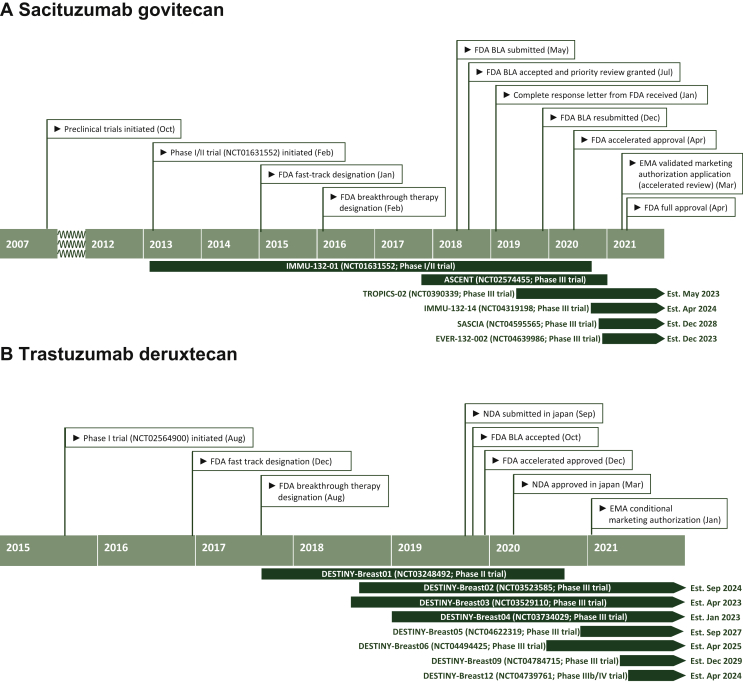
Results: We assessed 293 records for eligibility, of which 153 were included in this review after screening and exclusion. For SG, efficacy and safety data are available from a phase III trial in pretreated mTNBC and from a phase I/II basket study in mTNBC and hormone receptor-positive/HER2-negative aBC. Thirteen trials with pending primary analysis are ongoing with SG as single agent or in combination, of which 11 are enrolling (2/11 in the early setting). For T-DXd, efficacy/safety data are available as single agent in pretreated HER2-positive (phase Ib and phase II) and in HER2-low aBC (phase Ib), and in combination with nivolumab in HER2-low/positive aBC (phase Ib). Of 23 ongoing trials with T-DXd, 12 are open for enrollment and 3 phase III trials have completed recruitment. The distinct safety profiles of both drugs and their management are discussed.
Conclusion: Given their robust single-agent activity, SG and T-DXd are expected to substantially impact treatment standards, both in and far beyond the currently approved indications. Several trials are investigating new treatment settings for both drugs, including a transition to earlier lines and combinations with other anticancer treatments such as immune checkpoint inhibitors.
Keywords: HER2-positive breast cancer; antibody–drug conjugates; sacituzumab govitecan; trastuzumab deruxtecan; triple-negative breast cancer.
Copyright © 2021 The Author(s). Published by Elsevier Ltd.. All rights reserved.
Conflict of interest statement
Disclosure PN's institution received honoraria for advisory boards and research funding from AstraZeneca, Amgen, Eli Lilly, Novartis, Pfizer and Roche (all outside the submitted work). HW received travel support from Roche and Pfizer (all outside the submitted work), institution received consulting fees and honoraria from AstraZeneca, Biocartis, Lilly, Novartis, Pfizer, PUMA Biotechnology, Roche, Sirtex and Daiichii-Sankyo and unrestricted research grants from Roche and Novartis. KP received travel support from AstraZeneca, Pfizer, PharmaMar and Roche (all outside the submitted work), institution received honoraria for advisory/consultancy roles for AstraZeneca, Eli Lilly, Gilead Sciences, Novartis, Pfizer, Pierre Fabre, Roche, Teva and Vifor Pharma; speaker fees for Eli Lilly, Medscape, MSD, Mundi Pharma, Novartis, Pfizer and Roche; and research funding from Sanofi. EA has declared no conflicts of interest.
Figures
References
Publication types
MeSH terms
Substances
LinkOut - more resources
Full Text Sources
Other Literature Sources
Research Materials
Miscellaneous
