. 2021 Nov 10:794:148749.
doi: 10.1016/j.scitotenv.2021.148749. Epub 2021 Jun 30.

Close proximity risk assessment for SARS-CoV-2 infection

Affiliations

Close proximity risk assessment for SARS-CoV-2 infection

G Cortellessa et al. Sci Total Environ. .

Abstract

Although the interpersonal distance represents an important parameter affecting the risk of infection due to respiratory viruses, the mechanism of exposure to exhaled droplets remains insufficiently characterized. In this study, an integrated risk assessment is presented for SARS-CoV-2 close proximity exposure between a speaking infectious subject and a susceptible subject. It is based on a three-dimensional transient numerical model for the description of exhaled droplet spread once emitted by a speaking person, coupled with a recently proposed SARS-CoV-2 emission approach. Particle image velocimetry measurements were conducted to validate the numerical model. The contribution of the large droplets to the risk is barely noticeable only for distances well below 0.6 m, whereas it drops to zero for greater distances where it depends only on airborne droplets. In particular, for short exposures (10 s) a minimum safety distance of 0.75 m should be maintained to lower the risk below 0.1%; for exposures of 1 and 15 min this distance increases to about 1.1 and 1.5 m, respectively. Based on the interpersonal distances across countries reported as a function of interacting individuals, cultural differences, and environmental and sociopsychological factors, the approach presented here revealed that, in addition to intimate and personal distances, particular attention must be paid to exposures longer than 1 min within social distances (of about 1 m).

Keywords: CFD analysis; Close proximity; Droplets; PIV; SARS-CoV-2; Virus transmission.


Conflict of interest statement

Declaration of competing interest The authors declare that they have no known competing financial interests or personal relationships that could have appeared to influence the work reported in this paper.

Figures
Unlabelled Image
Graphical abstract
Fig. 1
Fig. 1
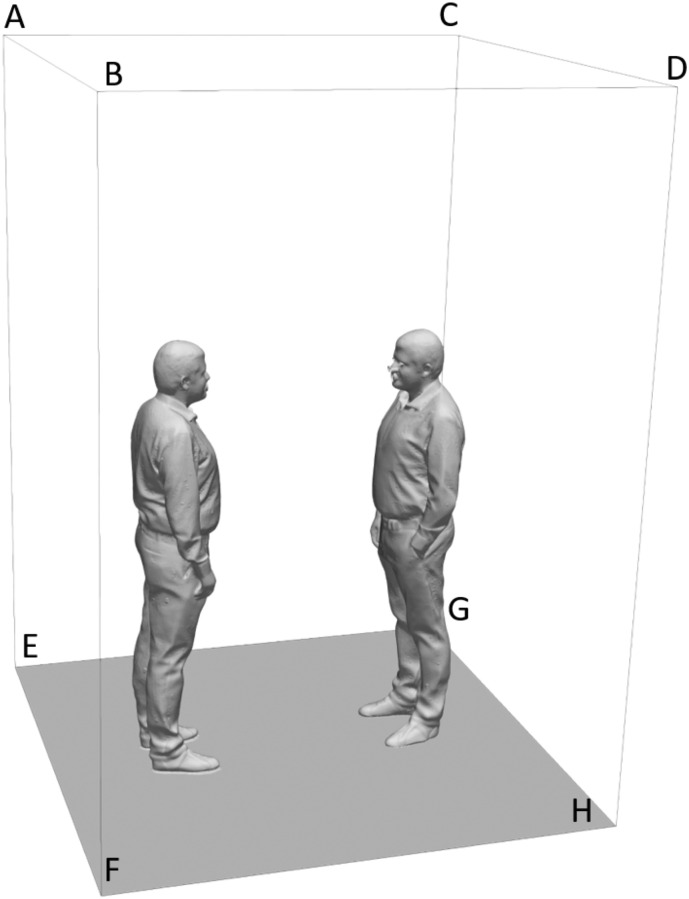
Computational domain in which the emitter (on the left), the receiver (on the right), and the external surfaces have been highlighted.
Fig. 2
Fig. 2
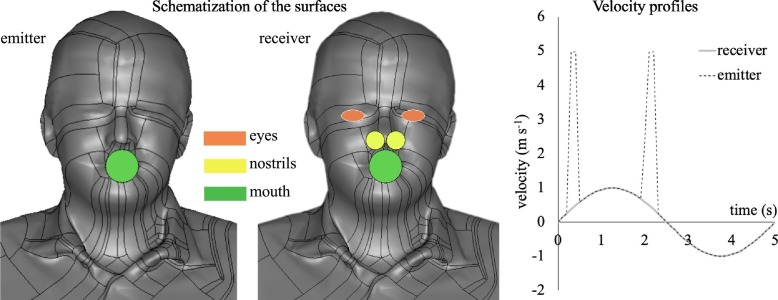
Schematization of the surfaces of interest for emitter and receiver (eyes, nostrils, and mouth) and the transient velocity profile adopted as a boundary condition at the emitter and receiver mouths.
Fig. 3
Fig. 3
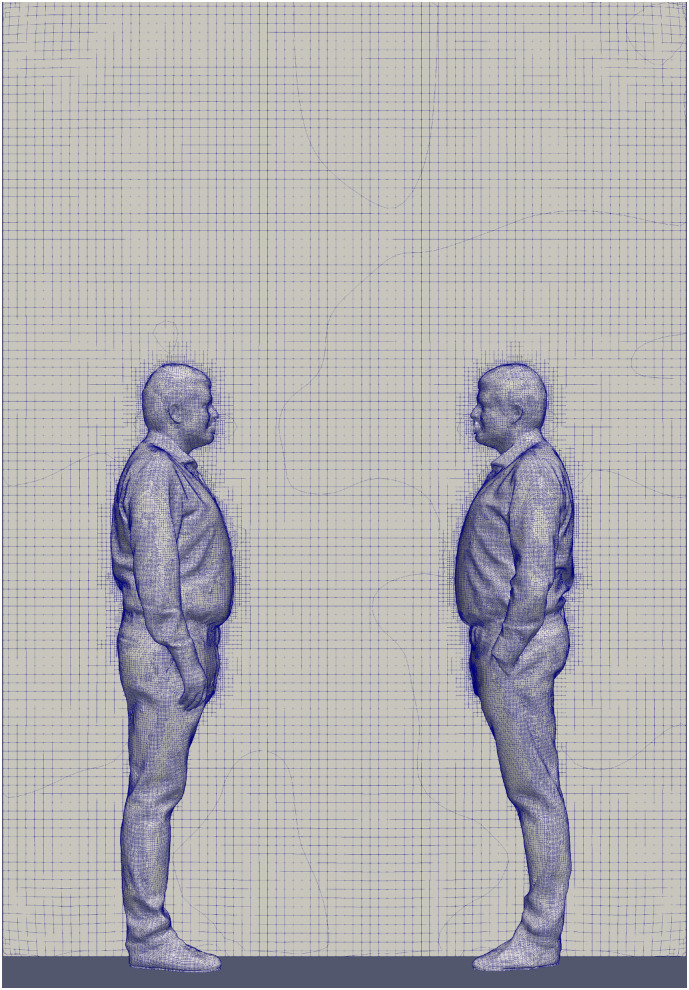
Computational grid employed (Mesh 2, 1,801,060 elements) to simulate droplet spread in the case of an interpersonal distance of 0.76 m.
Fig. 4
Fig. 4
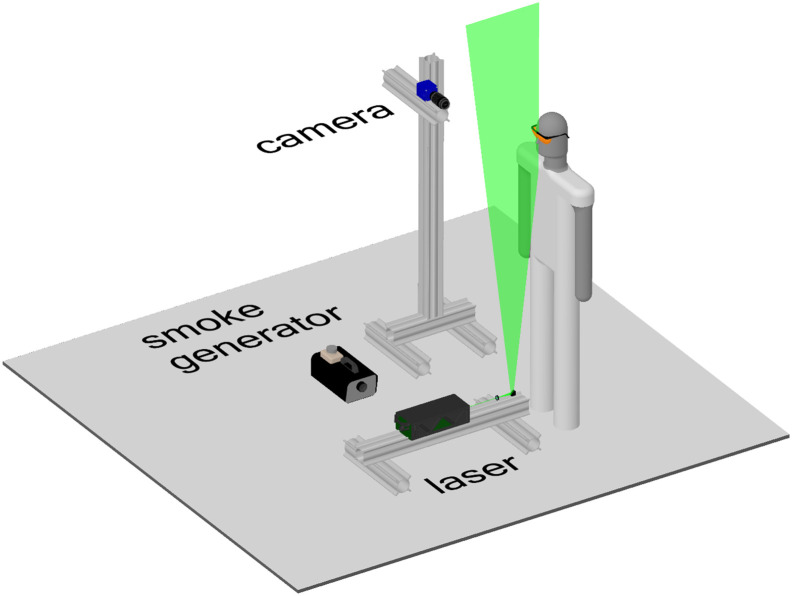
Particle image velocimetry experimental setup.
Fig. 5
Fig. 5
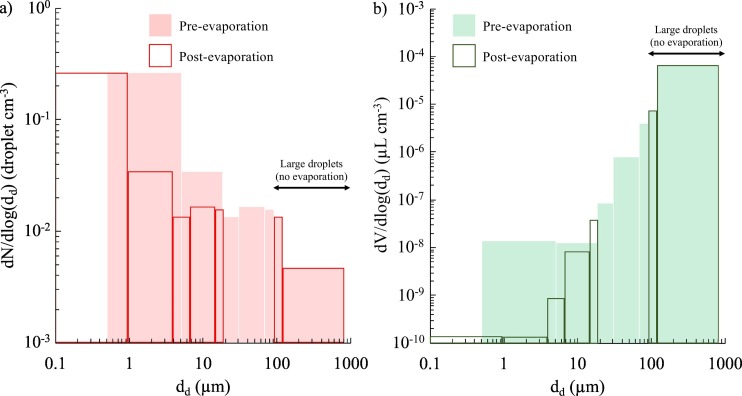
Droplet number (a) and volume (b) distributions adopted in the simulations as fitted through seven size ranges; in particular, distributions pre- and post-evaporation are reported to show how airborne and large droplets are affected by the evaporation phenomenon.
Fig. 6
Fig. 6
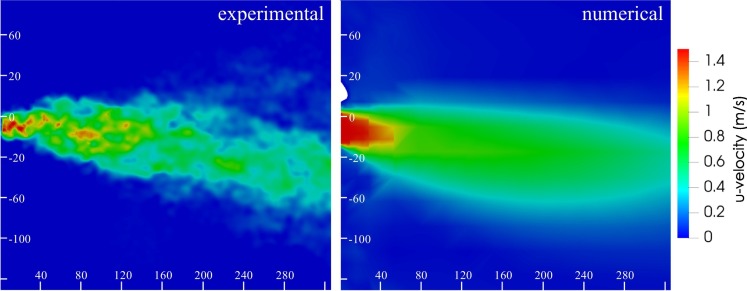
Experimental and CFD velocity contours obtained in a sagittal plane by synchronizing the instant of time for breathing at which the maximum velocity values are reached. Scales bars are reported in mm.
Fig. 7
Fig. 7
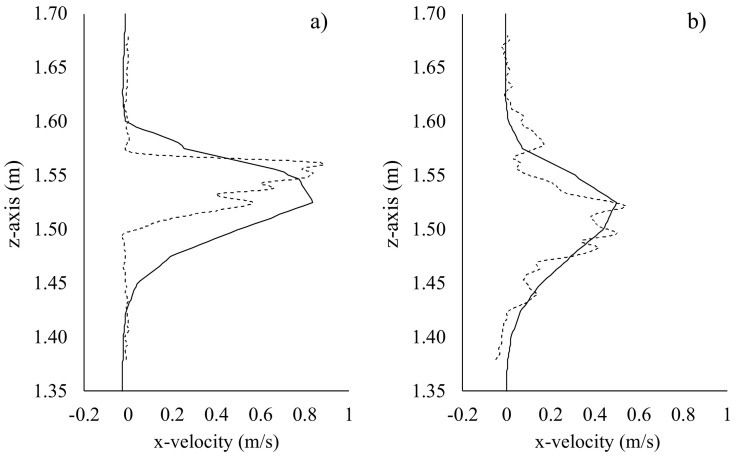
Experimental (particle image velocimetry, dotted lines) and CFD (solid lines) velocity profile comparison obtained in a sagittal plane at a distance from the emitter mouth equal to 0.10 m (a) and 0.32 m (b).
Fig. 8
Fig. 8
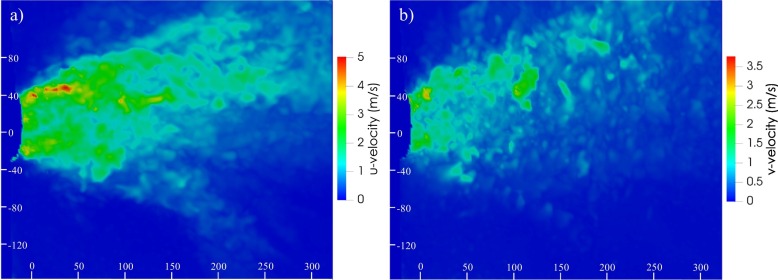
Instantaneous u-velocity (a) and v-velocity (b) contours for a cross-section plane at the height of the mouth obtained by particle image velocimetry during reading of the excerpt from the rainbow passage. Scales bars are reported in mm.
Fig. 9
Fig. 9
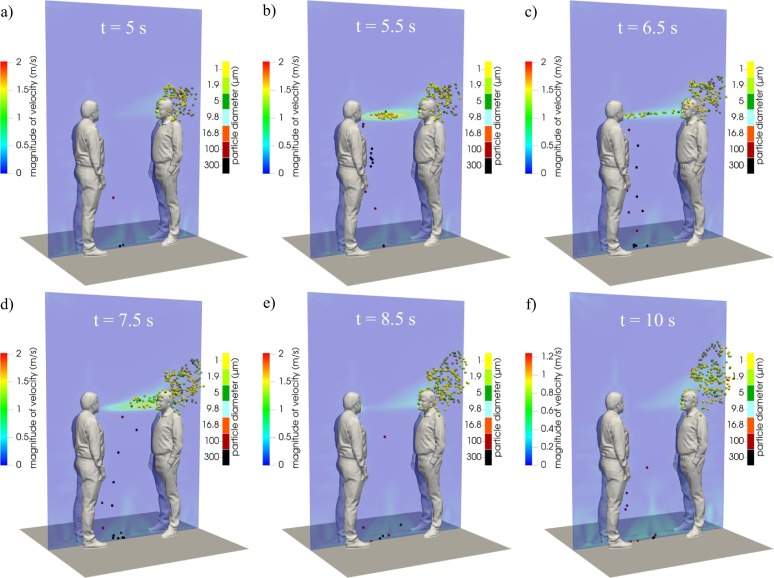
Numerical velocity contours during a single breath at a distance of 0.76 m between people: six selected computational times (5, 5.5, 6.5, 7.5, 8.5, and 10 s) are shown.
Fig. 10
Fig. 10
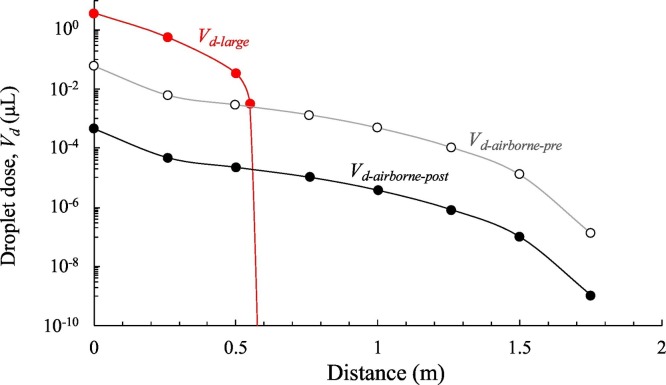
1-min large (Vd-large) and airborne droplet doses (Vd-airborne-pre and Vd-airborne-post) received by the susceptible subject (by deposition and inhalation, respectively) as a function of the distance between the two subjects.
Fig. 11
Fig. 11
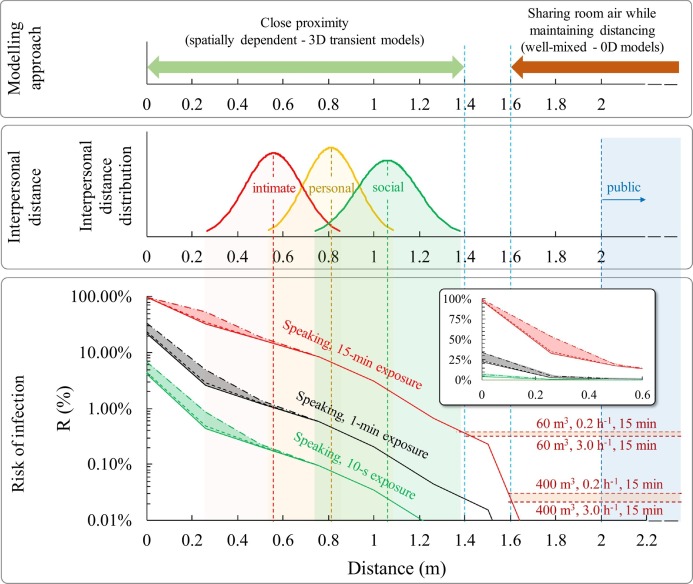
Infection risk (R, %) of a susceptible subject as a function of the time of exposure and interpersonal distance from the infected subject; infection risk trends at short and long distances are highlighted as well as the modeling approaches to be applied. The contributions of both deposited large droplets and inhaled airborne droplets are reported; in particular the risk contribution of the large droplets by deposition is shown considering a contribution of the dose of RNA copies related to the deposition of large droplets of one hundredth (dash-dotted line), one thousandth (dashed line), and negligible (solid line) with respect to inhalation of airborne droplets; the risk for distance <0.6 m was also zoomed to highlight the different relative contributions of the large droplets in these three different assumptions.

References

    1. Abkarian M., Mendez S., Xue N., Yang F., Stone H.A. Speech can produce jet-like transport relevant to asymptomatic spreading of virus. Proc. Natl. Acad. Sci. 2020;117:25237. doi: 10.1073/pnas.2012156117. - DOI - PMC - PubMed
    1. Ai Z.T., Melikov A.K. Airborne spread of expiratory droplet nuclei between the occupants of indoor environments: a review. Indoor Air. 2018;28:500–524. doi: 10.1111/ina.12465. - DOI - PubMed
    1. Ai Z., Hashimoto K., Melikov A.K. Influence of pulmonary ventilation rate and breathing cycle period on the risk of cross-infection. Indoor Air. 2019;29:993–1004. doi: 10.1111/ina.12589. - DOI - PubMed
    1. Arpino F., Cortellessa G., Dell’Isola M., Massarotti N., Mauro A. High order explicit solutions for the transient natural convection of incompressible fluids in tall cavities. Numer. Heat Transf. Part Appl. 2014;66:839–862. doi: 10.1080/10407782.2014.892389. - DOI
    1. Balachandar S., Zaleski S., Soldati A., Ahmadi G., Bourouiba L. Host-to-host airborne transmission as a multiphase flow problem for science-based social distance guidelines. Int. J. Multiphase Flow. 2020;132:103439. doi: 10.1016/j.ijmultiphaseflow.2020.103439. - DOI