


Fitness, strength and severity of COVID-19: a prospective register study of 1 559 187 Swedish conscripts
- PMID: 34226237
- PMCID: PMC8260308
- DOI: 10.1136/bmjopen-2021-051316
Fitness, strength and severity of COVID-19: a prospective register study of 1 559 187 Swedish conscripts
Abstract
Objective: To investigate the possible connection between cardiorespiratory fitness (CRF) and muscle strength in early adulthood and severity of COVID-19 later in life.
Design: Prospective registry-based cohort study.
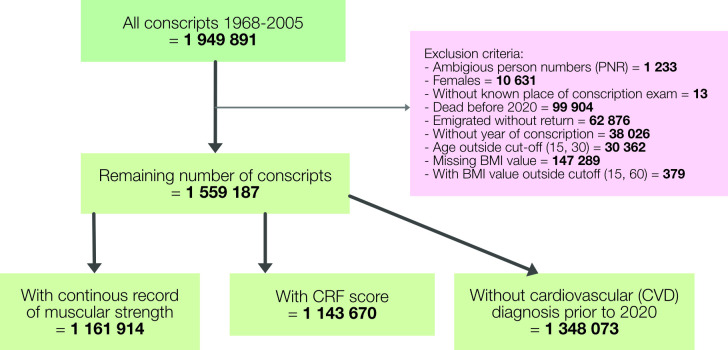
Participants: 1 559 187 Swedish men, undergoing military conscription between 1968 and 2005 at a mean age of 18.3 (SD 0.73) years.
Main outcome measures: Hospitalisation, intensive care or death due to COVID-19 from March to September 2020, in relation to CRF and muscle strength.
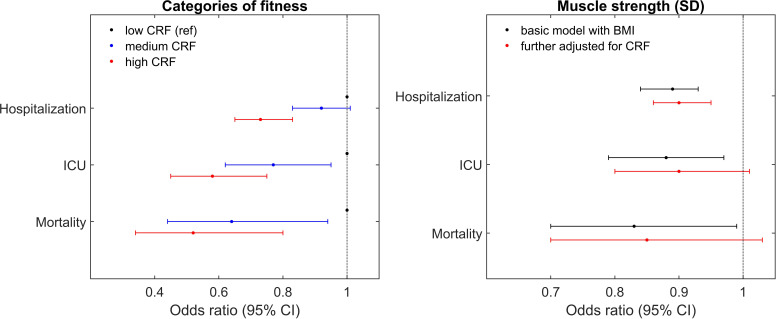
Results: High CRF in late adolescence and early adulthood had a protective association with severe COVID-19 later in life with OR (95% CI) 0.76 (0.67 to 0.85) for hospitalisation (n=2 006), 0.61 (0.48 to 0.78) for intensive care (n=445) and 0.56 (0.37 to 0.85) for mortality (n=149), compared with the lowest category of CRF. The association remains unchanged when controlled for body mass index (BMI), blood pressure, chronic diseases and parental education level at baseline, and incident cardiovascular disease before 2020. Moreover, lower muscle strength in late adolescence showed a linear association with a higher risk of all three outcomes when controlled for BMI and height.
Conclusions: Physical fitness at a young age is associated with severity of COVID-19 many years later. This underscores the necessity to increase the general physical fitness of the population to offer protection against future viral pandemics.
Keywords: COVID-19; epidemiology; public health.
© Author(s) (or their employer(s)) 2021. Re-use permitted under CC BY. Published by BMJ.
Conflict of interest statement
Competing interests: None declared.
Figures
References
-
- Ross R, Blair S, Arena R. American heart association physical activity Committee of the Council on lifestyle and cardiometabolic health; Council on clinical cardiology; Council on epidemiology and prevention; Council on cardiovascular and stroke nursing; Council on functional genomics and translational biology; stroke Council. Importance of assessing cardiorespiratory fitness in clinical practice: a case for fitness as a clinical vital sign: a scientific statement from the American heart association. Circulation 2016;134:e653–99. - PubMed
Publication types
MeSH terms
LinkOut - more resources
Full Text Sources
Medical
