Review
. 2021 Oct;125(8):1056-1067.
doi: 10.1038/s41416-021-01424-8. Epub 2021 Jul 5.

Breast cancer brain metastasis: insight into molecular mechanisms and therapeutic strategies

Affiliations
Review

Breast cancer brain metastasis: insight into molecular mechanisms and therapeutic strategies

Yajie Wang et al. Br J Cancer. 2021 Oct.

Abstract

Breast cancer is one of the most prevalent malignancies in women worldwide. Early-stage breast cancer is considered a curable disease; however, once distant metastasis occurs, the 5-year overall survival rate of patients becomes significantly reduced. There are four distinct metastatic patterns in breast cancer: bone, lung, liver and brain. Among these, breast cancer brain metastasis (BCBM) is the leading cause of death; it is highly associated with impaired quality of life and poor prognosis due to the limited permeability of the blood-brain barrier and consequent lack of effective treatments. Although the sequence of events in BCBM is universally accepted, the underlying mechanisms have not yet been fully elucidated. In this review, we outline progress surrounding the molecular mechanisms involved in BCBM as well as experimental methods and research models to better understand the process. We further discuss the challenges in the management of brain metastases, as well as providing an overview of current therapies and highlighting innovative research towards developing novel efficacious targeted therapies.


Conflict of interest statement

The authors declare no competing interests.

Figures
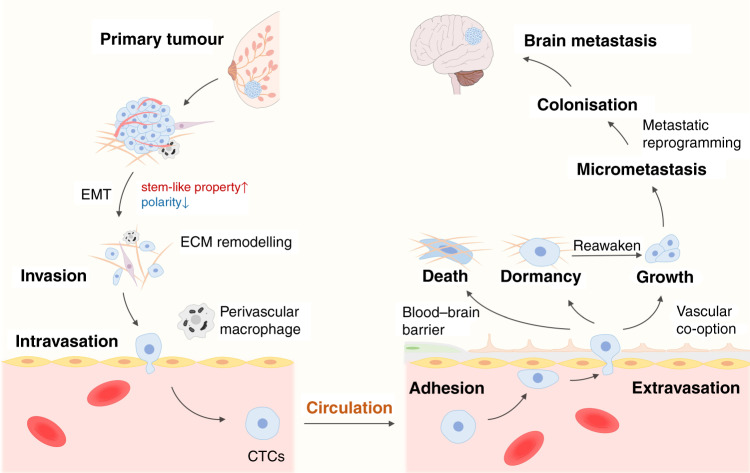
Fig. 1
Fig. 1. Breast cancer cell metastatic dissemination to brain.
a small population of cells at the primary site acquired invasive properties before gaining stem-cell-like properties and losing cell polarity through epithelial-to-mesenchymal transition (EMT). Invasive cancer cells then infiltrate the surrounding tissue by ECM remodelling, and the become circulating tumour cells (CTCs) with the help of perivascular macrophages and interaction with blood vessel endothelial cells (ECs). By virtue of the bloodstream, cancer cells then spread throughout the body and cross the blood–brain barrier (BBB) through extravasation after their adhesion with ECs in the brain. Subsequently, most cells die or enter a state of dormancy, few proliferate within this new microenvironment. Vascular co-option can be regarded as the first step of colonisation and then micrometastases forms. After metabolic reprogramming, tumour cells establish a more stable colonisation and then form brain metastasis. Besides, dormant cells tend to be reawakened in certain condition and participate in colonisation and cause tumour recurrence.
Fig. 2
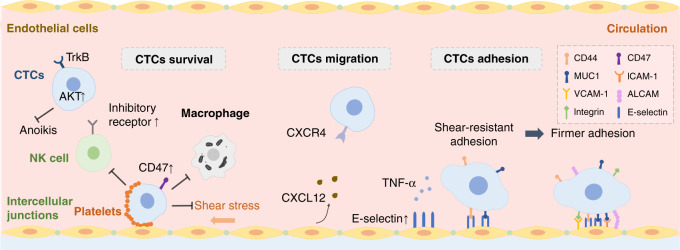
Fig. 2. Survival, migration and adhesion of CTCs in breast cancer brain metastasis.
In the bloodstream, a number of circulating tumours cells (CTCs) can successfully survive by upregulating AKT and CD47 to resist shear stress and escape clearance by immune cells such as natural killer (NK) cells and macrophages. The interaction of CXCR4 on CTCs with CXCL12 secreted by endothelial cells (ECs) facilitates chemotactic migration to the brain. CTCs undergo shear-resistant adhesion to the inside of blood vessel walls by expressing CD44 and MUC1, which interact with E-selectin on ECs. To achieve stronger adhesion, further cell adhesion molecules, such as ICAM-1, VCAM-1, ALCAM and integrin, will be expressed on CTCs and ECs.
Fig. 3
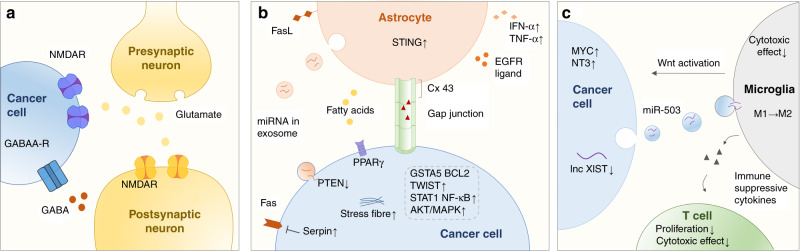
Fig. 3. Interactions between cancer cells and resident cells.
The main host cells that interact with tumour cells in the brain include neurons, astrocytes and microglia. a Breast cancer cells that metastasis to the brain can develop a GABAergic or glutamatergic phenotype to take up GABA and glutamate for proliferation. b Interactions between astrocytes and cancer cells through gap-junction communication can activate the STING pathway in astrocytes as well as STAT1, NF-κB and AKT–MAPK pathway in cancer cells, and also upregulate GSTA5, BCL2L1 and TWIST1 in BC cells to enhance tumour growth and chemoresistance. Exosome-mediated secretion miRNAs downregulate the tumour suppressor PTEN. Other key molecule such as serpins, PPARγ, EGFR ligands and vital processes such as actin stress fibre organisation also promote BC cell colonisation. c Interactions between cancer cells, microglia and T cells can promote BCBM immune escape. Exosomal miR-503 regulated by lncRNA XIST in cancer cells prompted microglia M2 polarisation. M2-like phenotype promote BCBM invasion and colonisation in a Wnt-dependent manner and suppress T-cell proliferation and cytotoxic effect by immune-suppressive cytokines secretion.
Fig. 4
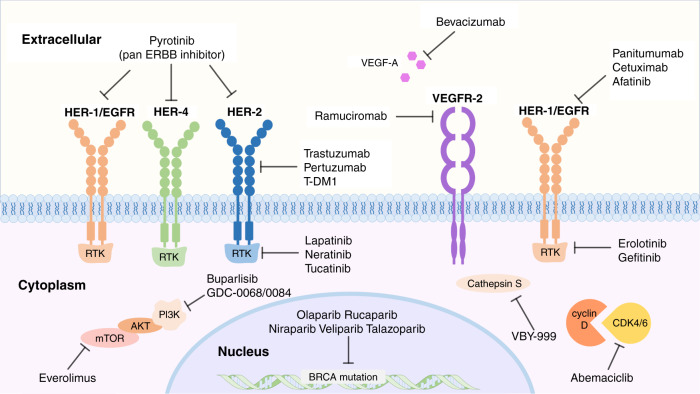
Fig. 4. Targeted therapy of BCBM treatment.
Increased research into the molecular mechanisms of breast cancer brain metastasis has identified that, key molecule inhibitors such as PARP inhibitors, cathepsin S inhibitors, HER2/ERBB inhibitors, EGFR inhibitors; and pathway inhibitors such as VEGF pathway inhibitors, PI3K–Akt–mTOR pathway inhibitors and CDK4/6 pathway inhibitors, play vital roles and that have become target of study in preclinical research or clinical trials.

References

    1. Siegel RL, Miller KD, Jemal A. Cancer statistics, 2020. CA Cancer J. Clin. 2020;70:7–30. doi: 10.3322/caac.21590. - DOI - PubMed
    1. Liang Y, Zhang H, Song X, Yang Q. Metastatic heterogeneity of breast cancer: molecular mechanism and potential therapeutic targets. Semin. Cancer Biol. 2020;60:14–27. doi: 10.1016/j.semcancer.2019.08.012. - DOI - PubMed
    1. Kanchan RK, Siddiqui JA, Mahapatra S, Batra SK, Nasser MW. microRNAs orchestrate pathophysiology of breast cancer brain metastasis: advances in therapy. Mol. Cancer. 2020;19:29. doi: 10.1186/s12943-020-1140-x. - DOI - PMC - PubMed
    1. Ren D, Cheng H, Wang X, Vishnoi M, Teh BS, Rostomily R, et al. Emerging treatment strategies for breast cancer brain metastasis: from translational therapeutics to real-world experience. Ther. Adv. Med. Oncol. 2020;12:1758835920936151. - PMC - PubMed
    1. Wang S, Liang K, Hu Q, Li P, Song J, Yang Y, et al. JAK2-binding long noncoding RNA promotes breast cancer brain metastasis. J. Clin. Invest. 2017;127:4498–515.. doi: 10.1172/JCI91553. - DOI - PMC - PubMed

Publication types