


Endothelial Dysfunction is Associated With Early-Onset Cryptogenic Ischemic Stroke in Men and With Increasing Age
- PMID: 34227391
- PMCID: PMC8483459
- DOI: 10.1161/JAHA.121.020838
Endothelial Dysfunction is Associated With Early-Onset Cryptogenic Ischemic Stroke in Men and With Increasing Age
Abstract
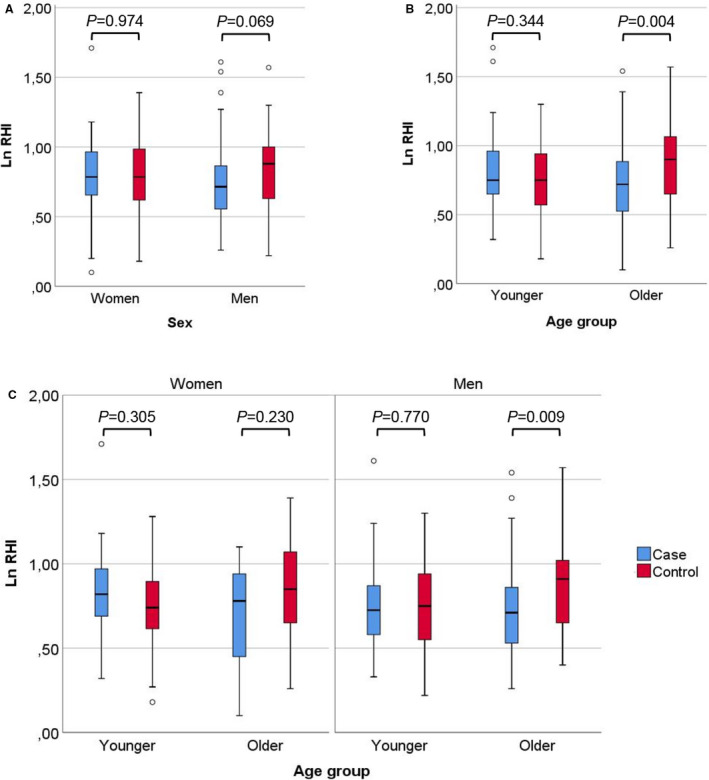
Background The aim of this study was to assess the association between endothelial function and early-onset cryptogenic ischemic stroke (CIS), with subgroup analyses stratified by sex and age groups. Methods and Results We prospectively enrolled 136 consecutive patients aged 18 to 49 years (median age, 41 years; 44% women) with a recent CIS and 136 age- and sex-matched (±5 years) stroke-free controls. Endothelial function was measured with an EndoPAT 2000 device and analyzed as tertiles of natural logarithm of reactive hyperemia index with lower values reflecting dysfunction. We used conditional logistic regression adjusting for age, education, hypertension, diabetes mellitus, dyslipidemia, current smoking, heavy drinking, obesity, and diet score to assess the independent association between endothelial function and CIS. Patients in the lowest tertile of natural logarithm of reactive hyperemia index were more often men and they more frequently had a history of dyslipidemia; they were also more often obese, had a lower diet score, and lower high-density lipoprotein cholesterol. In the entire cohort, we found no association in patients with endothelial function and CIS compared with stroke-free controls. In sex- and age-specific analyses, endothelial dysfunction was associated with CIS in men (adjusted odds ratio [OR], 3.50 for lowest versus highest natural logarithm of reactive hyperemia index tertile; 95% CI, 1.22-10.07) and in patients ≥41 years (OR, 5.78; 95% CI, 1.52-21.95). These associations remained significant when dyslipidemia was replaced with the ratio of total to high-density lipoprotein cholesterol. Conclusions Endothelial dysfunction appears to be an independent player in early-onset CIS in men and patients approaching middle age.
Keywords: brain infarction; cryptogenic stroke; endothelial function; ischemic stroke; microcirculation; risk factors; young adults.
Conflict of interest statement
D.G. has received lecture or advisory honoraria from AstraZeneca, Boehringer Ingelheim, Fresenius, GE Healthcare, and Novo Nordisk; and support to attend medical meetings from CVRx and Sanofi Aventis. T.T. reports academic grants from European Union, Finnish Academy of Sciences, University of Gothenburg, Sahlgrenska University Hospital, Sigrid Juselius Foundation, and Wennerström’s Foundation; research contracts with Bayer, Boehringer Ingelheim, and Bristol Myers Squibb; and advisory board memberships with Bayer, Boehringer Ingelheim, Bristol Myers Squibb, and Portola Pharm. The remaining authors have no disclosures to report.
Figures
References
-
- Yesilot Barlas N, Putaala J, Waje‐Andreassen U, Vassilopoulou S, Nardi K, Odier C, Hofgart G, Engelter S, Burow A, Mihalka L, et al. Etiology of first‐ever ischaemic stroke in European young adults: the 15 cities young stroke study. Eur J Neurol. 2013;20:1431–1439. DOI: 10.1111/ene.12228 - DOI - PubMed
Publication types
MeSH terms
LinkOut - more resources
Full Text Sources
Medical
