


Understanding opioid overdose risk and response preparedness among people who use cocaine and other drugs: Mixed-methods findings from a large, multi-city study
- PMID: 34228944
- PMCID: PMC9155258
- DOI: 10.1080/08897077.2021.1946893
Understanding opioid overdose risk and response preparedness among people who use cocaine and other drugs: Mixed-methods findings from a large, multi-city study
Abstract
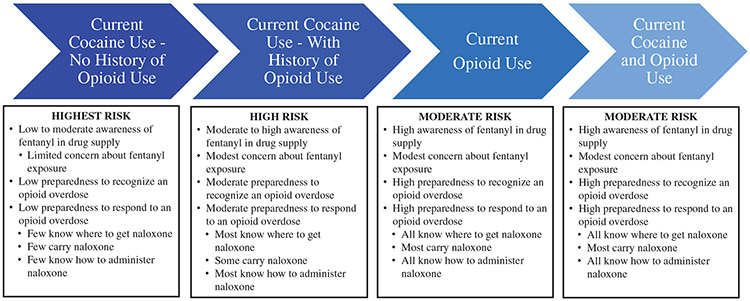
Background: Fatal overdoses involving cocaine (powdered or crack) and fentanyl have increased nationally and in Massachusetts. It is unclear how overdose risk and preparedness to respond to an overdose differs by patterns of cocaine and opioid use. Methods: From 2017 to 2019, we conducted a nine-community mixed-methods study of Massachusetts residents who use drugs. Using survey data from 465 participants with past-month cocaine and/or opioid use, we examined global differences (p < 0.05) in overdose risk and response preparedness by patterns of cocaine and opioid use. Qualitative interviews (n = 172) contextualized survey findings. Results: The majority of the sample (66%) used cocaine and opioids in the past month; 18.9% used opioids alone; 9.2% used cocaine and had no opioid use history; and 6.2% used cocaine and had an opioid use history. Relative to those with a current/past history of opioid use, significantly fewer of those with no opioid use history were aware of fentanyl in the drug supply, carried naloxone, and had received naloxone training. Qualitative interviews documented how people who use cocaine and have no history of opioid use are largely unprepared to recognize and respond to an overdose. Conclusions: Public health efforts are needed to increase fentanyl awareness and overdose prevention preparedness among people primarily using cocaine.
Keywords: Substance use; cocaine; crack; opioids; overdose.
Conflict of interest statement
Disclosure statement
No potential conflict of interest was reported by the author(s).
Figures
References
-
- Massachusetts Department of Public Health. The Massachusetts opioid epidemic: a data visualization of findings from the Chapter 55 report. 2018. http://www.mass.gov/chapter55/ViewinArticle. Accessed January 17, 2018.
-
- MDPH. Data brief: opioid1-related overdose deaths among Massachusetts residents. 2017. https://www.mass.gov/doc/opioid-related-overdose-deaths-among-ma-residen.... Accessed January 17, 2021.
-
- MDPH. Data brief trends in stimulant-related overdose deaths. 2020. https://www.mass.gov/doc/data-brief-trends-in-stimulantrelated-overdose-....
Publication types
MeSH terms
Substances
Grants and funding
LinkOut - more resources
Full Text Sources
Medical
Miscellaneous
