. 2021 Jul 6;12(1):4015.
doi: 10.1038/s41467-021-24265-8.

Lack of consideration of sex and gender in COVID-19 clinical studies

Affiliations

Lack of consideration of sex and gender in COVID-19 clinical studies

Emer Brady et al. Nat Commun. .

Abstract

Sex and gender differences impact the incidence of SARS-CoV-2 infection and COVID-19 mortality. Furthermore, sex differences influence the frequency and severity of pharmacological side effects. A large number of clinical trials to develop new therapeutic approaches and vaccines for COVID-19 are ongoing. We investigated the inclusion of sex and/or gender in COVID-19 studies on ClinicalTrials.gov, collecting data for the period January 1, 2020 to January 26, 2021. Here, we show that of the 4,420 registered SARS-CoV-2/COVID-19 studies, 935 (21.2%) address sex/gender solely in the context of recruitment, 237 (5.4%) plan sex-matched or representative samples or emphasized sex/gender reporting, and only 178 (4%) explicitly report a plan to include sex/gender as an analytical variable. Just eight (17.8%) of the 45 COVID-19 related clinical trials published in scientific journals until December 15, 2020 report sex-disaggregated results or subgroup analyses.


Conflict of interest statement

The authors declare no competing interests.

Figures
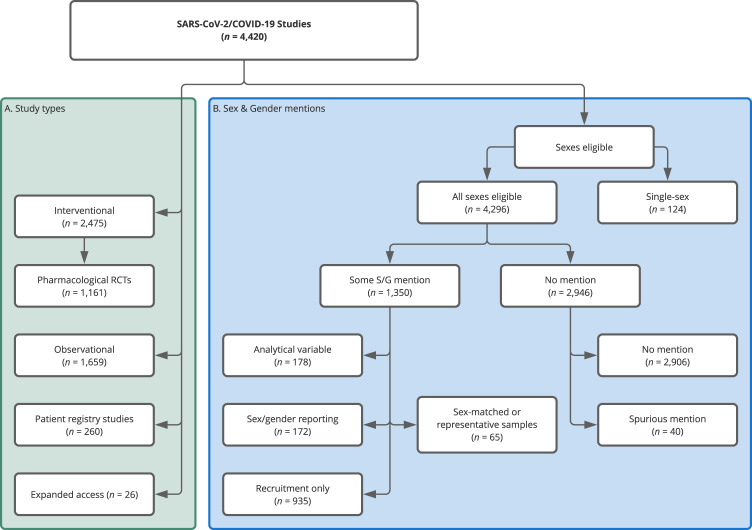
Fig. 1
Fig. 1. Study types and allocation into sex/gender (S/G) attention groups for the COVID-19 sample.
The left-hand (green) panel shows the distribution of the 4420 identified studies across study types. We created the (Pharmacological) RCT label following the procedure outlined in Methods section, the other classifications are taken from ClinicalTrials.gov. The right-hand panel (blue) shows the distribution of studies across the various mutually exclusive sex/gender groups we defined (see Methods section). In the ‘Some S/G mention’ set there is a hierarchy. The most extensive consideration was sex/gender as an analytical variable and after that sex/gender matching/representation, followed by explicit statements of intent to record or report participant sex/gender. Finally, the ‘Recruitment Only’ contains those studies whose only sex/gender mention was in a recruiting context. We allocated the studies to one of the categories based on the highest category of S/G consideration. For instance, if they reported attention to S/G in analysis and recruiting, we only counted them in analysis.
Fig. 2
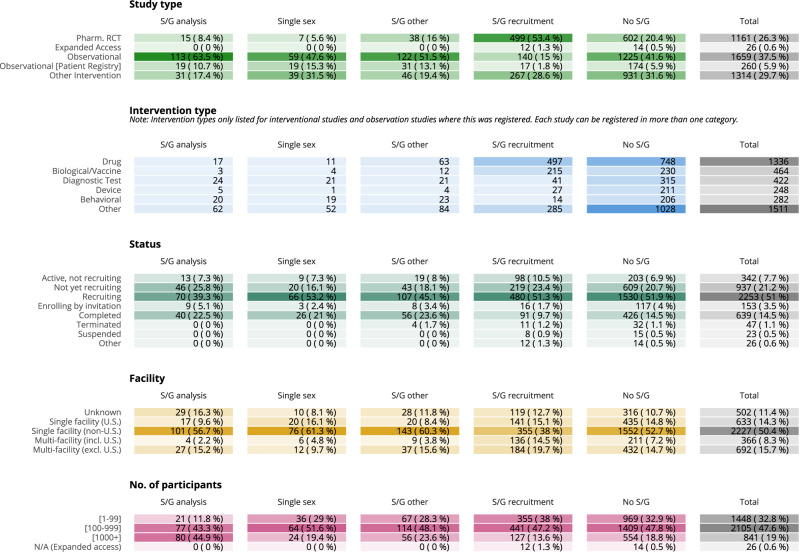
Fig. 2. Properties of COVID-19 Studies in the sample and level of attention to sex/gender (S/G).
Sex/gender coding and properties of studies at time of data collection on 26 January 2021. Studies are reported according to different analytical criteria. Color blocks represent one category of analysis. Studies are exclusively allocated to one category per analysis, with the exception of the “intervention” category. Here, studies can propose multiple interventions and, hence, appear under each unique intervention type they include. In the facility section, we focus on the number (single or multiple) and location (US or non-US) of the facilities recruiting participants into the studies. Address information for facilities is available for 89% of our full COVID-19 set. All studies (except the 26 Expanded Access) provide enrollment details and they are mostly ‘anticipated’, i.e. target numbers (80%).

References

    1. Pérez-López FR, et al. Coronavirus disease 2019 and gender-related mortality in European countries: a meta-analysis. Maturitas. 2020;141:59–62. doi: 10.1016/j.maturitas.2020.06.017. - DOI - PMC - PubMed
    1. Klein SL, Flanagan KL. Sex differences in immune responses. Nat. Rev. Immunol. 2016;16:626–638. doi: 10.1038/nri.2016.90. - DOI - PubMed
    1. Hoffmann M, et al. SARS-CoV-2 cell entry depends on ACE2 and TMPRSS2 and is blocked by a clinically proven protease inhibitor. Cell. 2020;181:271–280 e278. doi: 10.1016/j.cell.2020.02.052. - DOI - PMC - PubMed
    1. van der Made, C. I. et al. Presence of genetic variants among young men with severe COVID-19. JAMA, 10.1001/jama.2020.13719 (2020). - PMC - PubMed
    1. Scully EP, Haverfield J, Ursin RL, Tannenbaum C, Klein SL. Considering how biological sex impacts immune responses and COVID-19 outcomes. Nat. Rev. Immunol. 2020;20:442–447. doi: 10.1038/s41577-020-0348-8. - DOI - PMC - PubMed

Publication types