


Erythrocytes identify complement activation in patients with COVID-19
- PMID: 34231390
- PMCID: PMC8384475
- DOI: 10.1152/ajplung.00231.2021
Erythrocytes identify complement activation in patients with COVID-19
Abstract
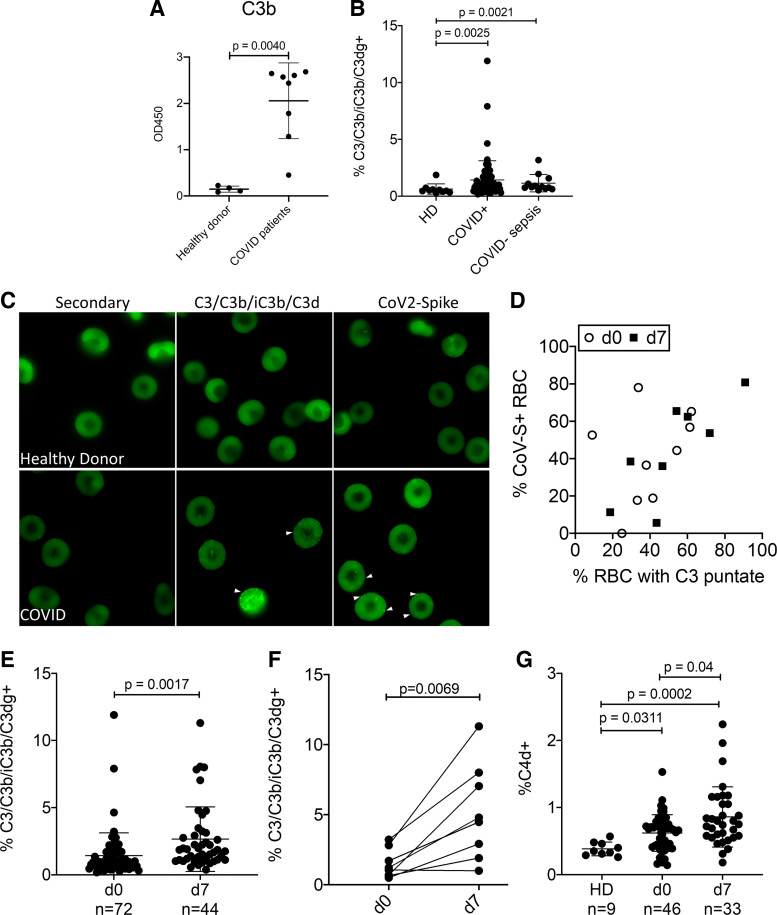
COVID-19, the disease caused by the SARS-CoV-2 virus, can progress to multisystem organ failure and viral sepsis characterized by respiratory failure, arrhythmias, thromboembolic complications, and shock with high mortality. Autopsy and preclinical evidence implicate aberrant complement activation in endothelial injury and organ failure. Erythrocytes express complement receptors and are capable of binding immune complexes; therefore, we investigated complement activation in patients with COVID-19 using erythrocytes as a tool to diagnose complement activation. We discovered enhanced C3b and C4d deposition on erythrocytes in COVID-19 sepsis patients and non-COVID sepsis patients compared with healthy controls, supporting the role of complement in sepsis-associated organ injury. Our data suggest that erythrocytes may contribute to a precision medicine approach to sepsis and have diagnostic value in monitoring complement dysregulation in COVID-19-sepsis and non-COVID sepsis and identifying patients who may benefit from complement targeted therapies.
Keywords: COVID-19; SARS-CoV-2; complement; erythrocyte; sepsis.
Figures
Update of
-
Erythrocytes Reveal Complement Activation in Patients with COVID-19.medRxiv [Preprint]. 2020 May 22:2020.05.20.20104398. doi: 10.1101/2020.05.20.20104398. medRxiv. 2020. Update in: Am J Physiol Lung Cell Mol Physiol. 2021 Aug 1;321(2):L485-L489. doi: 10.1152/ajplung.00231.2021. PMID: 32511554 Free PMC article. Updated. Preprint.
References
-
- Holter JC, Pischke SE, de Boer E, Lind A, Jenum S, Holten AR, Tonby K, Barratt-Due A, Sokolova M, Schjalm C, Chaban V, Kolderup A, Tran T, Gjolberg TT, Skeie LG, Hesstvedt L, Ormasen V, Fevang B, Austad C, Muller KE, Fladeby C, Holberg-Petersen M, Halvorsen B, Muller F, Aukrust P, Dudman S, Ueland T, Andersen JT, Lund-Johansen F, Heggelund L, Dyrhol-Riise AM, Mollnes TE. Systemic complement activation is associated with respiratory failure in COVID-19 hospitalized patients. Proc Natl Acad Sci USA 117: 25018–25025, 2020. doi: 10.1073/pnas.2010540117. - DOI - PMC - PubMed
-
- Magro C, Mulvey JJ, Berlin D, Nuovo G, Salvatore S, Harp J, Baxter-Stoltzfus A, Laurence J. Complement associated microvascular injury and thrombosis in the pathogenesis of severe COVID-19 infection: a report of five cases. Transl Res 220: 1–13, 2020. doi: 10.1016/j.trsl.2020.04.007. - DOI - PMC - PubMed
-
- Gao T, Hu M, Zhang X, Li H, Zhu L, Liu H, et al. Highly pathogenic coronavirus N protein aggravates lung injury by MASP-2-mediated complement over-activation (Preprint). medRxiv, 2020. doi: 10.1101/2020.03.29.20041962. - DOI
Publication types
MeSH terms
Substances
Grants and funding
LinkOut - more resources
Full Text Sources
Medical
Miscellaneous
