


A cross sectional study to compare cardiac structure and diastolic function in adolescents and young adults with youth-onset type 1 and type 2 diabetes: The SEARCH for Diabetes in Youth Study
- PMID: 34233679
- PMCID: PMC8265135
- DOI: 10.1186/s12933-021-01328-0
A cross sectional study to compare cardiac structure and diastolic function in adolescents and young adults with youth-onset type 1 and type 2 diabetes: The SEARCH for Diabetes in Youth Study
Abstract
Aims: To compare left ventricular structure (LV) and diastolic function in young adults with youth- onset diabetes by type, determine the prevalence of abnormal diastolic function by diabetes type using published values from age similar healthy controls, and examine the risk factors associated with diastolic function.
Methods: In a cross sectional analysis we compared LV structure and diastolic function from two dimensional echocardiogram in participants with type 1 (T1D) and type 2 diabetes (T2D) who participated in the SEARCH for Diabetes in Youth Study. Linear models were used to examine the risk factors associated with worse diastolic function.
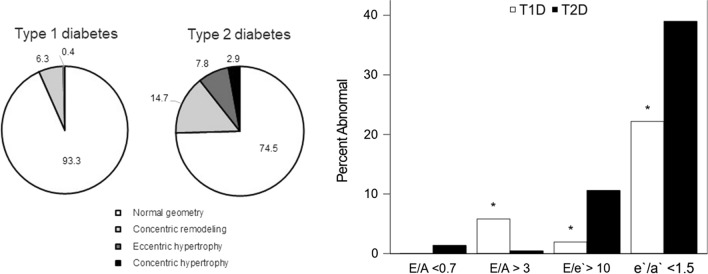
Results: Of 479 participants studied, 258 had T1D (mean age 21.2 ± 5.2 years, 60.5% non-Hispanic white, 53.9% female) and 221 had T2D (mean age 24.8 ± 4.3 years, 24.4% non-Hispanic white, 73.8% female). Median diabetes duration was 11.6 years. Participants with T2D had greater LV mass index and worse diastolic function that persisted after adjustment for differences in risk factors compared with participants with T1D (all p < 0.05). Abnormal diastolic function, quantified using healthy controls, was pronounced in both groups but greater in those with T2D than T1D (T2D: 57.7% vs T1D: 47.2%, respectively), p < 0.05. Risk factors associated with worse diastolic function included older age at diabetes diagnosis, female sex, higher BP, heart rate and HbA1c and longer diabetes duration.
Conclusions: LV structure and diastolic function is worse in individuals with T2D compared to T1D. However, abnormal diastolic function in seen in both groups compared to published values from age similar healthy controls.
Keywords: Cardiac structure; Diastolic function; Pediatrics; Type 1 diabetes; Type 2 diabetes; Young adults.
Conflict of interest statement
There are no conflicts of interest or competing interests to report.
Figures
References
-
- Hirakawa Y, Ninomiya T, Kiyohara Y, Murakami Y, Saitoh S, Nakagawa H, et al. Age-specific impact of diabetes mellitus on the risk of cardiovascular mortality: an overview from the evidence for Cardiovascular Prevention from Observational Cohorts in the Japan Research Group (EPOCH-JAPAN) J Epidemiol. 2017;27(3):123–129. doi: 10.1016/j.je.2016.04.001. - DOI - PMC - PubMed
Publication types
MeSH terms
Grants and funding
- P30 DK057516/DK/NIDDK NIH HHS/United States
- U01 DP000244/DP/NCCDPHP CDC HHS/United States
- U18 DP006139/DP/NCCDPHP CDC HHS/United States
- U01 DP000250/DP/NCCDPHP CDC HHS/United States
- U18 DP002714/DP/NCCDPHP CDC HHS/United States
- U18 DP002709/DP/NCCDPHP CDC HHS/United States
- U18 DP006136/DP/NCCDPHP CDC HHS/United States
- U01 DP000246/DP/NCCDPHP CDC HHS/United States
- U01 DP000254/DP/NCCDPHP CDC HHS/United States
- UL1 TR000062/TR/NCATS NIH HHS/United States
- U18 DP002710/DP/NCCDPHP CDC HHS/United States
- U18 DP006138/DP/NCCDPHP CDC HHS/United States
- U18 DP002708/DP/NCCDPHP CDC HHS/United States
- UL1 TR001425/TR/NCATS NIH HHS/United States
- U18 DP006131/DP/NCCDPHP CDC HHS/United States
- UC4 DK108173/DK/NIDDK NIH HHS/United States
- UL1 TR000154/TR/NCATS NIH HHS/United States
- U01 DP000248/DP/NCCDPHP CDC HHS/United States
- UL1 TR000077/TR/NCATS NIH HHS/United States
- U18 DP006134/DP/NCCDPHP CDC HHS/United States
- R01 DK127208/DK/NIDDK NIH HHS/United States
- UL1 TR000423/TR/NCATS NIH HHS/United States
- U18 DP006133/DP/NCCDPHP CDC HHS/United States
- U01 DP000247/DP/NCCDPHP CDC HHS/United States
LinkOut - more resources
Full Text Sources
Medical
