Review
. 2021 Jul 8;16(1):306.
doi: 10.1186/s13023-021-01929-8.

A review of mechanisms of disease across PIK3CA-related disorders with vascular manifestations

Affiliations
Review

A review of mechanisms of disease across PIK3CA-related disorders with vascular manifestations

Guillaume Canaud et al. Orphanet J Rare Dis. .

Abstract

Background: PIK3CA-related disorders include vascular malformations and overgrowth of various tissues that are caused by postzygotic, somatic variants in the gene encoding phosphatidylinositol-3-kinase (PI3K) catalytic subunit alpha. These mutations result in activation of the PI3K/AKT/mTOR signaling pathway. The goals of this review are to provide education on the underlying mechanism of disease for this group of rare conditions and to summarize recent advancements in the understanding of, as well as current and emerging treatment options for PIK3CA-related disorders.

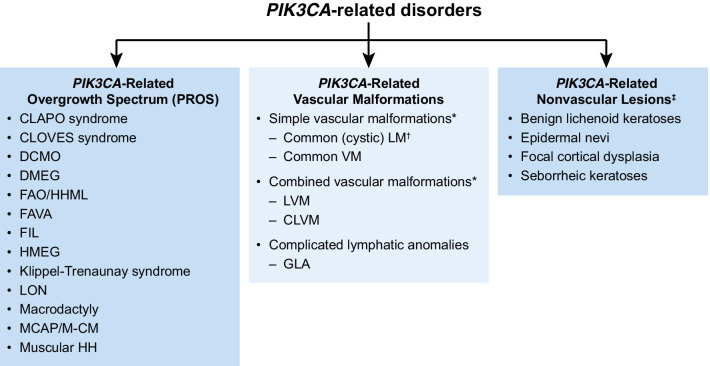
Main body: PIK3CA-related disorders include PIK3CA-related overgrowth spectrum (PROS), PIK3CA-related vascular malformations, and PIK3CA-related nonvascular lesions. Somatic activating mutations (predominantly in hotspots in the helical and kinase domains of PIK3CA, but also in other domains), lead to hyperactivation of the PI3K signaling pathway, which results in abnormal tissue growth. Diagnosis is complicated by the variability and overlap in phenotypes associated with PIK3CA-related disorders and should be performed by clinicians with the required expertise along with coordinated care from a multidisciplinary team. Although tissue mosaicism presents challenges for confirmation of PIK3CA mutations, next-generation sequencing and tissue selection have improved detection. Clinical improvement, radiological response, and patient-reported outcomes are typically used to assess treatment response in clinical studies of patients with PIK3CA-related disorders, but objective assessment of treatment response is difficult using imaging (due to the heterogeneous nature of these disorders, superimposed upon patient growth and development). Despite their limitations, patient-reported outcome tools may be best suited to gauge patient improvement. New therapeutic options are needed to provide an alternative or supplement to standard approaches such as surgery and sclerotherapy. Currently, there are no systemic agents that have regulatory approval for these disorders, but the mTOR inhibitor sirolimus has been used for several years in clinical trials and off label to address symptoms. There are also other agents under investigation for PIK3CA-related disorders that act as inhibitors to target different components of the PI3K signaling pathway including AKT (miransertib) and PI3K alpha (alpelisib).

Conclusion: Management of patients with PIK3CA-related disorders requires a multidisciplinary approach. Further results from ongoing clinical studies of agents targeting the PI3K pathway are highly anticipated.

Keywords: Alpelisib; Miransertib; PI3K; PIK3CA; PROS; Sirolimus; Vascular malformation.


Conflict of interest statement

G. Canaud: Personal fees from Novartis, Fresenius Medical Care, and BridgeBio; patent pending (WO2017140828A1). A. Hammill: Consultant and clinical trial contact for Novartis; clinical trial contact for ArQule/Merck and Venthera; compound received from Pfizer for investigator-initiated studies. D. Adams: Consultant to Novartis/Venthera. M. Vikkula: Consultant to Venthera. KMK-N: Investigator on clinical trial with Alpelisib.

Figures
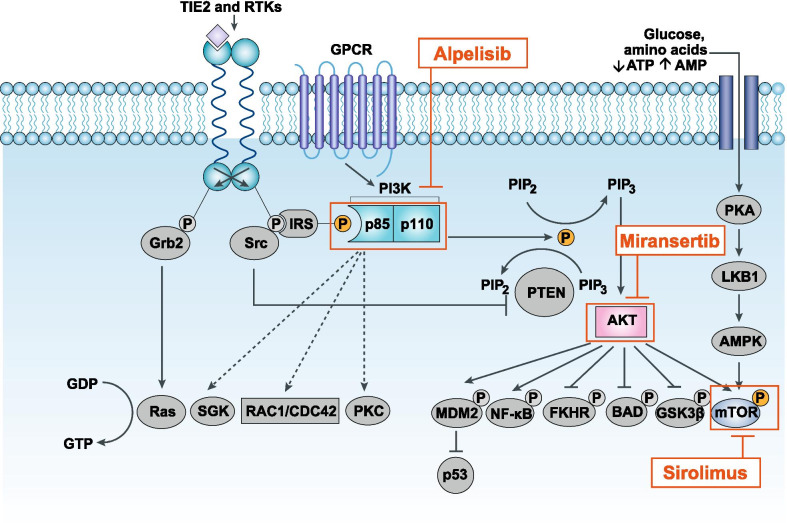
Fig. 1
Fig. 1
The PI3K signaling pathway and inhibitors under investigation. Because PIK3CA mutations underlie the pathogenesis of PIK3CA-related disorders, there are multiple strategies for targeting the PI3K pathway under investigation [6, 8]. AKT: protein kinase B; AMP: adenosine monophosphate; AMPK: AMP-activated protein kinase; ATP: adenosine triphosphate; BAD: Bcl-2-associated death promoter; CDC42: Cell division control protein 42 homolog; ERK: extracellular signal regulated kinase; FKHR: forkhead; GDP: guanosine diphosphate; GPCR, G protein-coupled receptor; Grb2: growth factor receptor-bound protein 2; GSK3: glycogen synthase kinase 3; GTP: guanosine-5'-triphosphate; IRS: insulin receptor substrate; LKB1: liver kinase B1; MAPK: mitogen-activated protein kinase; MDM2: mouse double minute 2; mTOR: mammalian target of rapamycin; NF-κB: nuclear factor kappa B; P: phosphate; PI3K: phosphatidylinositol-3-kinase; PIK3CA: phosphatidylinositol-4,5-bisphosphate 3-kinase catalytic subunit alpha; PIP2: phosphatidylinositol-4,5-bisphosphate; PIP3: phosphatidylinositol-3,4,5-triphosphate; PKA: protein kinases A; PKC: protein kinase C; PROS: PIK3CA-related overgrowth spectrum; PTEN: phosphatase and tensin homolog; RAC1: Ras-related C3 botulinum toxin substrate 1; Ras: rat sarcoma; RTK, receptor tyrosine kinase; SGK: serum- and glucocorticoid-inducible kinase; Src: rous sarcoma; TIE2, angiopoietin-1 receptor. Adapted with permission from Hennessy 2005 [7]
Fig. 2
Fig. 2
PIK3CA-related disorders. The category of PIK3CA-related disorders can be divided into 3 subcategories: PROS, PIK3CA-related vascular malformations, and PIK3CA-related nonvascular lesions. CLAPO: capillary malformation of the lower lip, lymphatic malformation of the face and neck, asymmetry and partial/generalized overgrowth; CLOVES: congenital lipomatous overgrowth, vascular malformations, epidermal nevi, scoliosis/skeletal and spinal; CLVM: combined capillary-lymphatic-venous malformation; DCMO: diffuse capillary malformation with overgrowth; DMEG: dysplastic megalencephaly; FAO/HHML: fibroadipose hyperplasia or overgrowth/hemihyperplasia-multiple lipomatosis; FAVA: fibroadipose vascular anomaly; FIL: fibroadipose or facial infiltrating lipomatosis; GLA, generalized lymphatic anomaly; HH: hemihyperplasia; HMEG: hemimegalencephaly; LM, lymphatic malformation; LON: lipomatosis of nerve; LVM: combined lymphatic-venous malformation; MCAP: megalencephaly-capillary malformation; PIK3CA: phosphatidylinositol-4,5-bisphosphate 3-kinase catalytic subunit alpha; VM, venous malformation. *Malformations that are composed of only one type of vessel are classified as “simple” (with the exception of arteriovenous malformation). If a lesion contains ≥ 2 types of vascular malformations, it is classified as “combined.” Vascular malformations are also classified according to major named vessels or by association with other anomalies (e.g., PROS) Wassef 2015 [33]. †Some common (cystic) LM are classified as PROS when they are associated with overgrowth ISSVA 2018 [2]. ‡Can occur as isolated lesions or with other clinical features. Supporting Sources: PIK3CA-related overgrowth spectrum: Keppler-Noreuil 2015 [3]; ISSVA 2018 [2]; Goss 2020 [28]; Hughes 2020 [29]; Mahan 2014 [30]; Rios 2013 [31]; Rodriguez-Laguna 2019 [32]; PIK3CA-related vascular malformations: ISSVA 2018 [2]; Rodriguez-Laguna 2019 [32]; PIK3CA-related nonvascular lesions: Keppler-Noreuil 2015 [3]; Combined vascular malformations: Wassef 2015 [33]; Brandigi 2018 [27]

References

    1. Parker VER, Keppler-Noreuil KM, Faivre L, Luu M, Oden NL, De Silva L, et al. Safety and efficacy of low-dose sirolimus in the PIK3CA-related overgrowth spectrum. Genet Med. 2019;21(5):1189–1198. doi: 10.1038/s41436-018-0297-9. - DOI - PMC - PubMed
    1. International Society for the Study of Vascular Anomalies. ISSVA classification for vascular anomalies. Revised 2018. https://www.issva.org/UserFiles/file/ISSVA-Classification-2018.pdf.
    1. Keppler-Noreuil KM, Rios JJ, Parker VE, Semple RK, Lindhurst MJ, Sapp JC, et al. PIK3CA-related overgrowth spectrum (PROS): diagnostic and testing eligibility criteria, differential diagnosis, and evaluation. Am J Med Genet A. 2015;167A(2):287–295. doi: 10.1002/ajmg.a.36836. - DOI - PMC - PubMed
    1. Limaye N, Kangas J, Mendola A, Godfraind C, Schlogel MJ, Helaers R, et al. Somatic activating PIK3CA mutations cause venous malformation. Am J Hum Genet. 2015;97(6):914–921. doi: 10.1016/j.ajhg.2015.11.011. - DOI - PMC - PubMed
    1. Biesecker LG, Adam MP, Alkuraya FS, Amemiya AR, Bamshad MJ, Beck AE, et al. A dyadic approach to the delineation of diagnostic entities in clinical genomics. Am J Hum Genet. 2021;108(1):8–15. doi: 10.1016/j.ajhg.2020.11.013. - DOI - PMC - PubMed

Publication types

MeSH terms

Substances