


Predictors of incident malnutrition-a nutritionDay analysis in 11,923 nursing home residents
- PMID: 34239065
- PMCID: PMC8907076
- DOI: 10.1038/s41430-021-00964-9
Predictors of incident malnutrition-a nutritionDay analysis in 11,923 nursing home residents
Abstract
Background/objectives: Malnutrition (MN) in nursing home (NH) residents is associated with poor outcome. In order to identify those with a high risk of incident MN, the knowledge of predictors is crucial. Therefore, we investigated predictors of incident MN in older NH-residents.
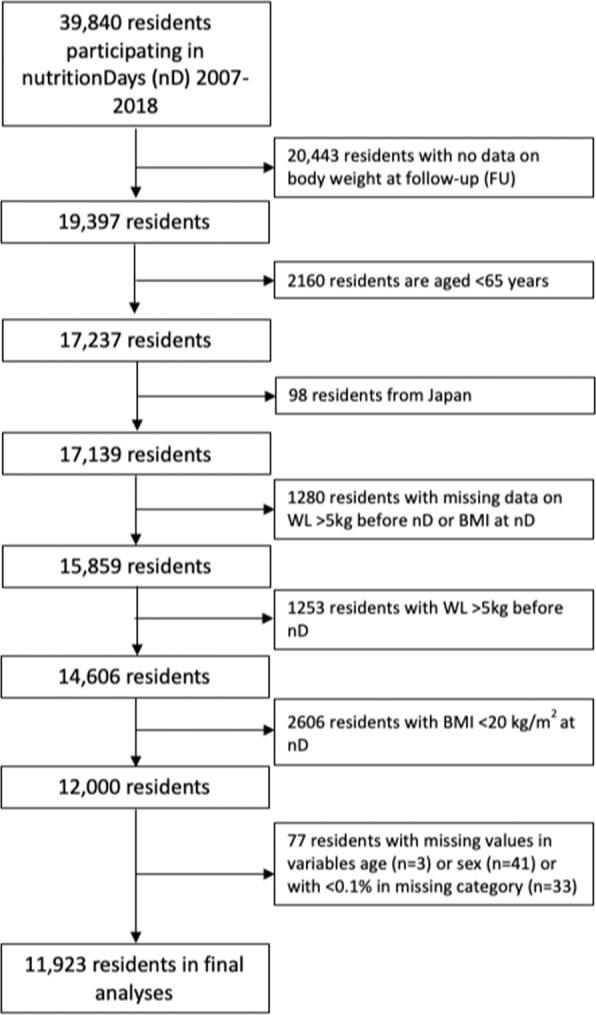
Subjects/methods: NH-residents participating in the nutritionDay-project (nD) between 2007 and 2018, aged ≥65 years, with complete data on nutritional status at nD and after 6 months and without MN at nD. The association of 17 variables (general characteristics (n = 3), function (n = 4), nutrition (n = 1), diseases (n = 5) and medication (n = 4)) with incident MN (weight loss ≥ 10% between nD and follow-up (FU) or BMI (kg/m2) < 20 at FU) was analyzed in univariate generalized estimated equation (GEE) models. Significant (p < 0.1) variables were selected for multivariate GEE-analyses. Effect estimates are presented as odds ratios and their respective 99.5%-confidence intervals.
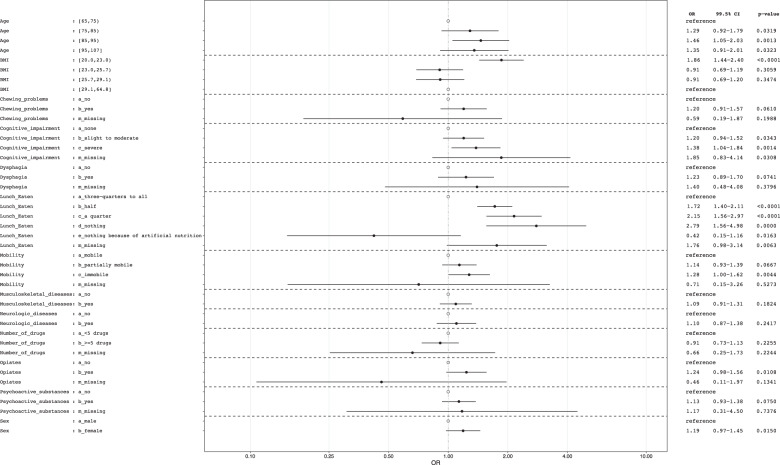
Results: Of 11,923 non-malnourished residents, 10.5% developed MN at FU. No intake at lunch (OR 2.79 [1.56-4.98]), a quarter (2.15 [1.56-2.97]) or half of the meal eaten (1.72 [1.40-2.11]) (vs. three-quarter to complete intake), the lowest BMI-quartile (20.0-23.0) (1.86 [1.44-2.40]) (vs. highest (≥29.1)), being between the ages of 85 and 94 years (1.46 [1.05; 2.03]) (vs. the youngest age-group 65-74 years)), severe cognitive impairment (1.38 [1.04; 1.84]) (vs. none) and being immobile (1.28 [1.00-1.62]) (vs. mobile) predicted incident MN in the final model.
Conclusion: 10.5% of non-malnourished NH-residents develop MN within 6 months. Attention should be paid to high-risk groups, namely residents with poor meal intake, low BMI, severe cognitive impairment, immobility, and older age.
© 2021. The Author(s).
Conflict of interest statement
GT, IS, FG, EK, KS, CCS, MV, and JW declare no conflict of interest. CCS has no conflicts of interest related to the submitted manuscript. Outside the submitted work CCS has received honoraria and travel cost reimbursement for congress participation from Abbott, Baxter, Fresenius, Nestlé and Nutricia. MJH has no conflicts of interest related to the submitted manuscript. Outside the submitted work MJH has received honoraria and travel cost reimbursement for congress participation from Fresenius, SSPC, Nestlé and Baxter. Research work has been partially supported by unrestricted grants of Abbott and Fresenius to Medical University Vienna. DV has no conflicts of interest related to the submitted manuscript. Outside the submitted work DV has received grants from Nestec S.A., other from Nutricia, Fresenius. DV is a member of the Scientific Board of apetito AG.
Figures
References
-
- OECD. Long-Term Care Rescources and Utilisation: Beds in residential long-term care facilities. Available at https://stats.oecd.org/Index.aspx?DataSetCode=HEALTH_LTCR#. Accessed January 07, 2021.
Publication types
MeSH terms
LinkOut - more resources
Full Text Sources
Medical
