


Sex Differences in Cardiac Troponin I and T and the Prediction of Cardiovascular Events in the General Population
- PMID: 34240125
- PMCID: PMC8486023
- DOI: 10.1093/clinchem/hvab109
Sex Differences in Cardiac Troponin I and T and the Prediction of Cardiovascular Events in the General Population
Abstract
Background: Cardiac troponin concentrations differ in women and men, but how this influences risk prediction and whether a sex-specific approach is required is unclear. We evaluated whether sex influences the predictive ability of cardiac troponin I and T for cardiovascular events in the general population.
Methods: High-sensitivity cardiac troponin (hs-cTn) I and T were measured in the Generation Scotland Scottish Family Health Study of randomly selected volunteers drawn from the general population between 2006 and 2011. Cox-regression models evaluated associations between hs-cTnI and hs-cTnT and the primary outcome of cardiovascular death, myocardial infarction, or stroke.
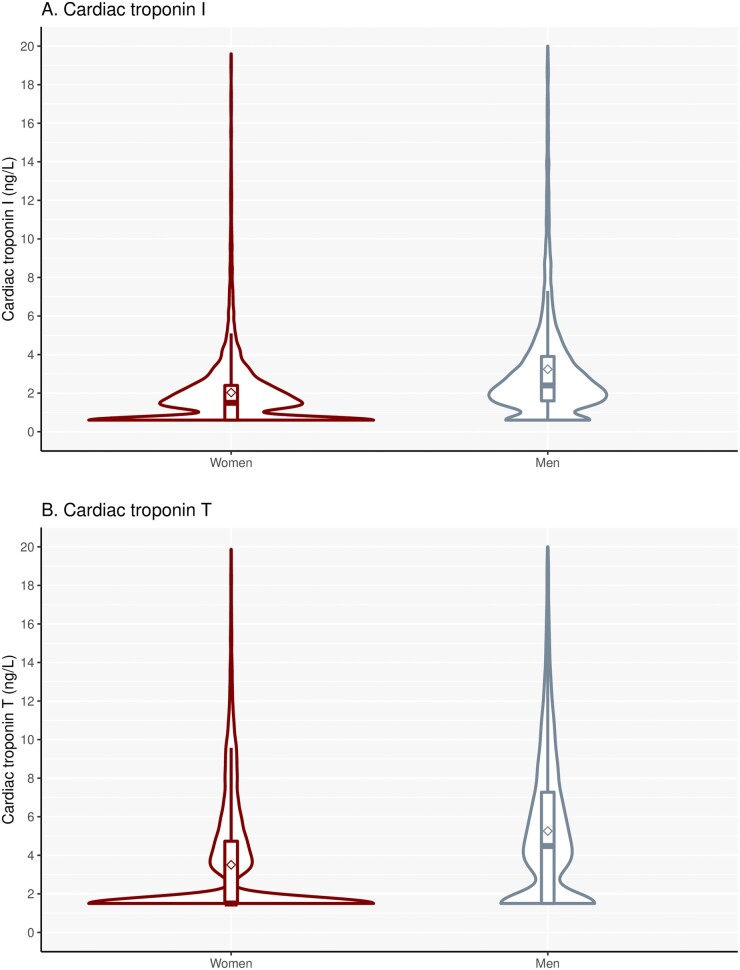
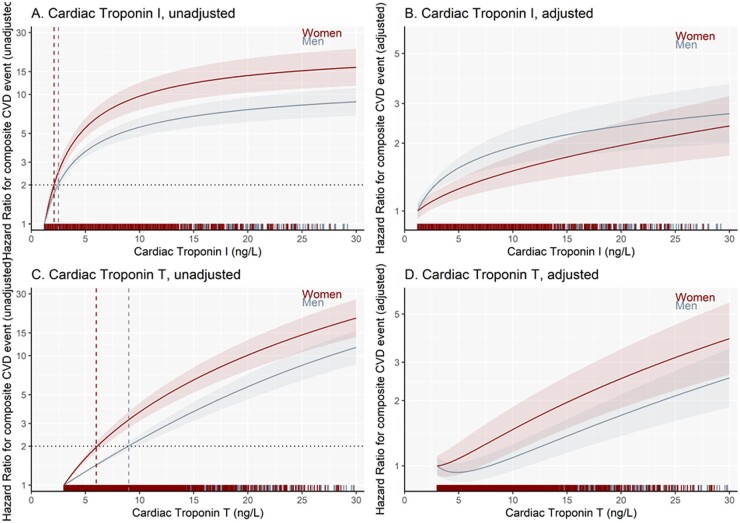
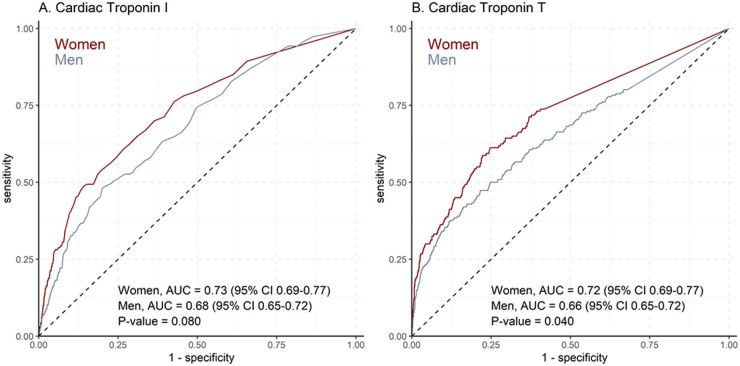
Results: In 19 501 (58% women, mean age 47 years) participants, the primary outcome occurred in 2.7% (306/11 375) of women and 5.1% (411/8126) of men during the median follow-up period of 7.9 (IQR, 7.1-9.2) years. Cardiac troponin I and T concentrations were lower in women than men (P < 0.001 for both), and both were more strongly associated with cardiovascular events in women than men. For example, at a hs-cTnI concentration of 10 ng/L, the hazard ratio relative to the limit of blank was 9.7 (95% CI 7.6-12.4) and 5.6 (95% CI 4.7-6.6) for women and men, respectively. The hazard ratio for hs-cTnT at a concentration of 10 ng/L relative to the limit of blank was 3.7 (95% CI 3.1-4.3) and 2.2 (95% CI 2.0-2.5) for women and men, respectively.
Conclusions: Cardiac troponin concentrations differ in women and men and are stronger predictors of cardiovascular events in women. Sex-specific approaches are required to provide equivalent risk prediction.
Keywords: cardiac troponin; cardiovascular events; risk factors; sex.
© American Association for Clinical Chemistry 2021.
Figures
Comment in
-
Can High-Sensitivity Troponins Help to Level the Playing Field in Cardiovascular Disease Prevention between Women and Men?Clin Chem. 2021 Oct 1;67(10):1301-1303. doi: 10.1093/clinchem/hvab144. Clin Chem. 2021. PMID: 34417818 No abstract available.
References
-
- Virani SS, Alonso A, Benjamin EJ, Bittencourt MS, Callaway CW, Carson AP, et al. American Heart Association Council on Epidemiology and Prevention Statistics Committee and Stroke Statistics Subcommittee. Heart disease and stroke statistics-2020 update: a report from the American Heart Association. Circulation 2020;141:e139–e596. - PubMed
-
- Shaw LJ, Pepine CJ, Xie J, Mehta PK, Morris AA, Dickert NW, et al.Quality and equitable health care gaps for women: attributions to sex differences in cardiovascular medicine. J Am Coll Cardiol 2017;70:373–88. - PubMed
-
- Regitz-Zagrosek V, Oertelt-Prigione S, Prescott E, Franconi F, Gerdts E, Foryst-Ludwig A, Group EUCCS, et al.Gender in cardiovascular diseases: impact on clinical manifestations, management, and outcomes. Eur Heart J 2016;37:24–34. - PubMed
-
- Peters SAE, Colantonio LD, Zhao H, Bittner V, Dai Y, Farkouh ME, et al.Sex differences in high-intensity statin use following myocardial infarction in the United States. J Am Coll Cardiol 2018;71:1729–37. - PubMed
-
- Haider A, Bengs S, Luu J, Osto E, Siller-Matula JM, Muka T, et al.Sex and gender in cardiovascular medicine: presentation and outcomes of acute coronary syndrome. Eur Heart J 2020;41:1328–36. - PubMed
Publication types
MeSH terms
Substances
Grants and funding
LinkOut - more resources
Full Text Sources
Medical
Research Materials
Miscellaneous
