


Exposure to low-dose ambient fine particulate matter PM2.5 and Alzheimer's disease, non-Alzheimer's dementia, and Parkinson's disease in North Carolina
- PMID: 34242242
- PMCID: PMC8270415
- DOI: 10.1371/journal.pone.0253253
Exposure to low-dose ambient fine particulate matter PM2.5 and Alzheimer's disease, non-Alzheimer's dementia, and Parkinson's disease in North Carolina
Abstract
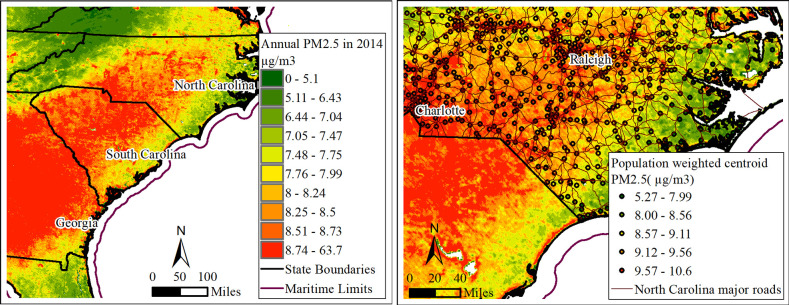
Alzheimer's disease (AD), non-AD dementia, and Parkinson's disease (PD) are increasingly common in older adults, yet all risk factors for their onset are not fully understood. Consequently, environmental exposures, including air pollution, have been hypothesized to contribute to the etiology of neurodegeneration. Because persistently elevated rates of AD mortality in the southern Piedmont area of North Carolina (NC) have been documented, we studied mortality and hospital admissions for AD, non-AD dementia, and PD in residential populations aged 65+ with long-term exposures to elevated levels of ambient air particulate matter 2.5 (PM2.5) exceeding the World Health Organization (WHO) air quality standards (≥10μg/m3). Health data were obtained from the State Center for Health Statistics and the Healthcare Cost and Utilization Project. PM2.5 levels were obtained from the MODIS/MISR and SeaWiFS datafiles. Residents in the Study group of elevated air particulate matter (87 zip codes with PM2.5≥10μg/m3) were compared to the residents in the Control group with low levels of air particulate matter (81 zip codes with PM2.5≤7.61μg/m3), and were found to have higher age-adjusted rates of mortality and hospital admissions for AD, non-AD dementia, and PD, including a most pronounced increase in AD mortality (323/100,000 vs. 257/100,000, respectively). After adjustment for multiple co-factors, the risk of death (odds ratio, or OR) from AD in the Study group (OR = 1.35, 95%CI[1.24-1.48]) was significantly higher than ORs of non-AD dementia or PD (OR = 0.97, 95%CI[0.90-1.04] and OR = 1.13, 95%CI[0.92-1.31]). The OR of hospital admissions was significantly increased only for AD as a primary case of hospitalization (OR = 1.54, 95%CI[1.31-1.82]). Conclusion: NC residents aged 65+ with long-term exposures to ambient PM2.5 levels exceeding the WHO standard had significantly increased risks of death and hospital admissions for AD. The effects for non-AD dementia and PD were less pronounced.
Conflict of interest statement
The authors have declared that no competing interest exist.
Figures
References
-
- Ambient W. air Quality and Health: Fact Sheet. Access on line. 2018;1.
-
- Cahill TA, Barnes DE, Spada NJ, Lawton JA, Cahill TM. Very fine and ultrafine metals and ischemic heart disease in the California central valley 1: 2003–2007. Aerosol Science and Technology. 2011;45(9):1123–34.
-
- Valavanidis A, Salika A, Theodoropoulou A. Generation of hydroxyl radicals by urban suspended particulate air matter. The role of iron ions. Atmospheric Environment. 2000;34(15):2379–86.
Publication types
MeSH terms
Substances
Grants and funding
LinkOut - more resources
Full Text Sources
Medical
