


Antirheumatic treatment is associated with reduced serum Syndecan-1 in Rheumatoid Arthritis
- PMID: 34242246
- PMCID: PMC8270157
- DOI: 10.1371/journal.pone.0253247
Antirheumatic treatment is associated with reduced serum Syndecan-1 in Rheumatoid Arthritis
Abstract
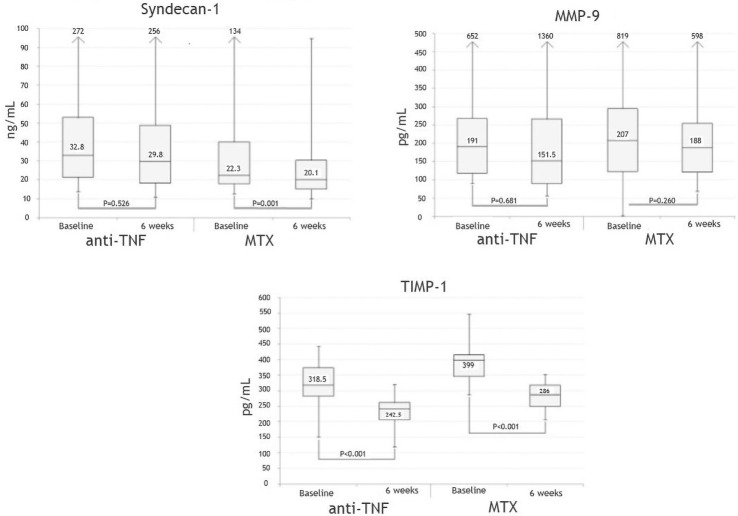
The endothelial glycocalyx (EG) is essential for proper function of the endothelium and for vascular integrity, but its role in premature atherogenesis in rheumatoid arthritis (RA) has not been studied yet. EG impairment can play a role in pathogenesis of vascular disease, and one of its characteristics is shedding of syndecan-1 from endothelial cells. Syndecan-1 shedding is mediated by matrix metalloproteinase-9 (MMP-9) and counteracted by tissue inhibitor of metalloproteinases (TIMP)-1. Cardiovascular disease risk in RA is reversible by disease modifying antirheumatic drugs (DMARDs), but the exact modes of action are still unclear. Therefore, we examined effects of DMARDs on syndecan-1, MMP-9 and TIMP-1 in RA patients, and searched for associations between these parameters and inflammatory activity. From the observational PSARA study, we examined 39 patients starting with methotrexate (MTX) monotherapy (in MTX naïve patients, n = 19) or tumor necrosis factor inhibitors (TNFi) in combination with MTX (in MTX non-responders, n = 20) due to active RA. Serum syndecan-1, MMP-9 and TIMP-1 were measured at baseline and after six weeks of treatment. Serum syndecan-1 (p = 0.008) and TIMP-1 (p<0.001) levels decreased after six weeks of anti-rheumatic treatment. Levels of MMP-9 also decreased, but the difference was not statistically significant. The improvement in syndecan-1 levels were independent of changes in inflammatory activity. There was no significant difference in changes in syndecan-1 levels from baseline to 6 weeks between the MTX and TNFi groups, however the change was significant within the MTX group. Six weeks of antirheumatic treatment was associated with reduction in serum levels of syndecan-1, which might reflect reduced syndecan-1 shedding from EG. Thus, it is possible that EG-preserving properties of DMARDs might contribute to their cardioprotective effects. These effects may be at least partly independent of their anti-inflammatory actions. Our findings do not support the notion that syndecan-1 shedding in RA is mediated mainly by increased MMP-9 or decreased TIMP-9 serum concentration.
Conflict of interest statement
The authors have declared that no competing interests exist.
Figures
References
-
- Aletaha D, Neogi T, Silman AJ, Funovits J, Felson DT, Bingham CO, et al.. 2010 rheumatoid arthritis classification criteria: an American College of Rheumatology/European League Against Rheumatism collaborative initiative. Arthritis & Rheumatism. 2010;62(9):2569–81. - PubMed
-
- Ronda N, Greco D, Adorni MP, Zimetti F, Favari E, Hjeltnes G, et al.. Newly identified antiatherosclerotic activity of methotrexate and adalimumab: complementary effects on lipoprotein function and macrophage cholesterol metabolism. Arthritis & rheumatology (Hoboken, NJ). 2015;67(5):1155–64. doi: 10.1002/art.39039 - DOI - PubMed
Publication types
MeSH terms
Substances
LinkOut - more resources
Full Text Sources
Medical
Research Materials
Miscellaneous
