


Diagnostic accuracy of a SARS-CoV-2 rapid antigen test in real-life clinical settings
- PMID: 34242764
- PMCID: PMC8260496
- DOI: 10.1016/j.ijid.2021.07.010
Diagnostic accuracy of a SARS-CoV-2 rapid antigen test in real-life clinical settings
Abstract
Background: Laboratory tests are a mainstay in managing the COVID-19 pandemic, and high hopes are placed on rapid antigen tests. However, the accuracy of rapid antigen tests in real-life clinical settings is unclear because adequately designed diagnostic accuracy studies are essentially lacking.
Objectives: The aim of this study was to assess the accuracy of a rapid antigen test in diagnosing SARS-CoV-2 infection in a primary/secondary care testing facility.
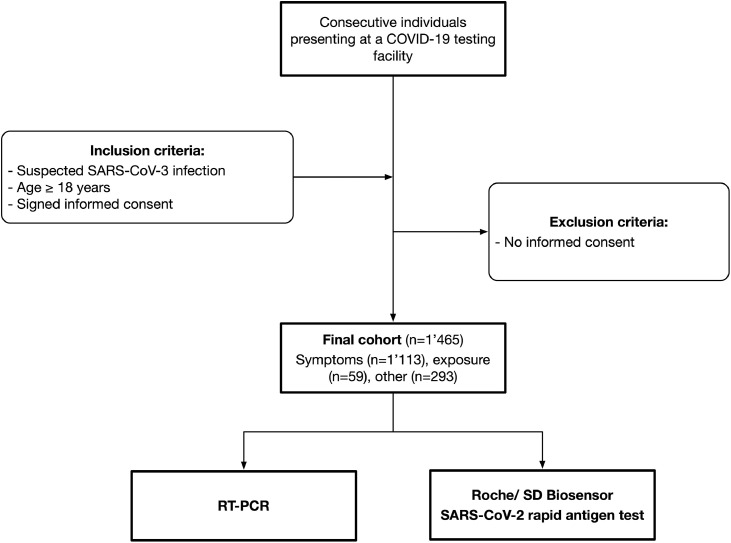
Methods: Consecutive individuals presenting at a COVID-19 testing facility affiliated to a Swiss University Hospital were recruited (n = 1465%). Nasopharyngeal swabs were obtained, and the Roche/SD Biosensor rapid antigen test was conducted in parallel with two real-time PCR tests (reference standard).
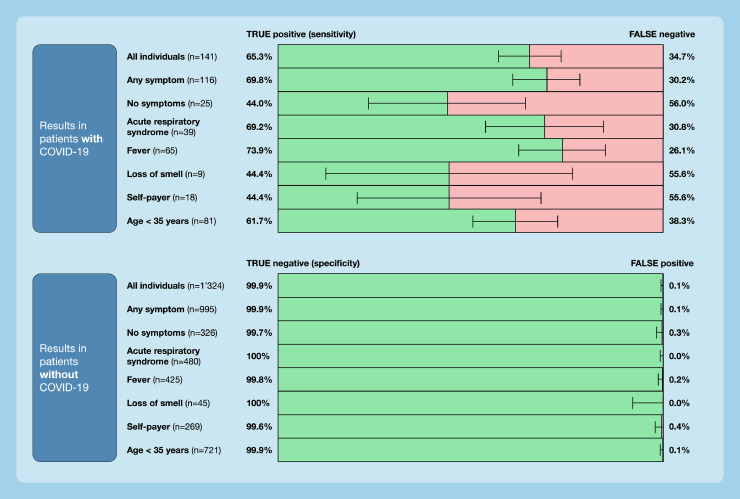
Results: Among the 1465 patients recruited, RT-PCR was positive in 141 individuals, corresponding to a prevalence of 9.6%. The Roche/SD Biosensor rapid antigen test was positive in 94 patients (6.4%), and negative in 1368 individuals (93.4%; insufficient sample material in 3 patients). The overall sensitivity of the rapid antigen test was 65.3% (95% confidence interval [CI] 56.8-73.1), the specificity was 99.9% (95% CI 99.5-100.0). In asymptomatic individuals, the sensitivity was 44.0% (95% CI 24.4-65.1).
Conclusions: The accuracy of the SARS-CoV-2 Roche/SD Biosensor rapid antigen test in diagnosing SARS-CoV-2 infections in a primary/secondary care testing facility was considerably lower compared with the manufacturer's data. Widespread application in such a setting might lead to a considerable number of individuals falsely classified as SARS-CoV-2 negative.
Keywords: COVID-19 diagnostic testing; epidemiology; infections; severe acute respiratory syndrome coronavirus 2; transmission.
Copyright © 2021 The Authors. Published by Elsevier Ltd.. All rights reserved.
Figures
References
-
- Bossuyt PMM. In: Evidence-based laboratory medicine. Second Edition. Price CP, Christenson RH, editors. AACC Press; Washington DC: 2007. Studies for evaluating diagnostic and prognostic accuracy; pp. 67–81.
-
- CDC. Coronavirus self-checker; 2020. Available from: https://www.cdc.gov/coronavirus/2019-ncov/.
MeSH terms
Substances
LinkOut - more resources
Full Text Sources
Medical
Miscellaneous
