


Child reward neurocircuitry and parental substance use history: Findings from the Adolescent Brain Cognitive Development Study
- PMID: 34246036
- PMCID: PMC8328938
- DOI: 10.1016/j.addbeh.2021.107034
Child reward neurocircuitry and parental substance use history: Findings from the Adolescent Brain Cognitive Development Study
Abstract
Background: Substance use research has focused on family history of alcohol use disorders but less on other addictions in biological family members. We examined how parental substance use history relates to reward system functioning, specifically nucleus accumbens (NAcc) and putamen activation at age 9-10 in the Adolescent Brain Cognitive Development (ABCD) Study. This research hopes to address limitations in prior literature by focusing analyses on a large, substance-naïve sample.
Method: We included ABCD participants with valid Monetary Incentive Delay task fMRI Baseline data and parent substance use history at project baseline from Data Release 2.0 (N = 10,622). Parent-history-positive (PH+) participants had one or both biological parents with a history of two+problems with alcohol (n = 741; PH+A) and/or other drugs (n = 638; PH+D). Of participants who were parent-history-negative (PH-) for alcohol and/or drugs, a stratified random sample based on six sociodemographic variables was created and matched to the PH+group (PH-A n = 699; PH-D n = 615). The contrast of interest was anticipation of a large reward vs. neutral response.
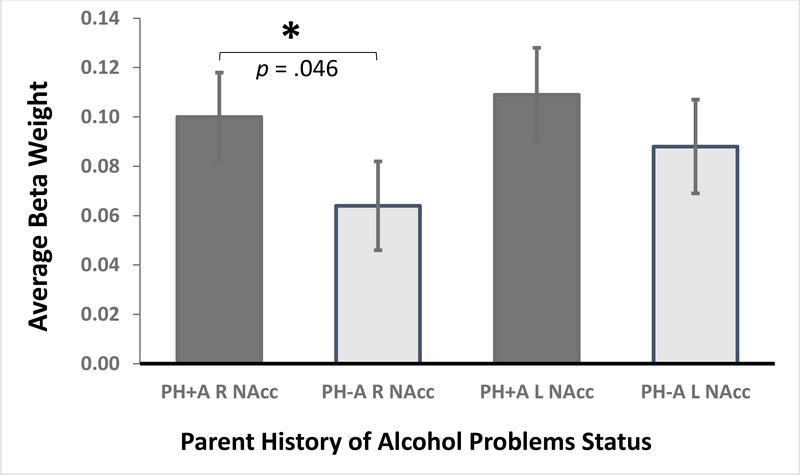
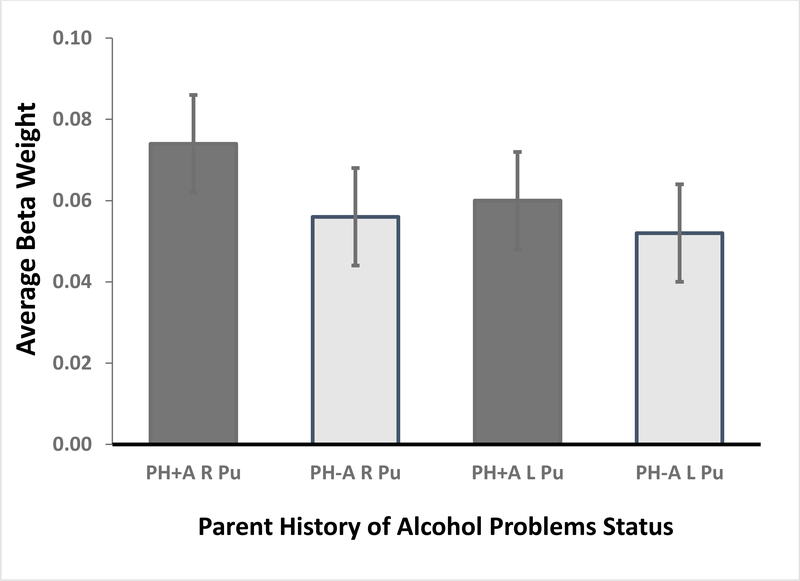
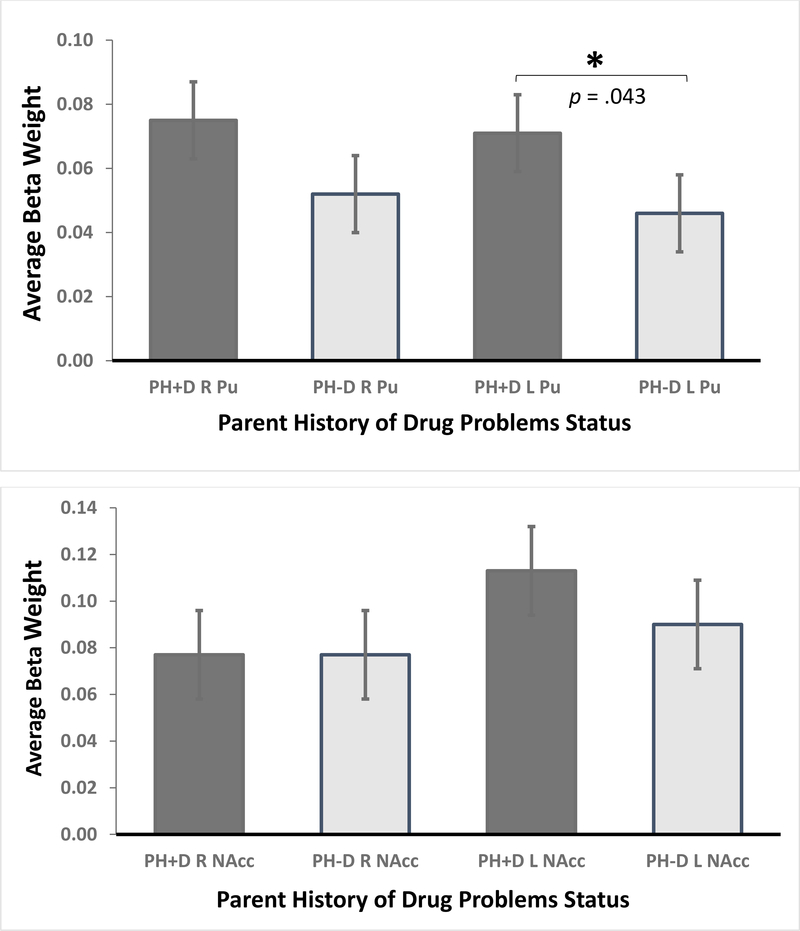
Results: PH+A youth had more activation in the right NAcc during large reward anticipation than PH-A. PH+D youth showed enhanced left putamen activation during large reward anticipation than PH-D youth. Bayesian hypothesis testing showed moderate evidence (BF > 3) in favor of the null hypothesis.
Conclusion: These findings suggest that pre-adolescents whose biological parents had a history of substance-related problems show small differences in reward processing compared to their PH- peers.
Keywords: ABCD Study; Monetary Incentive Delay task; Reward anticipation; Substance use history; fMRI.
Published by Elsevier Ltd.
Conflict of interest statement
Declaration of Competing Interest
The authors declare that they have no known competing financial interests or personal relationships that could have appeared to influence the work reported in this paper.
Figures
References
-
- Adolescent Brain Cognitive Development Study. (n.d.). ABCD Protocol Summary Baseline. https://abcdstudy.org/images/Protocol-Brochure-Baseline.pdf
-
- Adolescent Brain Cognitive Development Study. (n.d.). Protocols. https://abcdstudy.org/scientists/protocols/
-
- Andrews MM, Meda SA, Thomas AD, Potenza MN, Krystal JH, Worhunsky P, Stevens MC, O’Malley S, Book GA, Reynolds B, & Pearlson GD (2011). Individuals family history positive for alcoholism show fMRI differences in reward sensitivity that are related to impulsivity factors. Biological Psychiatry, 69(7), 675–683. 10.1016/j.biopsych.2010.09.049 - DOI - PMC - PubMed
-
- Casey BJ, Cannonier T, Conley MI, Cohen AO, Barch DM, Heitzeg MM, Soules ME, Teslovich T, Dellarco DV, Garavan H, Orr CA, Wager TD, Banich M T., Speer NK, Sutherland MT, Riedel MC, Dick AS, Bjork JM, Thomas KM, … ABCD Imaging Acquisition Workgroup. (2018). The Adolescent Brain Cognitive Development (ABCD) study: Imaging acquisition across 21 sites. Developmental Cognitive Neuroscience, 32, 43–54. 10.1016/j.dcn.2018.03.001 - DOI - PMC - PubMed
Publication types
MeSH terms
Grants and funding
- U24 DA041147/DA/NIDA NIH HHS/United States
- U01 DA051039/DA/NIDA NIH HHS/United States
- U01 DA041120/DA/NIDA NIH HHS/United States
- U01 DA051018/DA/NIDA NIH HHS/United States
- U24 DA041123/DA/NIDA NIH HHS/United States
- U01 DA051038/DA/NIDA NIH HHS/United States
- U01 DA051037/DA/NIDA NIH HHS/United States
- U01 DA051016/DA/NIDA NIH HHS/United States
- U01 DA041106/DA/NIDA NIH HHS/United States
- U01 DA041117/DA/NIDA NIH HHS/United States
- U01 DA041174/DA/NIDA NIH HHS/United States
- UL1 TR001863/TR/NCATS NIH HHS/United States
- U01 DA041093/DA/NIDA NIH HHS/United States
- U01 DA041134/DA/NIDA NIH HHS/United States
- U01 DA041022/DA/NIDA NIH HHS/United States
- U01 DA041156/DA/NIDA NIH HHS/United States
- U01 DA050987/DA/NIDA NIH HHS/United States
- U01 DA041025/DA/NIDA NIH HHS/United States
- U01 DA050989/DA/NIDA NIH HHS/United States
- U01 DA041089/DA/NIDA NIH HHS/United States
- U01 DA050988/DA/NIDA NIH HHS/United States
- U01 DA041028/DA/NIDA NIH HHS/United States
- U01 DA041048/DA/NIDA NIH HHS/United States
- ZIA DA000628/ImNIH/Intramural NIH HHS/United States
- U01 DA041148/DA/NIDA NIH HHS/United States
