


Comparison of a theoretically driven cognitive therapy (the Feeling Safe Programme) with befriending for the treatment of persistent persecutory delusions: a parallel, single-blind, randomised controlled trial
- PMID: 34246324
- PMCID: PMC8311296
- DOI: 10.1016/S2215-0366(21)00158-9
Comparison of a theoretically driven cognitive therapy (the Feeling Safe Programme) with befriending for the treatment of persistent persecutory delusions: a parallel, single-blind, randomised controlled trial
Abstract
Background: There is a large clinical need for improved treatments for patients with persecutory delusions. We aimed to test whether a new theoretically driven cognitive therapy (the Feeling Safe Programme) would lead to large reductions in persecutory delusions, above non-specific effects of therapy. We also aimed to test treatment effect mechanisms.
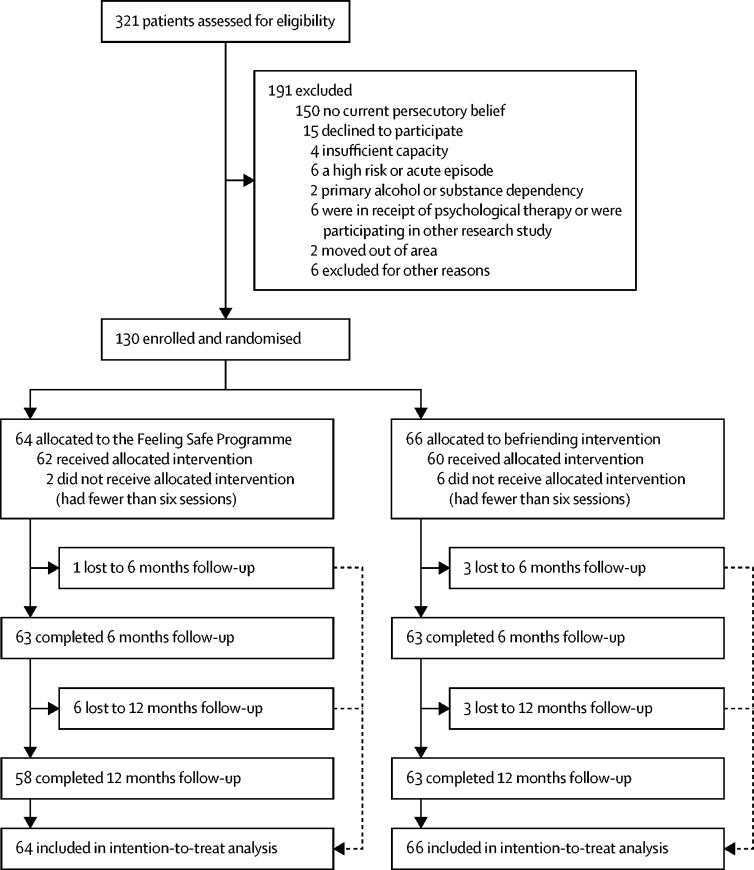
Methods: We did a parallel, single-blind, randomised controlled trial to test the Feeling Safe Programme against befriending with the same therapists for patients with persistent persecutory delusions in the context of non-affective psychosis diagnoses. Usual care continued throughout the duration of the trial. The trial took place in community mental health services in three UK National Health Service trusts. Participants were included if they were 16 years or older, had persecutory delusions (as defined by Freeman and Garety) for at least 3 months and held with at least 60% conviction, and had a primary diagnosis of non-affective psychosis from the referring clinical team. Patients were randomly assigned to either the Feeling Safe Programme or the befriending programme, using a permuted blocks algorithm with randomly varying block size, stratified by therapist. Trial assessors were masked to group allocation. If an allocation was unmasked then the unmasked assessor was replaced with a new masked assessor. Outcomes were assessed at 0 months, 6 months (primary endpoint), and 12 months. The primary outcome was persecutory delusion conviction, assessed within the Psychotic Symptoms Rating Scale (PSYRATS; rated 0-100%). Outcome analyses were done in the intention-to-treat population. Each intervention was provided individually over 6 months. This trial is registered with the ISRCTN registry, ISRCTN18705064.
Findings: From Feb 8, 2016, to July 26, 2019, 130 patients with persecutory delusions (78 [60%] men; 52 [40%] women, mean age 42 years [SD 12·1, range 17-71]; 86% White, 9% Black, 2% Indian; 2·3% Pakistani; 2% other) were recruited. 64 patients were randomly allocated to the Feeling Safe Programme and 66 patients to befriending. Compared with befriending, the Feeling Safe Programme led to significant end of treatment reductions in delusional conviction (-10·69 [95% CI -19·75 to -1·63], p=0·021, Cohen's d=-0·86) and delusion severity (PSYRATS, -2·94 [-4·58 to -1·31], p<0·0001, Cohen's d=-1·20). More adverse events occurred in the befriending group (68 unrelated adverse events reported in 20 [30%] participants) compared with the Feeling Safe group (53 unrelated adverse events reported in 16 [25%] participants).
Interpretation: The Feeling Safe Programme led to a significant reduction in persistent persecutory delusions compared with befriending. To our knowledge, these are the largest treatment effects seen for patients with persistent delusions. The principal limitation of our trial was the relatively small sample size when comparing two active treatments, meaning less precision in effect size estimates and lower power to detect moderate treatment differences in secondary outcomes. Further research could be done to determine whether greater effects could be possible by reducing the hypothesised delusion maintenance mechanisms further. The Feeling Safe Programme could become the recommended psychological treatment in clinical services for persecutory delusions.
Funding: NIHR Research Professorship and NIHR Oxford Health Biomedical Research Centre.
Copyright © 2021 The Author(s). Published by Elsevier Ltd. This is an Open Access article under the CC BY 4.0 license. Published by Elsevier Ltd.. All rights reserved.
Conflict of interest statement
Declaration of interests DF reports grants from National Institute for Health Research, Medical Research Council, and International Foundation, and is a founder and non-executive board director of a University of Oxford spin-out company, Oxford VR. DF has also written popular science, self-help, and academic books about paranoia with several publishers for which royalties are received. RE reports grants from the National Institute for Health Research. All other authors declare no competing interests.
References
-
- van der Gaag M, Valmaggia LR, Smit F. The effects of individually tailored formulation-based cognitive behavioural therapy in auditory hallucinations and delusions: a meta-analysis. Schizophr Res. 2014;156:30–37. - PubMed
-
- McGlanaghy E, Turner D, Davis GA. A network meta-analysis of psychological interventions for schizophrenia and psychosis: impact on symptoms. Schizophr Res. 2021;228:447–459. - PubMed
-
- Peralta V, Cuesta MJ. Dimensional structure of psychotic symptoms: an item-level analysis of SAPS and SANS symptoms in psychotic disorders. Schizophr Res. 1999;38:13–26. - PubMed
Publication types
MeSH terms
LinkOut - more resources
Full Text Sources
Medical
