


Prevalence of syphilis among men who have sex with men: a global systematic review and meta-analysis from 2000-20
- PMID: 34246332
- PMCID: PMC9150735
- DOI: 10.1016/S2214-109X(21)00221-7
Prevalence of syphilis among men who have sex with men: a global systematic review and meta-analysis from 2000-20
Abstract
Background: The WHO Global Health Sector Strategy aims to reduce worldwide syphilis incidence by 90% between 2018 and 2030. If this goal is to be achieved, interventions that target high-burden groups, including men who have sex with men (MSM), will be required. However, there are no global prevalence estimates of syphilis among MSM to serve as a baseline for monitoring or modelling disease burden. We aimed to assess the global prevalence of syphilis among MSM using the available literature.
Methods: In this global systematic review and meta-analysis, we searched MEDLINE, Embase, LILACS, and AIM databases, and Integrated Bio-Behavioral Surveillance (IBBS) reports between April 23, 2019, and Feb 1, 2020, to identify studies done between Jan 1, 2000, and Feb 1, 2020, with syphilis point prevalence data measured by biological assay among MSM (defined as people who were assigned as male at birth and had oral or anal sex with at least one other man in their lifetime). Studies were excluded if participants were exclusively HIV-infected MSM, injection-drug users, only seeking care for sexually transmitted infections (STIs) or genital symptoms, or routine STI clinic attendees. Data were extracted onto standardised forms and cross-checked for accuracy and validity. We used random-effects models to generate pooled prevalence estimates across the eight regions of the Sustainable Development Goals. We calculated risk of study bias based on the Appraisal tool for Cross-Sectional Studies, and stratified results based on low versus high risk of bias. This systematic review and meta-analysis was registered with PROSPERO, CRD42019144594.
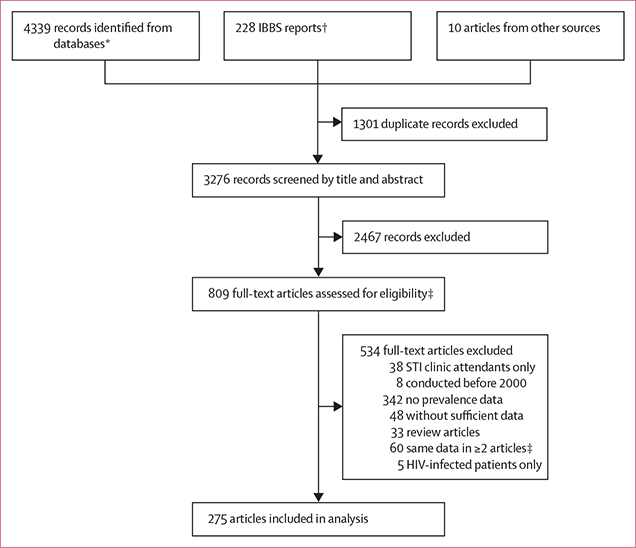
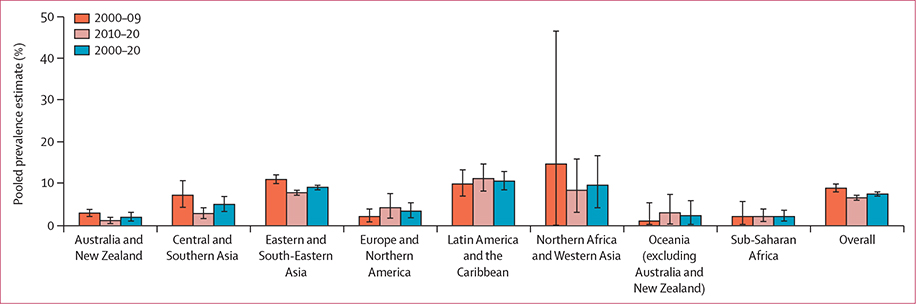
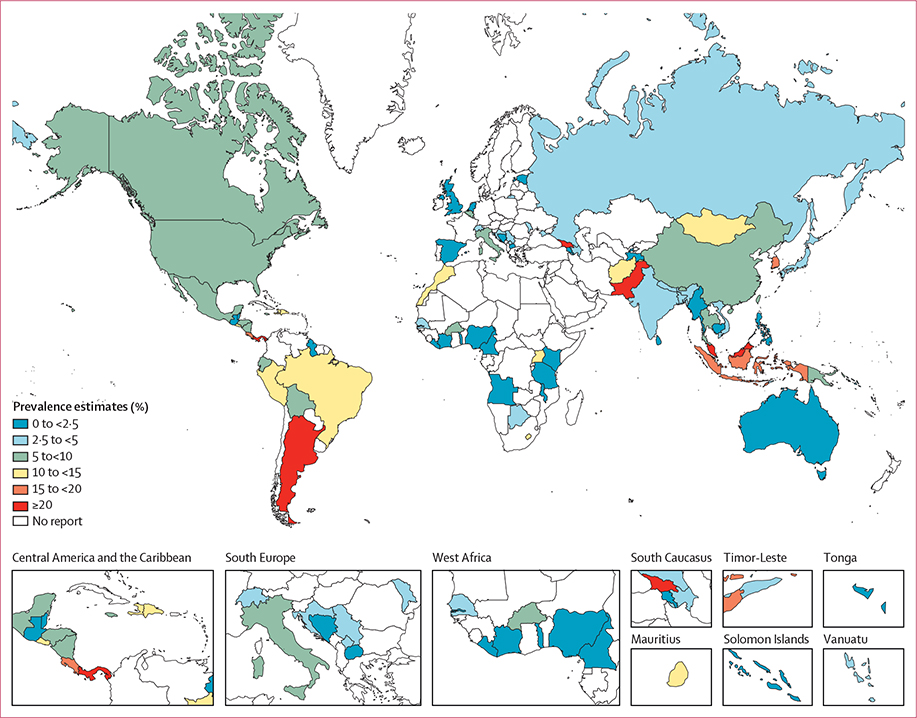
Findings: We reviewed 4339 records, 228 IBBS reports, and ten articles from other sources. Of these, 1301 duplicate records were excluded, 2467 records were excluded after title and abstract screening, and 534 articles were excluded after full-text analysis. We identified 345 prevalence data points from 275 studies across 77 countries, with a total of 606 232 participants. Global pooled prevalence from 2000-20 was 7·5% (95% CI 7·0-8·0%), ranging from 1·9% (1·0-3·1%) in Australia and New Zealand to 10·6% (8·5-12·9%) in Latin America and the Caribbean.
Interpretation: Unacceptably high syphilis prevalence among MSM warrants urgent action.
Funding: Wellcome Trust.
Copyright © 2021 The Author(s). Published by Elsevier Ltd. This is an Open Access article under the CC BY 4.0 license. Published by Elsevier Ltd.. All rights reserved.
Conflict of interest statement
Declaration of interests We declare no competing interests.
Figures
Comment in
-
Syphilis in men who have sex with men: advancing research and human rights.Lancet Glob Health. 2021 Aug;9(8):e1039-e1040. doi: 10.1016/S2214-109X(21)00269-2. Epub 2021 Jul 8. Lancet Glob Health. 2021. PMID: 34246333 Free PMC article. No abstract available.
-
Estimating burden of syphilis among men who have sex with men.Lancet Glob Health. 2021 Dec;9(12):e1648. doi: 10.1016/S2214-109X(21)00452-6. Lancet Glob Health. 2021. PMID: 34798017 No abstract available.
-
Estimating burden of syphilis among men who have sex with men - Authors' reply.Lancet Glob Health. 2021 Dec;9(12):e1649. doi: 10.1016/S2214-109X(21)00449-6. Lancet Glob Health. 2021. PMID: 34798018 Free PMC article. No abstract available.
References
-
- WHO. Global health sector strategy on sexually transmitted infections 2016–2021. 2017. https://www.who.int/reproductivehealth/publications/rtis/ghss-stis/en/ (accessed Aug 15, 2019).
-
- Kirby Institute of the University of New South Wales. Annual surveillance report on HIV, viral hepatitis and STIs in Australia 2017. 2017. https://kirby.unsw.edu.au/report/annual-surveillance-report-hiv-viral-he... (accessed March 10, 2019).
Publication types
MeSH terms
Grants and funding
LinkOut - more resources
Full Text Sources
Medical
Miscellaneous
