Review
. 2021 Jun 25:12:621440.
doi: 10.3389/fimmu.2021.621440. eCollection 2021.

Immune Dysregulation and the Increased Risk of Complications and Mortality Following Respiratory Tract Infections in Adults With Down Syndrome

Affiliations
Review

Immune Dysregulation and the Increased Risk of Complications and Mortality Following Respiratory Tract Infections in Adults With Down Syndrome

Tomer Illouz et al. Front Immunol. .

Abstract

The risk of severe outcomes following respiratory tract infections is significantly increased in individuals over 60 years, especially in those with chronic medical conditions, i.e., hypertension, diabetes, cardiovascular disease, dementia, chronic respiratory disease, and cancer. Down Syndrome (DS), the most prevalent intellectual disability, is caused by trisomy-21 in ~1:750 live births worldwide. Over the past few decades, a substantial body of evidence has accumulated, pointing at the occurrence of alterations, impairments, and subsequently dysfunction of the various components of the immune system in individuals with DS. This associates with increased vulnerability to respiratory tract infections in this population, such as the influenza virus, respiratory syncytial virus, SARS-CoV-2 (COVID-19), and bacterial pneumonias. To emphasize this link, here we comprehensively review the immunobiology of DS and its contribution to higher susceptibility to severe illness and mortality from respiratory tract infections.

Keywords: COVID-19; Down syndrome; hospitalization; immune dysregulation; interferon; respiratory tract infections.


Conflict of interest statement

The authors declare that the research was conducted in the absence of any commercial or financial relationships that could be construed as a potential conflict of interest.

Figures
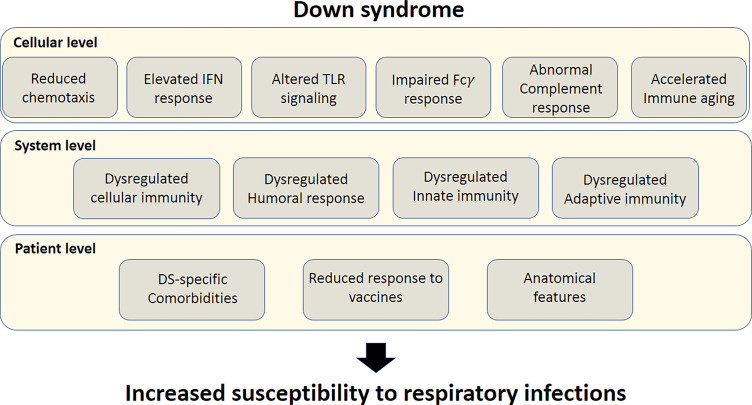
Figure 1
Figure 1
Susceptibility factors to severe response to respiratory tract infections in Down syndrome. Top bar; Cellular-level susceptibility factors. Middle bar; System-level susceptibility factors. Lower bar; patient-level susceptibility factors. All these factors culminate in increased susceptibility of individuals with DS to respiratory tract infections.
Figure 2
Figure 2
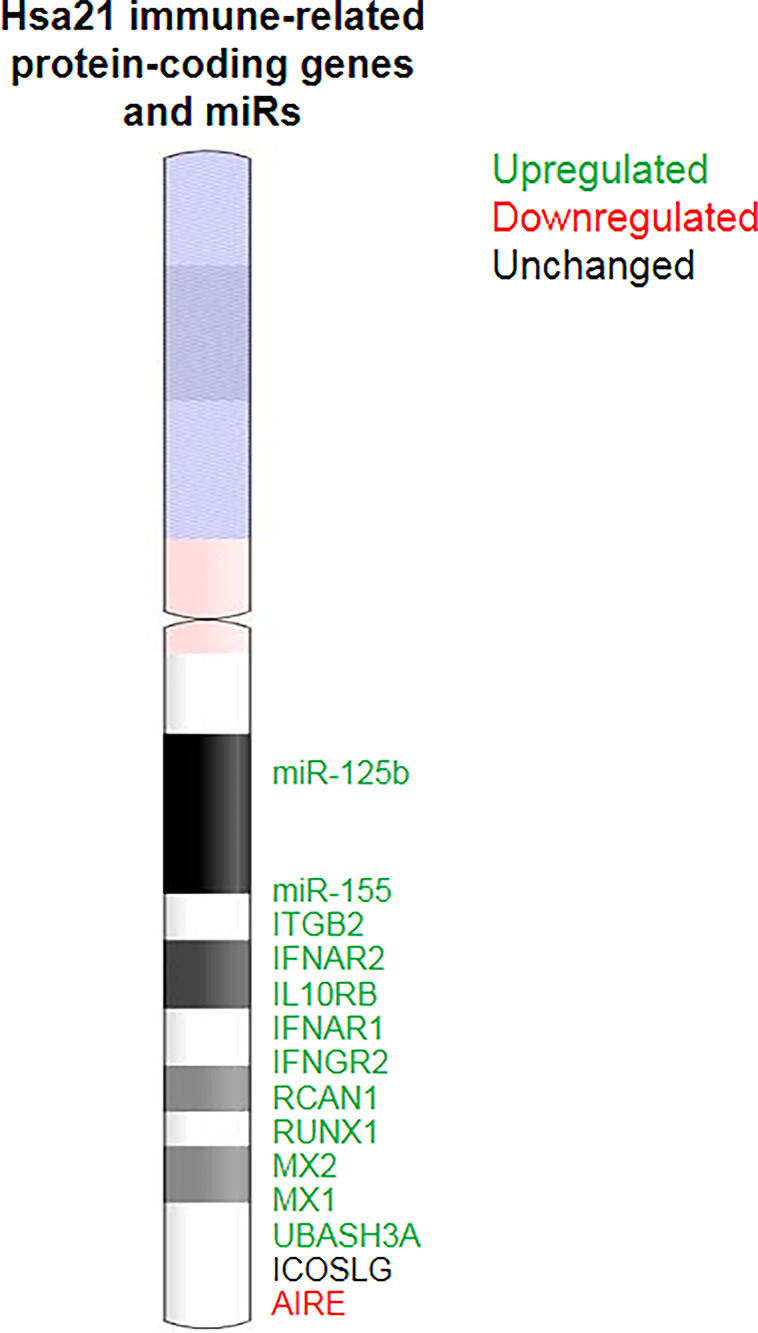
Immune-related genes in Chr21. Alterations in the expression of Chr21 immune-related genes and miRs may directly contribute to immune dysregulation in DS.
Figure 3
Figure 3
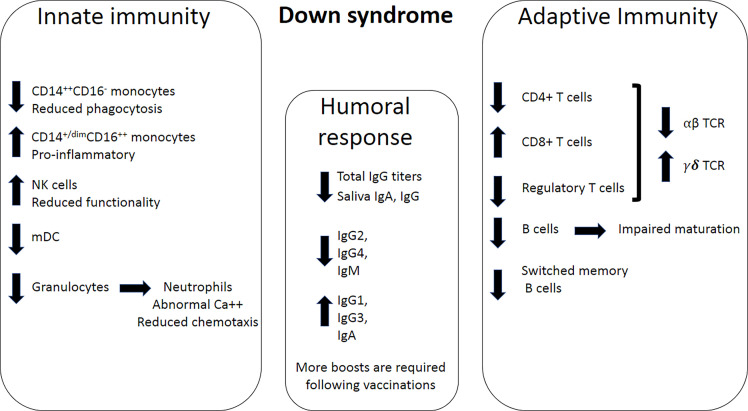
Immune dysregulation in DS. Left panel; Innate immunity impairments in DS include a decrease in CD14++CD16- monocytes, an increase in CD14+CD16+ monocytes, increase in NK cells, a decrease in myeloid dendritic cells (mDC), and a decrease in granulocytes. Neutrophils exhibit dysregulated Ca++ homeostasis and reduced chemotactic ability, which results in impaired functionality. Middle panel; humoral response dysregulation includes a decrease in total IgG, as well as IgG and IgA levels in the saliva. Specifically, of IgG2, IgG4, and IgM production levels decrease, while production levels of IgG1, IgG3 and IgA increase. Right panel; Adaptive immunity impairments include a decrease in the numbers of CD4+ T cells, an increase in the numbers of CD8+ cells, and a decrease in the number of T regulatory cells. Overall, fewer T cells in DS express the αβ subunits of the T-cell receptor (TCR), and more T cells express the γδ subunits of the TCR. The numbers of B cells and switched memory B cells also decrease in DS.
Figure 4
Figure 4
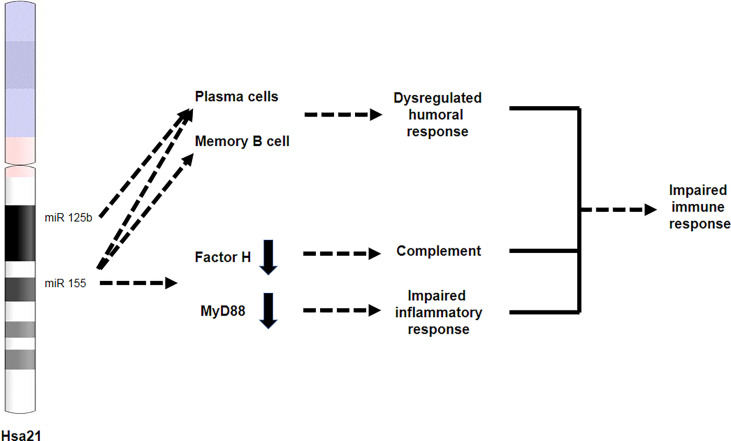
miR-125b and miR-155 are involved in immune dysregulation in DS. Both miR-125b and miR-155 are located on chromosome 21. miR-125b is overexpressed in plasma cells, while miR-155 is overexpressed in both plasma and memory B cells, leading to an impaired humoral response. miR-155 overexpression results in reduced expression of factor H and Myd88, leading to impaired complement response and impaired inflammatory response, respectively.

References

    1. Chan M, Park JJ, Shi T, Martinon-Torres F, Bont L, Nair H, et al. The Burden of Respiratory Syncytial Virus (RSV) Associated Acute Lower Respiratory Infections in Children With Down Syndrome: A Systematic Review and Meta-Analysis. J Glob Health (2017) 7(2):020413. 10.7189/jogh.07.020413 - DOI - PMC - PubMed
    1. Ceppi F, Stephens D, den Hollander BS, Krueger J, Whitlock J, Sung L, et al. Clinical Presentation and Risk Factors of Serious Infections in Children With Down Syndrome Treated for Acute Lymphoblastic Leukemia. Pediatr Blood Cancer (2016) 63(11):1949–53. 10.1002/pbc.26127 - DOI - PubMed
    1. Beckhaus AA, Castro-Rodriguez JA. Down Syndrome and the Risk of Severe Rsv Infection: A Meta-Analysis. Pediatrics (2018) 142(3). 10.1542/peds.2018-0225 - DOI - PubMed
    1. Sanchez-Luna M, Medrano C, Lirio J, Group R-S. Down Syndrome as Risk Factor for Respiratory Syncytial Virus Hospitalization: A Prospective Multicenter Epidemiological Study. Influenza other Respir viruses (2017) 11(2):157–64. 10.1111/irv.12431 - DOI - PMC - PubMed
    1. Mitra S, El Azrak M, McCord H, Paes BA. Hospitalization for Respiratory Syncytial Virus in Children With Down Syndrome Less Than 2 Years of Age: A Systematic Review and Meta-Analysis. J Pediatr (2018) 203:92–100.e3. 10.1016/j.jpeds.2018.08.006 - DOI - PubMed