Review
. 2021 Jun 23:12:687458.
doi: 10.3389/fimmu.2021.687458. eCollection 2021.

Targeting Bruton's Tyrosine Kinase in CLL

Affiliations
Review

Targeting Bruton's Tyrosine Kinase in CLL

Inhye E Ahn et al. Front Immunol. .

Abstract

Targeting the B-cell receptor signaling pathway through BTK inhibition proved to be effective for the treatment of chronic lymphocytic leukemia (CLL) and other B-cell lymphomas. Covalent BTK inhibitors (BTKis) led to an unprecedented improvement in outcome in CLL, in particular for high-risk subgroups with TP53 aberration and unmutated immunoglobulin heavy-chain variable-region gene (IGHV). Ibrutinib and acalabrutinib are approved by the US Food and Drug Administration for the treatment of CLL and other B-cell lymphomas, and zanubrutinib, for patients with mantle cell lymphoma. Distinct target selectivity of individual BTKis confer differences in target-mediated as well as off-target adverse effects. Disease progression on covalent BTKis, driven by histologic transformation or selective expansion of BTK and PLCG2 mutated CLL clones, remains a major challenge in the field. Fixed duration combination regimens and reversible BTKis with non-covalent binding chemistry hold promise for the prevention and treatment of BTKi-resistant disease.

Keywords: B-cell receptor signaling pathway; Bruton’s tyrosine kinase; acalabrutinib; chronic lymphocytic leukemia; ibrutinib; zanubrutinib.


Conflict of interest statement

JB has served as a consultant for Abbvie, Acerta, Astra-Zeneca, Beigene, Catapult, Dynamo Therapeutics, Eli Lilly, Genentech/Roche, Juno/Celgene/Bristol Myers Squibb, Kite, Loxo, MEI Pharma, Nextcea, Novartis, Pfizer, Pharmacyclics, Rigel, Sunesis, TG Therapeutics; received research funding from Gilead, Loxo, SPARC, TG Therapeutics and Verastem; and served on data safety monitoring committees for Invectys. The remaining author declares that the research was conducted in the absence of any commercial or financial relationships that could be construed as a potential conflict of interest.

Figures
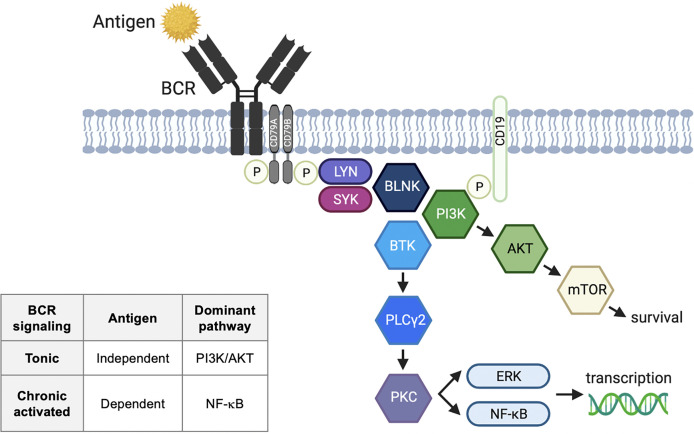
Figure 1
Figure 1
B cell receptor signaling pathway. Activated B cell receptor (BCR) signaling is an antigen-dependent process utilizing the canonical nuclear factor-κB (NF-κB) pathway. Antigen binding by surface immunoglobulin initiates BCR signaling, resulting in coupling and autophosphorylation of the CD79A/CD79B heterodimer by Src family kinases. The phosphorylation of the immunoreceptor tyrosine-based activation motifs recruits a cascade of signaling molecules. These include LYN tyrosine kinase (LYN), spleen tyrosine kinase (SYK), Bruton’s tyrosine kinase (BTK), phospholipase Cγ2 (PLCγ2), and protein kinase C (PKC), which lead to activation of NF-κB, phosphatidylinositol 3-kinase (PI3K) and ERK. Tonic BCR is an antigen-independent process that maintains B cell survival through PI3K-AKT-mTOR signaling rather than NF-κB. BLNK, B-cell linker; ERK, extracellular signal-regulated kinase; IgH, immunoglobulin heavy chain; IgL, immunoglobulin light chain; mTOR, mammalian target of rapamycin; P, phosphorylation.
Figure 2
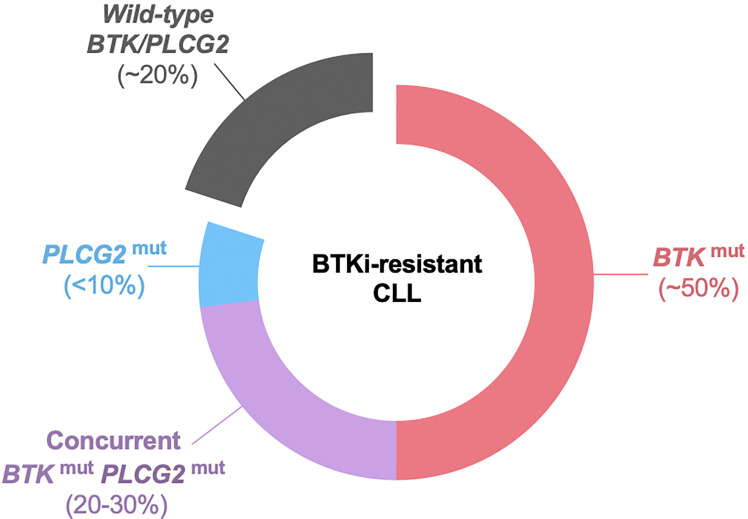
Figure 2
BTK and PLCG2 mutations in BTKi-resistant CLL. Approximately 20% of patients do not have detectable BTK or PLCG2 mutation at progression. BTK mutation is the most common mutation, found in half the patients as BTK mutation alone and in an additional 20-30% with coexisting PLCG2 mutation. Less than 10% of the patients have PLCG2 mutation alone. BTKi, Bruton’s tyrosine kinase inhibitor; mut, mutation.
Figure 3
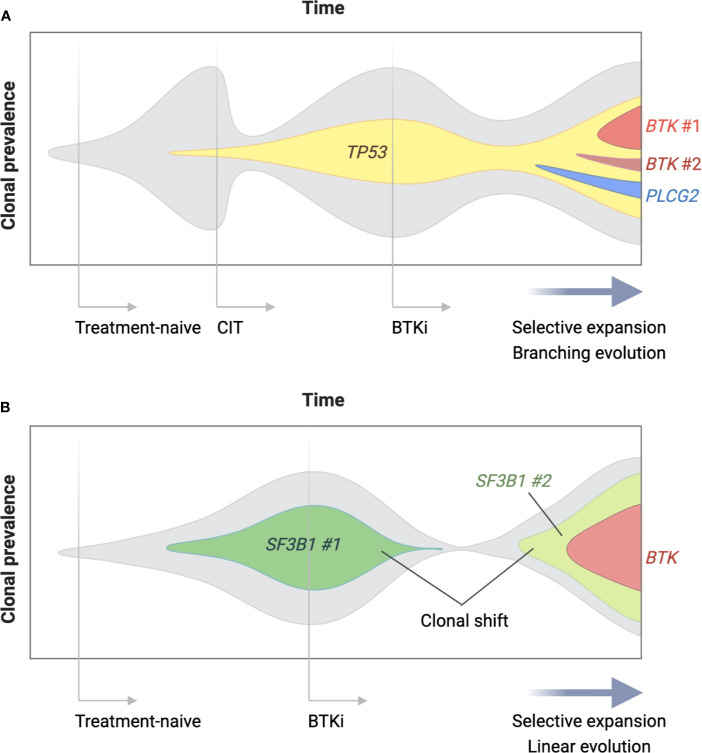
Figure 3
Clonal evolution of BTKi-resistant CLL. Clonal architecture of CLL changes over time under the selective pressure of treatment and in the presence of driver gene mutations. Panel (A) is a schematic representation of a patient who was treated with chemoimmunotherapy (CIT) as first-line and a BTK inhibitor (BTKi) as second-line therapy for CLL. Two lines of therapy selectively expanded a parental clone with a driver gene mutation (TP53 in this case), which became a parental clone of BTKi-resistant disease. Multiple BTK and PLCG2 mutations arose after branching evolution and were detectable at relatively low allele frequency at the time of progression. Panel (B) shows a patient who underwent a major shift in clonal dominance from one clone (SF3B1 mutation #1) to another (SF3B1 mutation #2) during treatment with a BTKi. Linear evolution of the emerging clone led to a single dominant BTK mutation at progression detectable at high allele frequency.

References

    1. Davis RE, Ngo VN, Lenz G, Tolar P, Young RM, Romesser PB, et al. Chronic Active B-Cell-Receptor Signalling in Diffuse Large B-Cell Lymphoma. Nature (2010) 463(7277):88–92. 10.1038/nature08638 - DOI - PMC - PubMed
    1. Gauld SB, Dal Porto JM, Cambier JC. B Cell Antigen Receptor Signaling: Roles in Cell Development and Disease. Science (2002) 296(5573):1641–2. 10.1126/science.1071546 - DOI - PubMed
    1. Srinivasan L, Sasaki Y, Calado DP, Zhang B, Paik JH, DePinho RA, et al. PI3 Kinase Signals BCR-Dependent Mature B Cell Survival. Cell (2009) 139(3):573–86. 10.1016/j.cell.2009.08.041 - DOI - PMC - PubMed
    1. Lam KP, Kuhn R, Rajewsky K. In Vivo Ablation of Surface Immunoglobulin on Mature B Cells by Inducible Gene Targeting Results in Rapid Cell Death. Cell (1997) 90(6):1073–83. 10.1016/S0092-8674(00)80373-6 - DOI - PubMed
    1. Chen L, Monti S, Juszczynski P, Ouyang J, Chapuy B, Neuberg D, et al. SYK Inhibition Modulates Distinct PI3K/AKT-Dependent Survival Pathways and Cholesterol Biosynthesis in Diffuse Large B Cell Lymphomas. Cancer Cell (2013) 23(6):826–38. 10.1016/j.ccr.2013.05.002 - DOI - PMC - PubMed

Publication types

MeSH terms