


Homozygous Co-Deletion of Type I Interferons and CDKN2A Genes in Thoracic Cancers: Potential Consequences for Therapy
- PMID: 34249754
- PMCID: PMC8266377
- DOI: 10.3389/fonc.2021.695770
Homozygous Co-Deletion of Type I Interferons and CDKN2A Genes in Thoracic Cancers: Potential Consequences for Therapy
Abstract
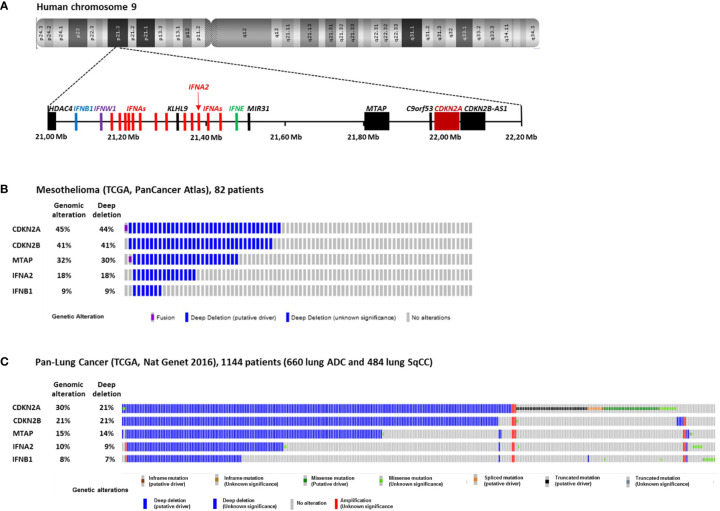
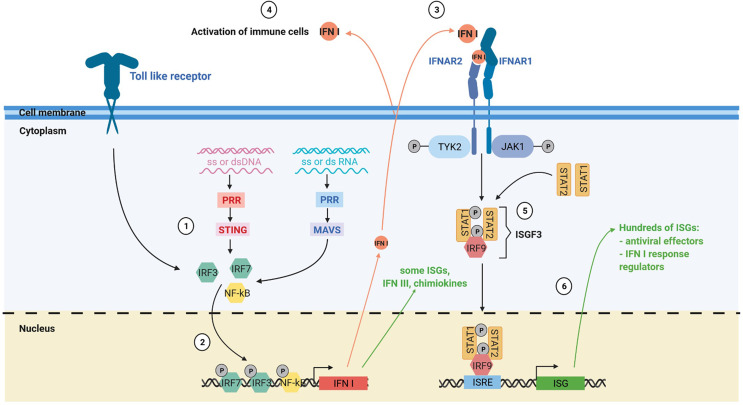
Homozygous deletion (HD) of the tumor suppressor gene CDKN2A is the most frequent genetic alteration in malignant pleural mesothelioma and is also frequent in non-small cell lung cancers. This HD is often accompanied by the HD of the type I interferons (IFN I) genes that are located closed to the CDKN2A gene on the p21.3 region of chromosome 9. IFN I genes encode sixteen cytokines (IFN-α, IFN-β…) that are implicated in cellular antiviral and antitumor defense and in the induction of the immune response. In this review, we discuss the potential influence of IFN I genes HD on thoracic cancers therapy and speak in favor of better taking these HD into account in patients monitoring.
Keywords: CDKN2A (p16); STING; homozygous deletion; immunotherapy; lung cancer; mesothelioma; type I interferon.
Copyright © 2021 Grard, Chatelain, Delaunay, Pons-Tostivint, Bennouna and Fonteneau.
Conflict of interest statement
The authors declare that the research was conducted in the absence of any commercial or financial relationships that could be construed as a potential conflict of interest.
Figures
References
-
- Cheng JQ, Jhanwar SC, Klein WM, Bell DW, Lee WC, Altomare DA, et al. . p16 Alterations and Deletion Mapping of 9p21-p22 in Malignant Mesothelioma. Cancer Res (1994) 54(21):5547–51. - PubMed
-
- Xio S, Li D, Vijg J, Sugarbaker DJ, Corson JM, Fletcher JA. Codeletion of p15 and p16 in Primary Malignant Mesothelioma. Oncogene (1995) 11(3):511–5. - PubMed
-
- Cheng YY, Yuen ML, Rath EM, Johnson B, Zhuang L, Yu TK, et al. . CDKN2A and MTAP Are Useful Biomarkers Detectable by Droplet Digital PCR in Malignant Pleural Mesothelioma: A Potential Alternative Method in Diagnosis Compared to Fluorescence in Situ Hybridisation. Front Oncol (2020) 10:579327. 10.3389/fonc.2020.579327 - DOI - PMC - PubMed
-
- Illei PB, Rusch VW, Zakowski MF, Ladanyi M. Homozygous Deletion of CDKN2A and Codeletion of the Methylthioadenosine Phosphorylase Gene in the Majority of Pleural Mesotheliomas. Clin Cancer Res (2003) 9(6):2108–13. - PubMed
Publication types
LinkOut - more resources
Full Text Sources
Research Materials
Miscellaneous
