


Biomechanical Effects of Combined Anterior Cruciate Ligament Reconstruction and Anterolateral Ligament Reconstruction: A Systematic Review and Meta-analysis
- PMID: 34250171
- PMCID: PMC8237218
- DOI: 10.1177/23259671211009879
Biomechanical Effects of Combined Anterior Cruciate Ligament Reconstruction and Anterolateral Ligament Reconstruction: A Systematic Review and Meta-analysis
Abstract
Background: Combined anterior cruciate ligament (ACL) reconstruction (ACLR) and anterolateral ligament reconstruction (ALLR) are performed with the intention to restore native knee kinematics after ACL tears. There continue to be varying results as to the difference in kinematics between combined and isolated procedures, including anterior tibial translation (ATT) and internal tibial rotation (IR).
Purpose: To perform a systematic review and meta-analysis to evaluate the kinematic changes of a combined ACLR/ALLR versus isolated ACLR and to assess the effects of different fixation techniques.
Study design: Systematic review.
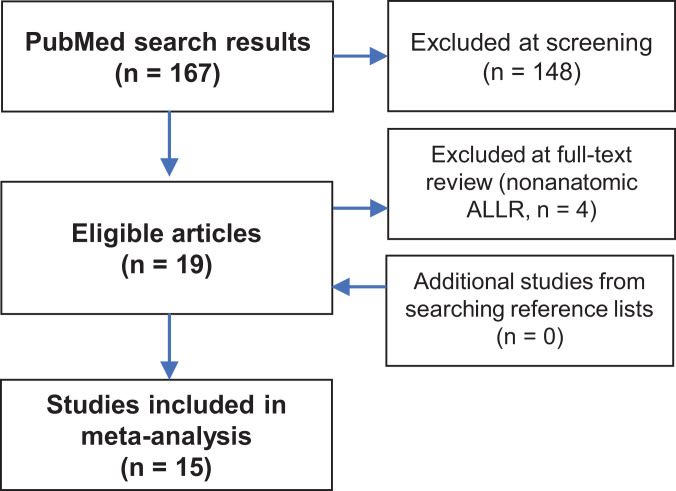
Methods: We conducted a systematic review and meta-analysis of 15 human cadaveric biomechanical studies evaluating combined ACLR/ALLR versus isolated ACLR and their effects on ATT and IR in 149 specimens. The primary outcomes were ATT and IR. Secondary outcomes included graft type and size as well as fixation methods such as type, angle, tension, and position of fixation. Meta-regression was used to examine the effect of various cofactors on the resulting measures.
Results: Compared with isolated ACLR, combined ACLR/ALLR decreased ATT and IR by 0.01 mm (95% CI, -0.059 to 0.079 mm; P = .777) and 1.64° (95% CI, 1.30°-1.98°; P < .001), respectively. Regarding ACLR/ALLR, increasing the knee flexion angle and applied IR force led to a significant reduction in IR (P < .001 and P = .044, respectively). There was also a significant reduction in IR in combined procedures with semitendinosus ALL graft, higher flexion fixation angles, and tension but no change in IR with differing femoral fixation points (P < .001, P < .001, and P = .268, respectively). Multivariate meta-regression showed that the use of tibial-sided suture anchor fixation significantly reduced IR (P < .001).
Conclusion: These results suggest that a combined ACLR/ALLR procedure significantly decreases IR compared with isolated ACLR, especially at higher knee flexion angles. Semitendinosus ALL graft, fixation at higher knee flexion, increased tensioning, and tibial-sided interference screw fixation in ALLR may help to further reduce IR.
Keywords: anterolateral ligament reconstruction; biomechanics; kinematics; knee.
© The Author(s) 2021.
Conflict of interest statement
One or more of the authors has declared the following potential conflict of interest or source of funding: E.G.H. has received research support Arthrex and Sequoia Medical, consulting fees from DePuy, educational payments from Smith & Nephew, and hospitality payments from Wright Medical. AOSSM checks author disclosures against the Open Payments Database (OPD). AOSSM has not conducted an independent investigation on the OPD and disclaims any liability or responsibility relating thereto.
Figures
References
-
- Campos JC, Chung CB, Lektrakul, et al. Pathogenesis of the Segond fracture: anatomic and MR imaging evidence of an iliotibial tract or anterior oblique band avulsion. Radiology. 2001;219(2):381–386. - PubMed
-
- Daggett M, Ockuly AC, Cullen M, et al. Femoral origin of the anterolateral ligament: an anatomic analysis. Arthroscopy. 2016;32(5):835–841. - PubMed
-
- Delaloye J, Hartog C, Blatter S, et al. Anterolateral ligament reconstruction and modified lemaire lateral extra-articular tenodesis improve stability after anterior cruciate ligament reconstruction: a biomechanical study. Arthroscopy. 2020;36(7):1942–1950. - PubMed
Publication types
LinkOut - more resources
Full Text Sources
