


Patient Access in 14 High-Income Countries to New Antibacterials Approved by the US Food and Drug Administration, European Medicines Agency, Japanese Pharmaceuticals and Medical Devices Agency, or Health Canada, 2010-2020
- PMID: 34251436
- PMCID: PMC8994582
- DOI: 10.1093/cid/ciab612
Patient Access in 14 High-Income Countries to New Antibacterials Approved by the US Food and Drug Administration, European Medicines Agency, Japanese Pharmaceuticals and Medical Devices Agency, or Health Canada, 2010-2020
Abstract
Background: Inaccessibility of medicines in low- and middle-income countries is a frequent challenge. Yet it is typically assumed that high-income countries have complete access to the full arsenal of medicines. This study tests this assumption for new antibacterials, which are saved as a last resort in order to prevent the development of resistance, resulting in insufficient revenues to offset costs. Prior studies report only regulatory approval, missing the important lag that occurs between approval and commercial launch, although some antibiotics never launch in some countries.
Methods: We identified all antibacterials approved and launched in the G7 and 7 other high-income countries in Europe for the decade beginning 1 January 2010, using quantitative methods to explore associations.
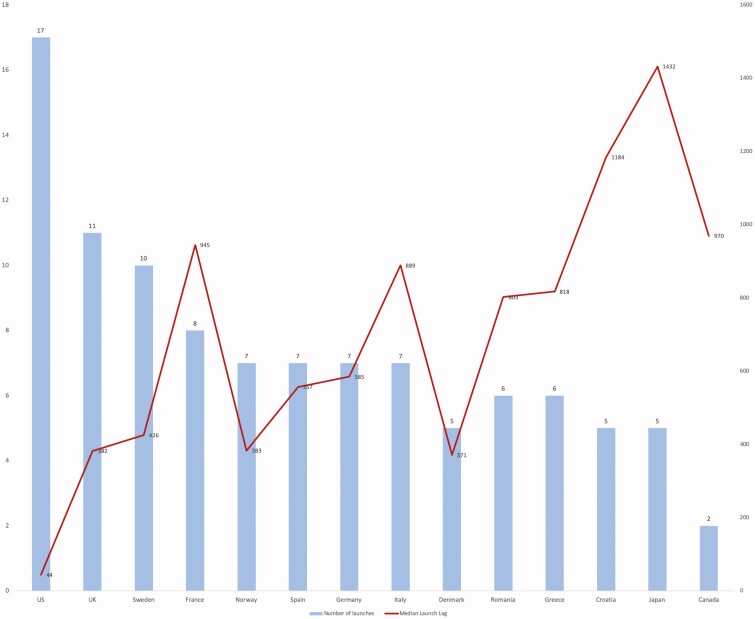
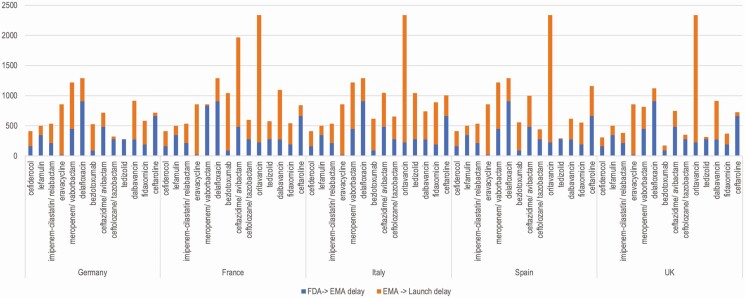
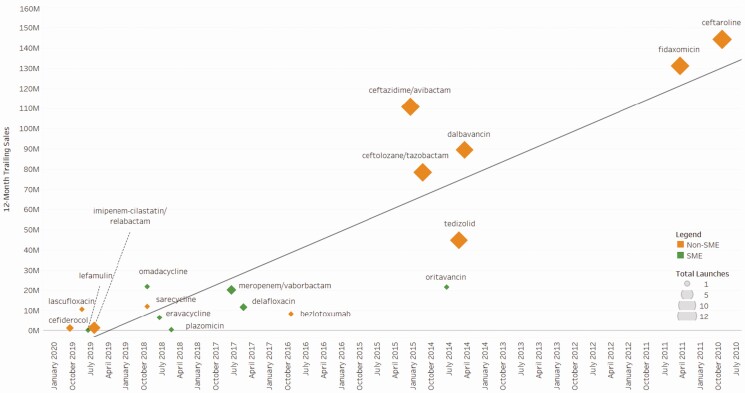
Results: Eighteen new antibacterials were identified. The majority were accessible in only 3 countries (United States, United Kingdom, and Sweden), with the remaining 11 high-income countries having access to less than half of them. European marketing authorization did not lead to automatic European access, as 14 of the antibacterials were approved by the European Medicines Agency but many fewer were commercially launched. There was no significant difference in access between "innovative" and "noninnovative" antibacterials. Median annual sales in the first launched market (generally the United States) for these 18 antibiotics were low, $16.2M.
Conclusions: Patient access to new antibacterials is limited in some high-income countries including Canada, Japan, France, Germany, Italy, and Spain. With low expected sales, companies may have decided to delay or forego commercialization due to expectations of insufficient profitability.
Keywords: access; antibacterial; approval; commercial launch.
© The Author(s) 2021. Published by Oxford University Press for the Infectious Diseases Society of America. All rights reserved. For permissions, e-mail: journals.permissions@oup.com.
Figures
References
-
- Infectious Diseases Society of America. The 10×’20 initiative: pursuing a global commitment to develop 10 new antibacterial drugs by 2020. Clin Infect Dis 2010; 50:1081–3. - PubMed
-
- World Health Organization. WHO model lists of essential medicines. 2020. Available at: https://www.who.int/medicines/publications/essentialmedicines/en/. Accessed 24 October 2020.
-
- World Health Organization. Adopt AWaRe: handle antibiotics with care. 2020. Available at: https://adoptaware.org/. Accessed 24 October 2020.
-
- World Health Organization. Antibacterial agents in clinical development: an analysis of the antibacterial clinical development pipeline, including tuberculosis. 2017. Available at: https://apps.who.int/iris/bitstream/handle/10665/258965/WHO-EMP-IAU-2017.... Accessed 15 January 2020.
Publication types
MeSH terms
Substances
LinkOut - more resources
Full Text Sources
Medical
