


[Pneumococcal vaccination]
- PMID: 34251467
- PMCID: PMC8274268
- DOI: 10.1007/s00108-021-01100-2
[Pneumococcal vaccination]
Erratum in
-
[Erratum to: Pneumococcal vaccination].Internist (Berl). 2021 Nov;62(11):1256. doi: 10.1007/s00108-021-01175-x. Internist (Berl). 2021. PMID: 34605972 Free PMC article. German. No abstract available.
Abstract
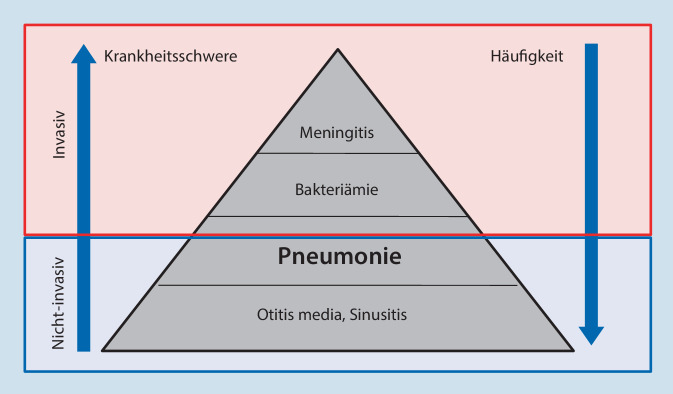
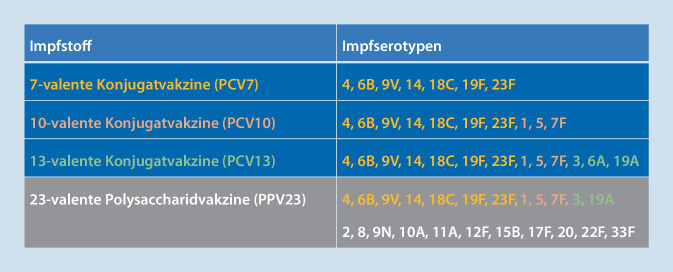
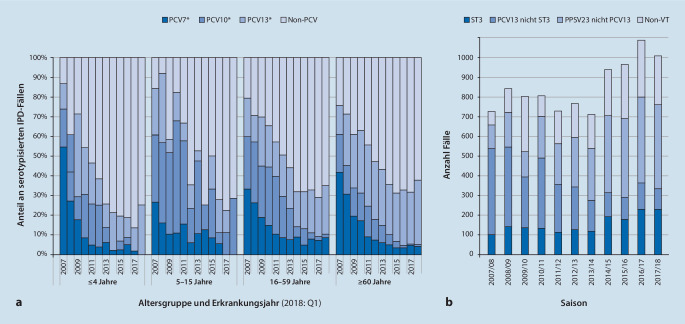
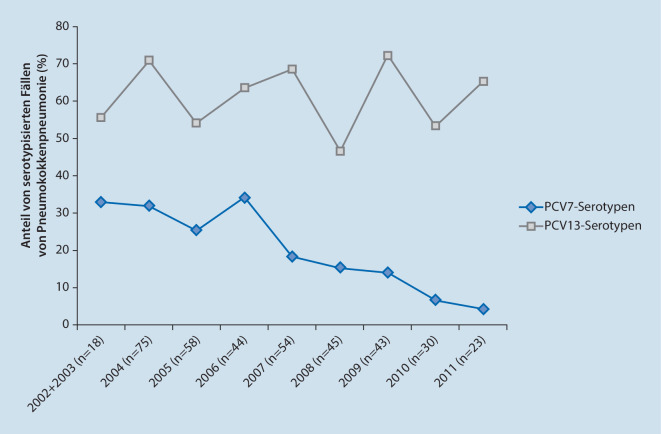
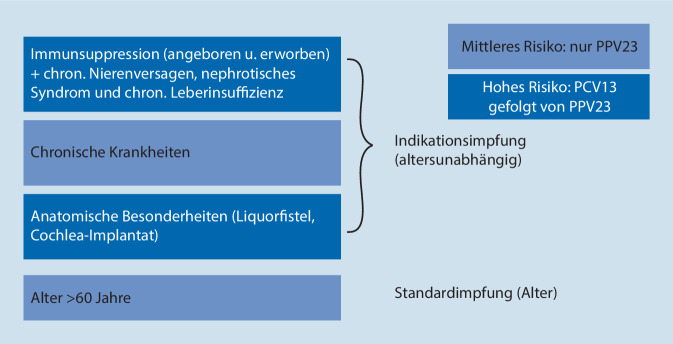
Pneumococci are the most frequent bacterial agent of community-acquired pneumonia and are one of the most common vaccine-preventable causes of death worldwide. There is a polysaccharide vaccine that contains the capsular polysaccharides of 23 of the more than 90 known serotypes. PPV23 confers good protection against invasive pneumococcal infections but does not stimulate T cells and thus leaves no immunologic memory. It has limited efficacy in immunocompromised individuals. Initially for young children and later for adults, a 13 valent conjugate vaccine was licensed that covers fewer serotypes but leaves immunologic memory and mediates mucosal immunity, i.e. by eradicating healthy pneumococcal carriers, and thus has herd-protective effects. The German Standing Commission on Vaccination Practices (STIKO) currently recommends PPV23 for indication vaccination in various comorbidities and as standard vaccination for all above 60 years with repeat vaccination after 6 years at the earliest. Patients with immunosuppression, chronic renal failure or chronic liver failure should receive a sequential vaccination (first PCV13 followed by PPV23 after 6-12 months) due to the limited efficacy of PPV23 and their increased risk for infection.
Pneumokokken sind der häufigste bakterielle Erreger der ambulant erworbenen Pneumonie und gehören weltweit zu den häufigsten impfpräventablen Todesursachen. Es gibt einen Polysaccharidimpfstoff, der die Kapselpolysaccharide von 23 der über 90 bekannten Serotypen enthält, einen guten Schutz vor invasiven Pneumokokkeninfektionen vermittelt, aber T‑Zellen nicht stimuliert und damit kein immunologisches Gedächtnis hinterlässt. Bei Immunsupprimierten hat er eine eingeschränkte Wirksamkeit. Zunächst für Kleinkinder und später auch für Erwachsene wurde ein 13-valenter Konjugatimpfstoff zugelassen, der weniger Serotypen erfasst, aber ein immunologisches Gedächtnis hinterlässt und eine mukosale Immunität, d. h. die Eradikation gesunder Pneumokokkenträger und damit Herdenprotektionseffekte, vermittelt. Die STIKO empfiehlt derzeit bei verschiedenen Komorbiditäten sowie als Standardimpfung ab 60 Jahre die Indikationsimpfung mit PPV23, ggf. mit Wiederholungsimpfung nach frühestens 6 Jahren. Patienten mit Immunsuppression, chronischem Nierenversagen oder chronischer Leberinsuffizienz sollten wegen der eingeschränkten Wirksamkeit von PPV23 sowie einem hohen Risiko für Infektionen eine sequenzielle Impfung (zuerst PCV13, gefolgt von PPV23 nach 6 bis 12 Monaten) erhalten.
Keywords: Community-acquired pneumonia; Conjugate vaccine; Herd immunity; Polysaccharide vaccine; Serotype 3.
© 2021. Springer Medizin Verlag GmbH, ein Teil von Springer Nature.
References
Publication types
MeSH terms
Substances
LinkOut - more resources
Full Text Sources
Medical
